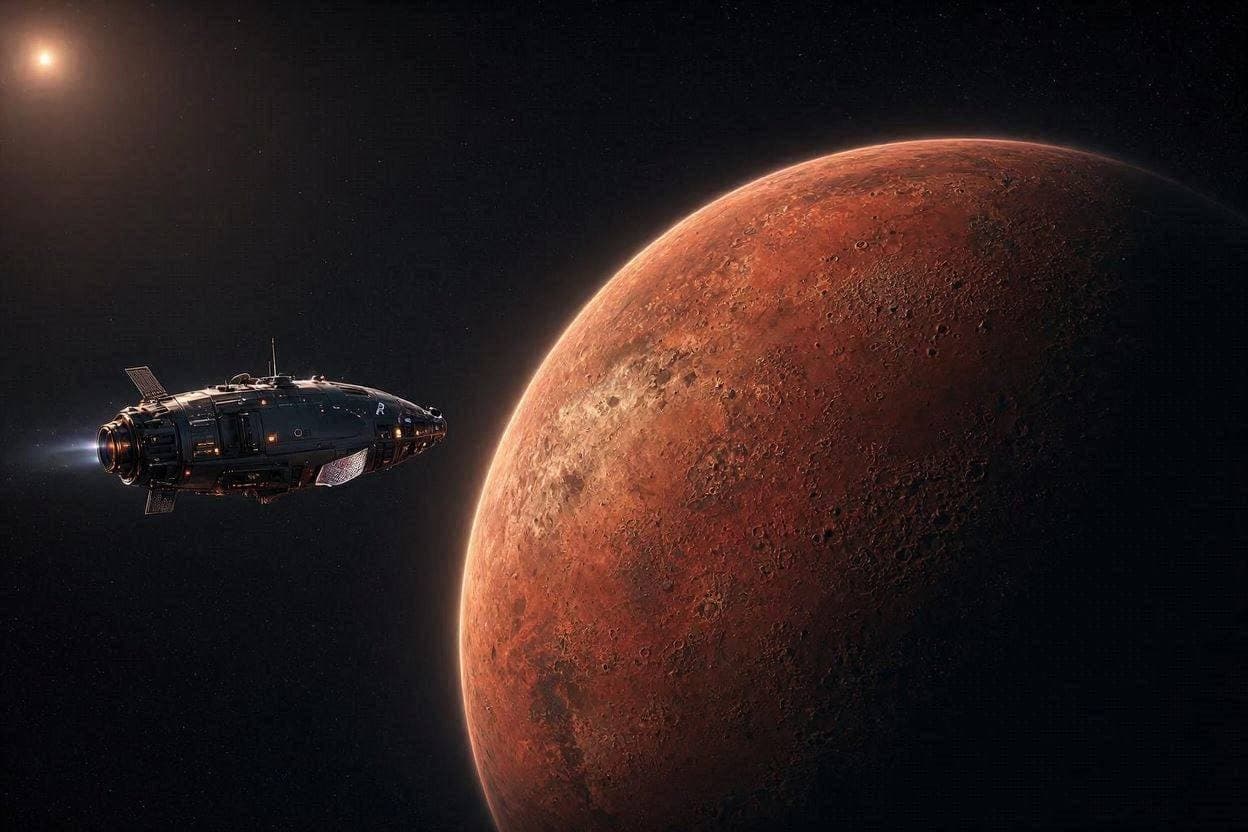
In the vast silence between planets, a solitary traveler moves with purpose. NASA’s Psyche spacecraft, bound for a metal-rich asteroid deep in the belt, recently paused to glance back at a familiar neighbor: Mars. The images it captured are not just scientific data; they are portraits of a world that has captivated human imagination for centuries. These new photos, taken during a gravity-assist maneuver, offer a fresh perspective on the Red Planet, reminding us of the beauty and mystery that lie in our cosmic backyard.
Body: The flyby occurred in May 2026, as Psyche used Mars’ gravity to adjust its trajectory and gain speed for the next leg of its journey. This technique, known as a gravity assist, is a delicate dance that requires precise timing and navigation. As the spacecraft approached, its cameras were activated, capturing stunning views of the planet’s surface. The images reveal the rugged terrain of the southern highlands, bathed in the soft light of the sun.
Unlike previous missions that orbited Mars for years, Psyche’s view was fleeting. The spacecraft captured the planet as a crescent, similar to how we see the Moon from Earth. This phase angle highlights the contours of craters and valleys, casting long shadows that emphasize the topography. The contrast between light and dark creates a dramatic effect, showcasing the geological diversity of the Martian landscape.
The photos also serve a practical purpose. They help engineers verify the spacecraft’s orientation and camera functionality after months in deep space. By comparing the images with known maps of Mars, scientists can confirm that Psyche is on the correct path. This validation is crucial for the success of the primary mission, which aims to explore the metallic core of asteroid 16 Psyche.
For the public, the images are a gift. They provide a moment of connection with a world that may one day be visited by humans. The red hues and dusty plains evoke a sense of adventure and possibility. Sharing these photos allows people to feel part of the exploration, fostering a sense of wonder about what lies beyond our own planet.
The journey to asteroid 16 Psyche is long, expected to last until 2029. During this time, the spacecraft will travel through empty space, far from the warmth of the sun. The Mars flyby was a brief encounter with a planetary body, a last taste of the inner solar system before venturing into the unknown. It serves as a milestone, marking the transition from the familiar to the frontier.
Scientists are analyzing the data for any unexpected findings. While Psyche is not equipped to study Mars in detail, the images may reveal subtle changes in surface features or atmospheric conditions. Every bit of information contributes to our overall understanding of the solar system, adding pieces to the puzzle of planetary evolution.
Closing: As Psyche continues its voyage, the images of Mars remain a testament to the power of exploration. They remind us that even in the pursuit of distant goals, there is value in looking back. The Red Planet, captured in a fleeting moment, stands as a silent witness to our quest for knowledge.
AI Image Disclaimer: Visuals in this article are AI-generated representations of spacecraft imagery and planetary landscapes, intended to illustrate the context of the flyby without depicting specific real-time telemetry.
Sources: NASA Jet Propulsion Laboratory Space.com Smithsonian Magazine EarthSky
Published by Banx Network. This article is part of the Banx decentralized media programme, powered by the BXE token on the XRP Ledger.