Space exploration is often a journey of the unseen, where data streams replace visual splendor. But occasionally, the cosmos offers a glimpse of its grandeur, a moment where machinery and celestial bodies align in a dance of precision. NASA’s Psyche mission, destined for a metal-rich asteroid, recently passed close to Mars, using the planet’s gravity to slingshot toward its final target. The images captured during this flyby are not just scientific records; they are portraits of our neighbor, reminding us of the beauty that lies just beyond our atmosphere.
The Psyche spacecraft, launched to study the unique metallic asteroid of the same name, required a gravitational assist from Mars to adjust its trajectory and speed. This maneuver, known as a gravity assist, is a common technique in deep space missions, allowing spacecraft to save fuel and reach distant destinations. As Psyche swept past the Red Planet, its instruments were activated, capturing high-resolution images of the Martian surface and atmosphere.
The photos reveal familiar features in new light. Dust storms, polar ice caps, and ancient crater basins are visible in stunning detail. For scientists, these images provide valuable context for understanding the Martian environment, which can affect spacecraft operations. For the public, they offer a fresh perspective on a world that has captivated human imagination for centuries. It is a reminder that even well-known places can surprise us.
The flyby was a critical test for the mission’s navigation and communication systems. Successfully executing such a precise maneuver requires careful planning and real-time adjustments. The team at NASA’s Jet Propulsion Laboratory monitored the spacecraft closely, ensuring that it remained on course for its primary mission. The success of this phase builds confidence in the technologies that will carry Psyche to the asteroid belt.
Psyche’s ultimate destination is an asteroid believed to be the exposed core of a protoplanet. Studying it could provide insights into the formation of terrestrial planets, including Earth. By examining a metallic body, scientists hope to learn more about the differentiation processes that occurred in the early solar system. The Mars flyby is merely a stepping stone on this longer journey of discovery.
The images also serve as a testament to international collaboration in space exploration. Mars has been visited by numerous missions from different countries, each contributing to our collective knowledge. Psyche’s passage adds another layer to this rich history, connecting the study of asteroids with the ongoing exploration of the Red Planet. It highlights the interconnected nature of planetary science.
As the spacecraft continues its journey, the data from the flyby will be analyzed and shared with the scientific community. These findings may inform future missions to Mars and other celestial bodies. The legacy of this encounter extends beyond the immediate mission, contributing to the broader tapestry of human understanding of the solar system.
The photos from Psyche’s Mars flyby are a gift to those who look up with wonder. They capture a fleeting moment in a long voyage, bridging the gap between two worlds. As Psyche moves onward, it carries with it the curiosity of humanity, seeking answers in the metal heart of an ancient asteroid.
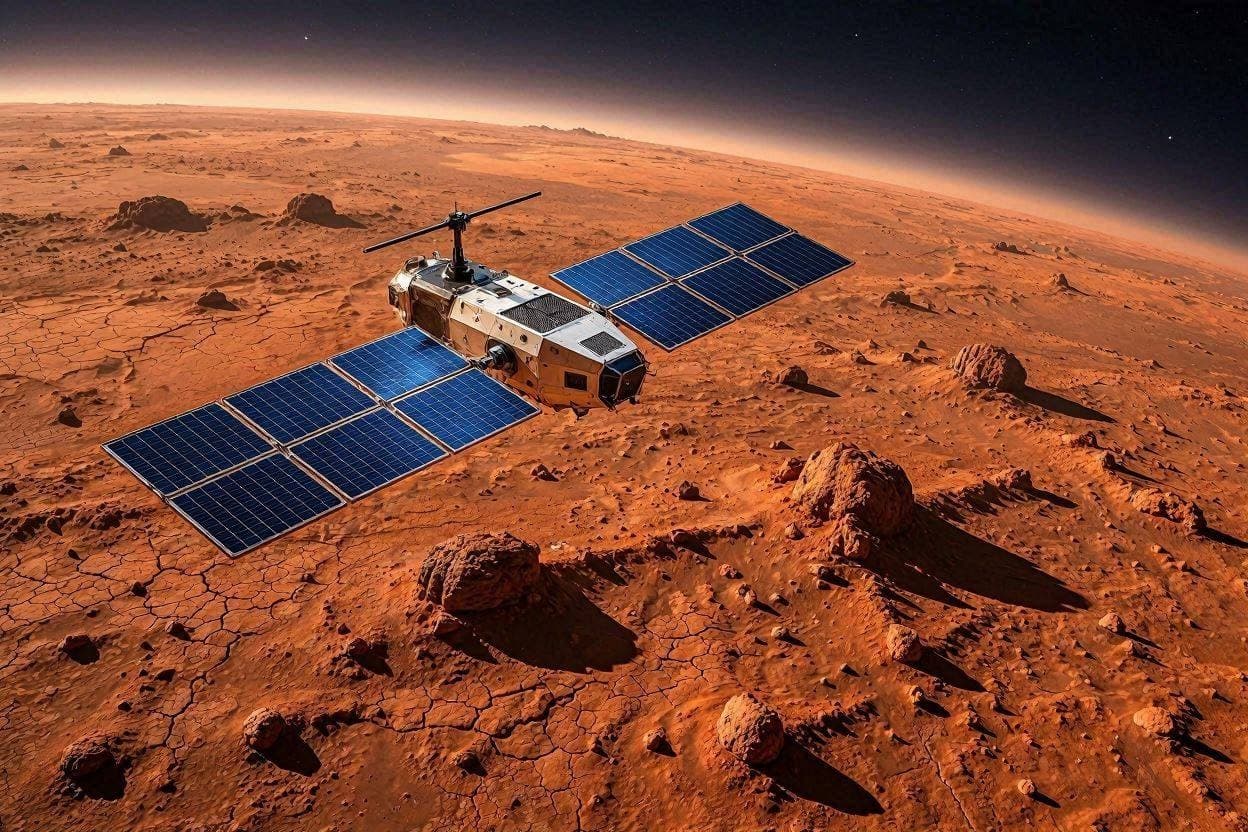
AI Image Disclaimer: The images associated with this article are AI-generated concepts of spacecraft flybys and Martian landscapes, designed to evoke the spirit of exploration and discovery.
Sources: NASA Jet Propulsion Laboratory Space.com CNN Science The Planetary Society
Published by Banx Network. This article is part of the Banx decentralized media programme, powered by the BXE token on the XRP Ledger.