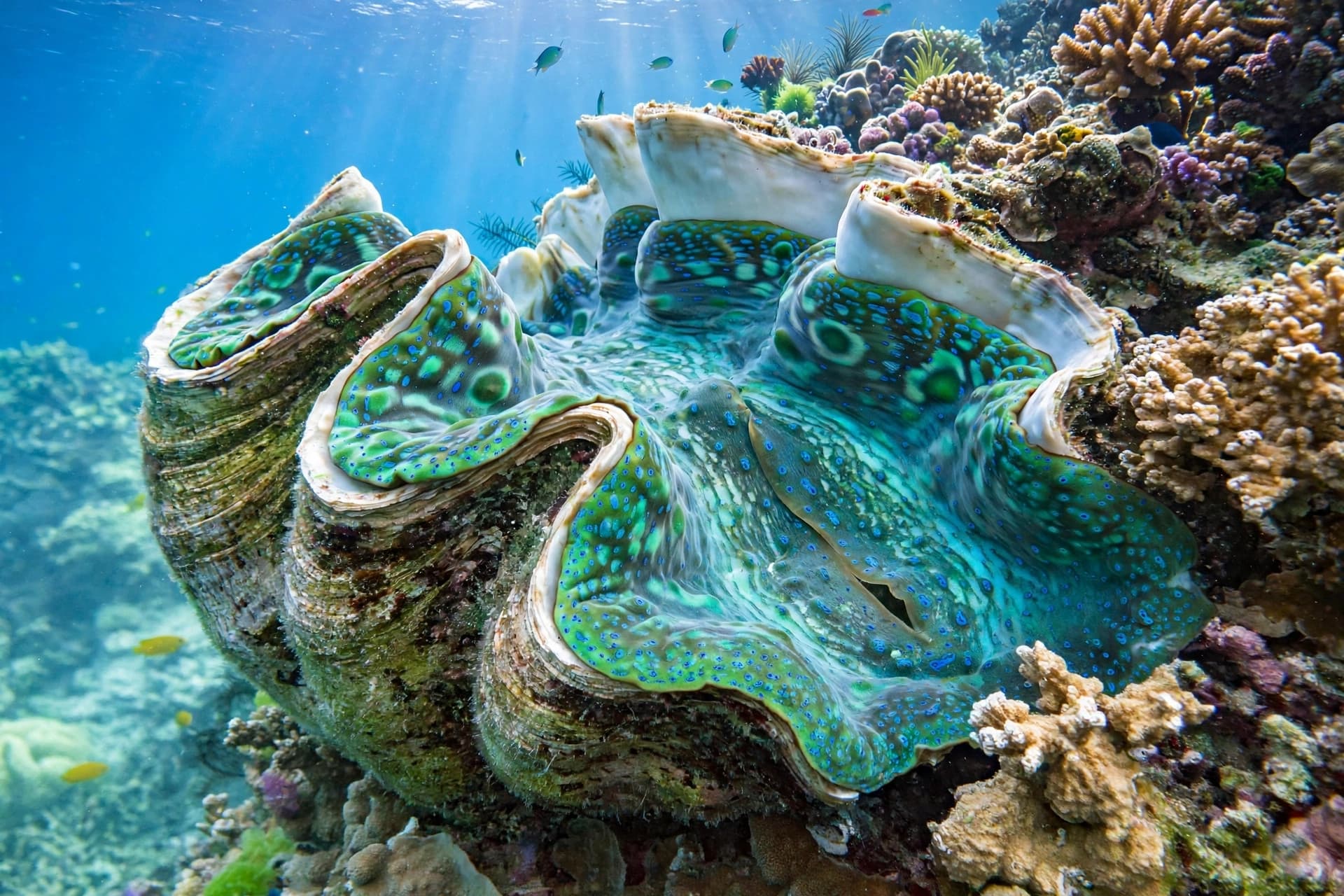
Beneath the blue waters of Australia's Great Barrier Reef, there is a creature almost impossible to overlook. It rests on the seafloor, its fluted shell wrapped around a soft body that shimmers with electric blue, emerald, and gold. As the largest bivalve in the world, the giant clam can grow to 1.2 meters and weigh more than 200 kilograms, living for a century or more. And across that long life, it has been quietly writing a diary in its shell.
A new study has read one page of that diary, reconstructing the month-by-month climate of the northern Great Barrier Reef around Lizard Island two hundred years ago. The researchers found that summers were cooler than today in the pre-industrial era, while winters were unexpectedly similar.
The giant clam's shell records climate in a way not unlike tree rings. Each day, a tiny growth line is laid down; each season, a wider annual band forms. These lines provide the dates, while the chemistry of the surrounding seawater provides the content. Geochemistry is the language of this diary. By reading oxygen and carbon isotopes within the shell, researchers can decode how the reef environment changed across the clam's long life.
The study was carried out by researchers at James Cook University, in partnership with the Walmbaar Aboriginal Corporation and Nguurruumungu Indigenous Corporation, and published in the journal Global and Planetary Change. The subject was a 58-centimeter giant clam shell collected from a Lizard Island lagoon. Radiocarbon dating showed the clam lived roughly between 1785 and 1827, at the tail end of a pre-industrial cooling period known as the Little Ice Age. Under a microscope, researchers counted nearly 10,900 daily growth lines, indicating it lived about 30 years.
The team drilled 784 tiny holes into the outer shell to collect powder samples, measuring oxygen and carbon isotope ratios in each. Oxygen isotopes helped estimate past water temperatures, while carbon isotopes offered clues about rainfall. Matching these chemical signals to the shell's growth structure produced a month-by-month picture of the reef environment.
Compared with observed sea surface temperatures at the same lagoon between 1995 and 2015, the reconstruction showed annual temperatures 0.6 to 0.9 degrees Celsius lower 225 years ago. Summers were 0.9 to 1.2 degrees Celsius cooler, but winter temperatures were nearly identical. Carbon isotopes also revealed clear wet and dry season rhythms, and the temperature record showed a recurring two-to-three-year cycle consistent with local El Niño- and La Niña-like variability. In the late 18th century, El Niño-like warm, dry periods were more frequent; by the early 19th century, La Niña-like cool, wet conditions became more common, including the strongest event in the record.
Why does this matter? Because most of the most detailed pre-industrial climate records come from the Northern Hemisphere and high latitudes, while records from the tropical Southern Hemisphere oceans are scarce. Giant clams are widely distributed across the tropical Indo-Pacific, and their shells can add localized, sub-seasonal data to this "lost southern narrative." The Lizard Island case is not isolated; coral records from other parts of the Great Barrier Reef and northwestern Australia also point to cooler waters or shifting ocean conditions. Across different archives, these lines of evidence are gradually piecing together a fuller picture of Southern Hemisphere climate.
AI Image Disclaimer: The images accompanying this article were generated by artificial intelligence and are intended for conceptual illustration only.
Sources: The Conversation, James Cook University, Global and Planetary Change
Published by Banx Network. This article is part of the Banx decentralized media programme, powered by the BXE token on the XRP Ledger.