Far beyond Earth’s blue horizon, the solar system moves with a quiet patience. Planets circle the Sun in long, measured arcs. Asteroids wander in their own ancient paths, shaped by gravity and time. For billions of years, those paths have changed only under the slow influence of cosmic forces.
Then, one autumn evening in 2022, humanity added its own gentle touch.
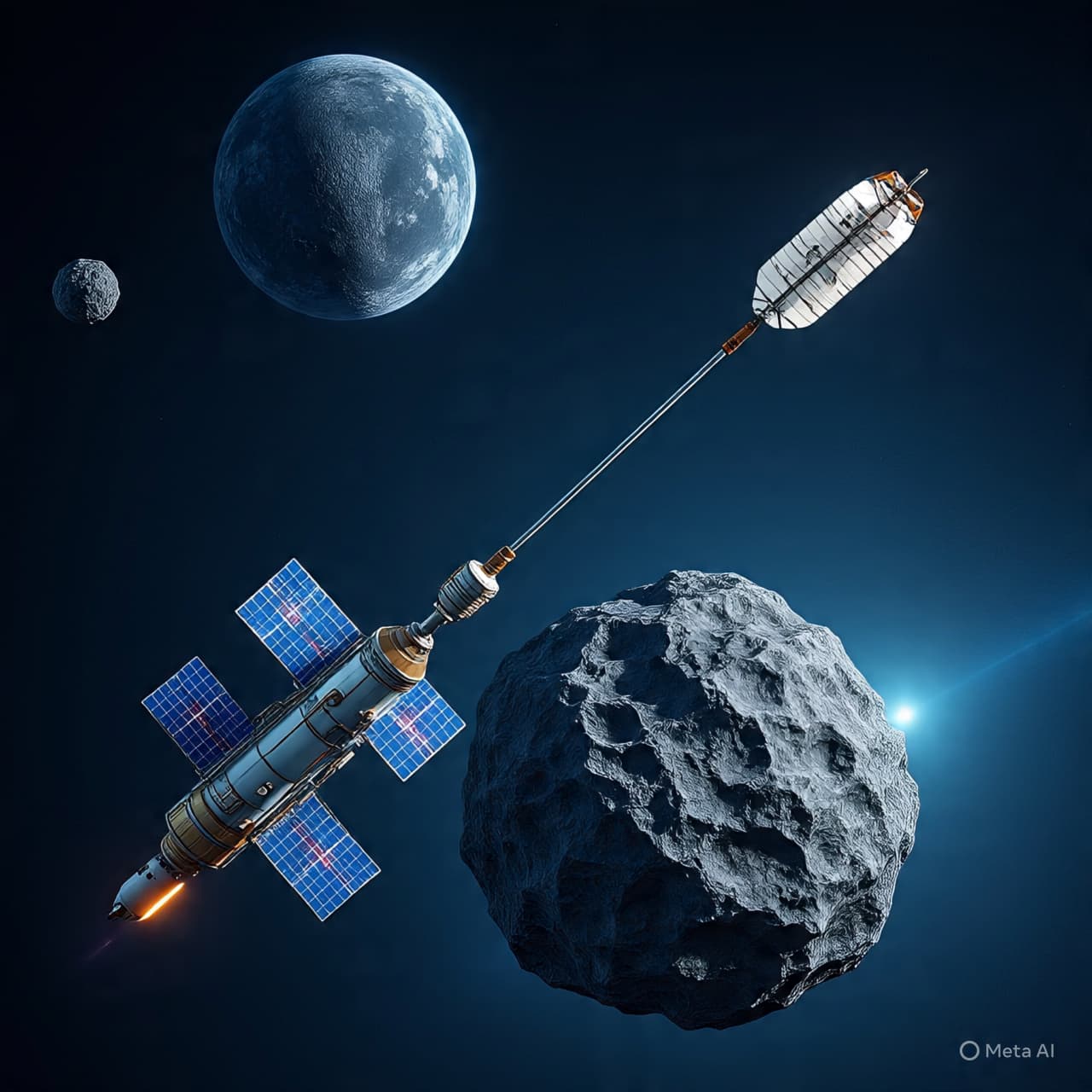
NASA’s Double Asteroid Redirection Test, known simply as the DART mission, sent a spacecraft on a deliberate collision course with a small asteroid moonlet named Dimorphos. The target was not chosen out of danger or urgency; the asteroid system posed no threat to Earth. Instead, the mission carried a quiet question: could a spacecraft, striking at high speed, slightly alter the motion of an asteroid?
The answer, it now appears, was yes—and perhaps in a way even more profound than scientists first expected.
Dimorphos is part of a binary asteroid system, orbiting a larger body called Didymos. When DART struck the smaller asteroid on September 26, 2022, the immediate goal was to shorten Dimorphos’ orbit around its parent asteroid. Early observations soon confirmed that the collision had indeed changed that orbit dramatically, shortening the orbital period by about 32 minutes.
Yet the story did not end there.
Scientists continued observing the asteroid pair using telescopes and precise tracking techniques, including stellar occultations—moments when an asteroid passes in front of a distant star and briefly blocks its light. These subtle measurements revealed something remarkable: the impact had also altered the motion of the entire asteroid system around the Sun.
The change was incredibly small. The orbital period of the Didymos–Dimorphos system around the Sun shifted by about 0.15 seconds, and the speed of the system changed by roughly 11.7 micrometers per second.
In everyday terms, such numbers may sound almost invisible. But in the quiet mathematics of orbital mechanics, even the faintest push can grow over time.
Researchers explain that when DART slammed into Dimorphos at roughly 14,000 miles per hour, it blasted a plume of debris outward from the asteroid’s surface. That expanding cloud carried momentum away from the system, effectively giving the asteroid pair a small but measurable nudge.
In fact, the debris amplified the effect of the impact. Scientists estimate that the momentum delivered to the asteroid was roughly twice as strong as what the spacecraft alone could have produced, a phenomenon known as momentum enhancement.
What emerged from this experiment was more than a technical success. It was a demonstration that humanity can, in principle, alter the trajectory of a celestial body—however slightly.
For decades, scientists have discussed the idea of planetary defense, the concept of protecting Earth from potentially hazardous asteroids. While large impacts are rare, the geological record reminds us that they are not impossible. The extinction of the dinosaurs, widely believed to have been triggered by an asteroid impact, stands as a distant but powerful reminder.
The DART mission was designed as the first real-world test of one possible defense strategy: the kinetic impactor, a spacecraft that collides with an asteroid to gradually change its course.
The lesson from Didymos and Dimorphos is that such a push does not need to be dramatic. If detected early enough—years or even decades before a potential impact—tiny changes in an asteroid’s motion can accumulate over time, shifting its path far enough for Earth to remain safely out of reach.
Future missions may build on this knowledge. The European Space Agency’s Hera spacecraft, scheduled to arrive at the Didymos system later this decade, will study the aftermath of the collision in detail, examining the crater, debris field, and internal structure of the asteroid.
For now, the findings mark a quiet milestone.
For the first time in recorded history, a human-built spacecraft has measurably altered the orbit of a natural object around the Sun. It was a change measured in fractions of seconds and microscopic shifts in speed—but it revealed something larger about humanity’s growing role in the cosmic landscape.
And while the solar system continues its vast and patient dance, the DART mission suggests that, one careful step at a time, we are learning how to guide it—just a little.
In recent statements, NASA scientists described the result as confirmation that kinetic impacts could serve as a practical method for asteroid deflection. The Didymos system itself remains harmless to Earth, and further observations will continue as new missions prepare to study the aftermath.
AI Image Disclaimer Images in this article are AI-generated illustrations, meant for concept only.
Sources NASA Associated Press Reuters ScienceDaily Wired
Published by Banx Network. This article is part of the Banx decentralized media programme, powered by the BXE token on the XRP Ledger.