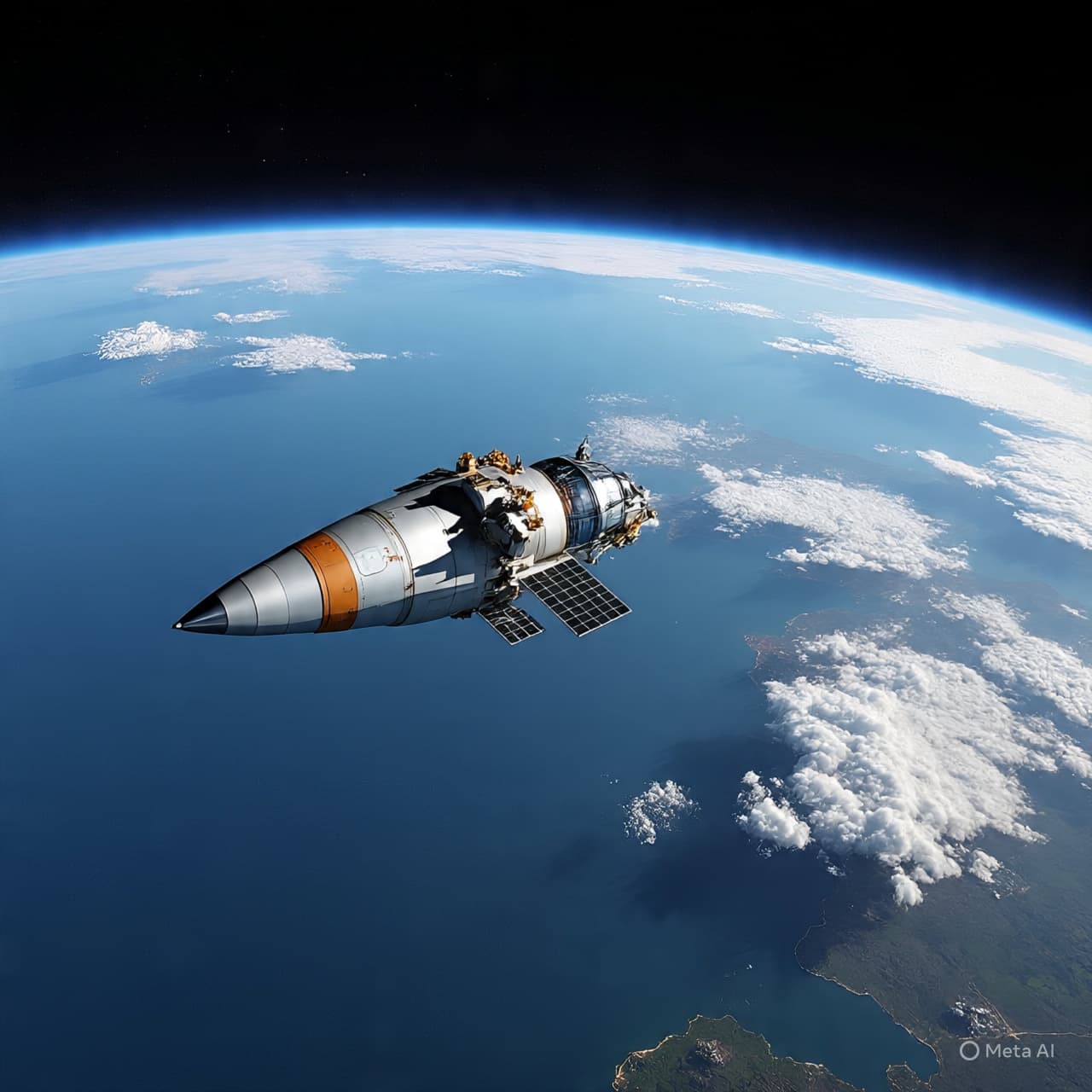
Space arrivals are rarely loud in the way we imagine. There is no trumpet call in orbit, no grand procession. Instead, there is a careful approach—two vehicles moving at thousands of miles per hour, guided by mathematics and trust, until metal meets metal with a measured, almost gentle embrace. It is in that quiet docking that human journeys extend beyond Earth, once again.
This week, French astronaut Sophie Adenot and her three crewmates reached the International Space Station, adding a new chapter to the ongoing story of international cooperation in space. Their arrival marks another rotation aboard the orbiting laboratory, where research, maintenance, and daily life unfold in weightlessness roughly 250 miles above the planet.
The journey began with a launch from Earth aboard a spacecraft designed to ferry crews safely between ground and orbit. After the precision of liftoff and orbital insertion, the capsule performed a series of carefully timed maneuvers before docking with the station. Such choreography has become routine in modern spaceflight, yet it remains an intricate ballet of engineering and calculation.
For Adenot, the mission carries both personal and national resonance. As part of the European astronaut corps, her flight reflects France’s enduring role within international space exploration efforts. The ISS itself stands as a collaborative achievement, operated by agencies including NASA, European Space Agency, and other global partners. Each crew rotation reinforces that shared commitment, where political boundaries give way to scientific purpose.
Life aboard the ISS follows a disciplined rhythm. Astronauts conduct experiments spanning biology, physics, materials science, and Earth observation. They maintain complex systems that keep the station habitable—recycling air and water, monitoring power supplies, and ensuring that every module remains secure. The work is technical, often meticulous, and grounded in the understanding that small details matter greatly in space.
The presence of Adenot and her colleagues also underscores the steady continuity of human presence in orbit. Since the year 2000, the ISS has been continuously inhabited, a testament to sustained cooperation across continents. Each new arrival represents both renewal and continuity: fresh perspectives joining a long-running endeavor.
Beyond the science, there is symbolism in such missions. A French astronaut floating through the modules of an international station speaks to decades of training, diplomacy, and shared ambition. The ISS is not merely hardware in orbit; it is a living laboratory where languages, cultures, and expertise converge in pursuit of discovery.
As the hatch opened and the crew was welcomed aboard, another transition quietly took place. The station’s population adjusted, responsibilities shifted, and the next sequence of experiments and tasks began. The event, while significant, was handled with the calm professionalism that has come to define operations in low Earth orbit.
In straightforward terms, Sophie Adenot and her three crewmates have successfully arrived at the International Space Station and joined the existing crew. They are scheduled to remain aboard for a multi-month mission focused on scientific research and station maintenance. Operations continue as planned under the coordination of international space agencies.
AI Image Disclaimer
Images in this article are AI-generated illustrations, meant for concept only.
Source Check
Credible mainstream and space-focused sources covering this development include:
1. Reuters 2. BBC 3. The Associated Press 4. Agence France-Presse (AFP) 5. Le Monde
Published by Banx Network. This article is part of the Banx decentralized media programme, powered by the BXE token on the XRP Ledger.