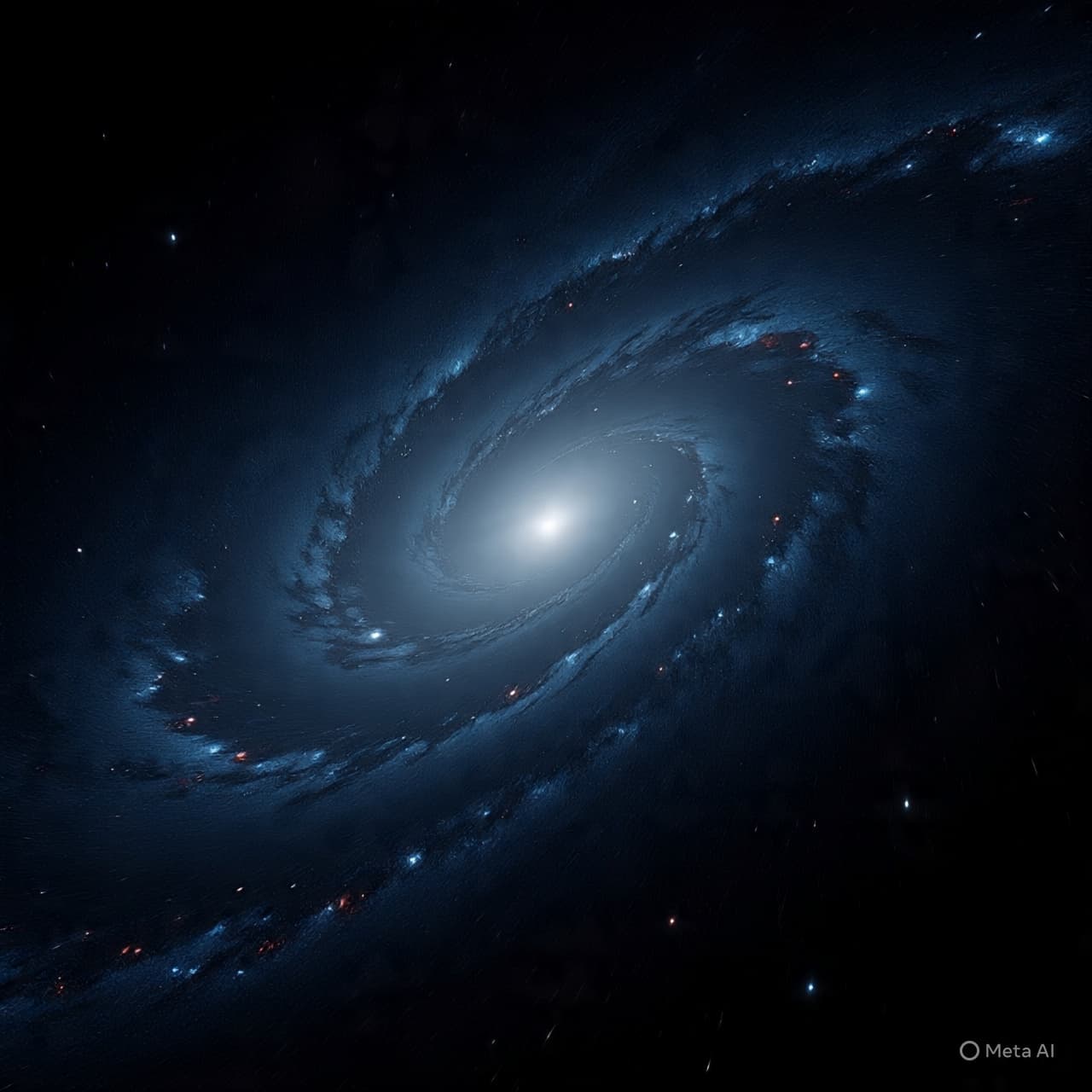
There are parts of the universe that reveal themselves in brilliance—clusters of stars, glowing nebulae, galaxies spiraling with visible light. And then there are those that exist almost entirely in silence, their presence felt not through what they show, but through what they withhold.
In a recent breakthrough, astronomers have confirmed the existence of a galaxy composed almost entirely of dark matter, a form of matter that does not emit, absorb, or reflect light. Unlike typical galaxies, where stars serve as both structure and signal, this newly studied system appears to be largely devoid of luminous matter, making it one of the clearest examples yet of a “dark galaxy.”
Dark matter itself has long occupied a peculiar place in science. Though invisible, its gravitational effects are essential to explaining how galaxies form and move. Without it, the observed rotation of galaxies and the large-scale structure of the universe would remain difficult to reconcile. Yet, despite decades of study, dark matter has never been directly observed—only inferred through its influence.
What makes this galaxy particularly significant is how strongly it appears to be dominated by this unseen component. Measurements of its motion and mass suggest that nearly all of its structure is governed by dark matter, with only a minimal presence of stars or visible gas. In other words, it is a galaxy that exists more as a gravitational framework than as a luminous object.
The confirmation of such a system offers more than just a new cosmic curiosity. It provides a rare opportunity to study dark matter in a relatively “pure” environment, one less complicated by the interactions of ordinary matter. For researchers, this could help refine models of how dark matter behaves and how it shapes the universe on both small and large scales.
At the same time, the discovery invites a more reflective question: how much of the universe remains hidden simply because it does not shine? If galaxies can exist with so little visible matter, it suggests that what we observe may be only a fraction of what is truly there. The night sky, for all its richness, may be only a partial map of a far more complex reality.
Still, as with many findings at the frontier of science, the confirmation comes with careful language. Researchers continue to analyze the data, seeking to understand how such galaxies form and how common they might be. Each answer, it seems, opens the door to further questions, extending the horizon rather than closing it.
In the quiet vastness of space, this dark galaxy stands as both discovery and reminder. It tells us that absence can be as meaningful as presence, and that the universe often speaks most profoundly through what it does not reveal.
AI Image Disclaimer (Rotated): Images in this article are AI-generated illustrations, meant for concept only.
Source Check (Credible Media Identified):
Nature Science NASA European Space Agency (ESA) The Guardian
Published by Banx Network. This article is part of the Banx decentralized media programme, powered by the BXE token on the XRP Ledger.