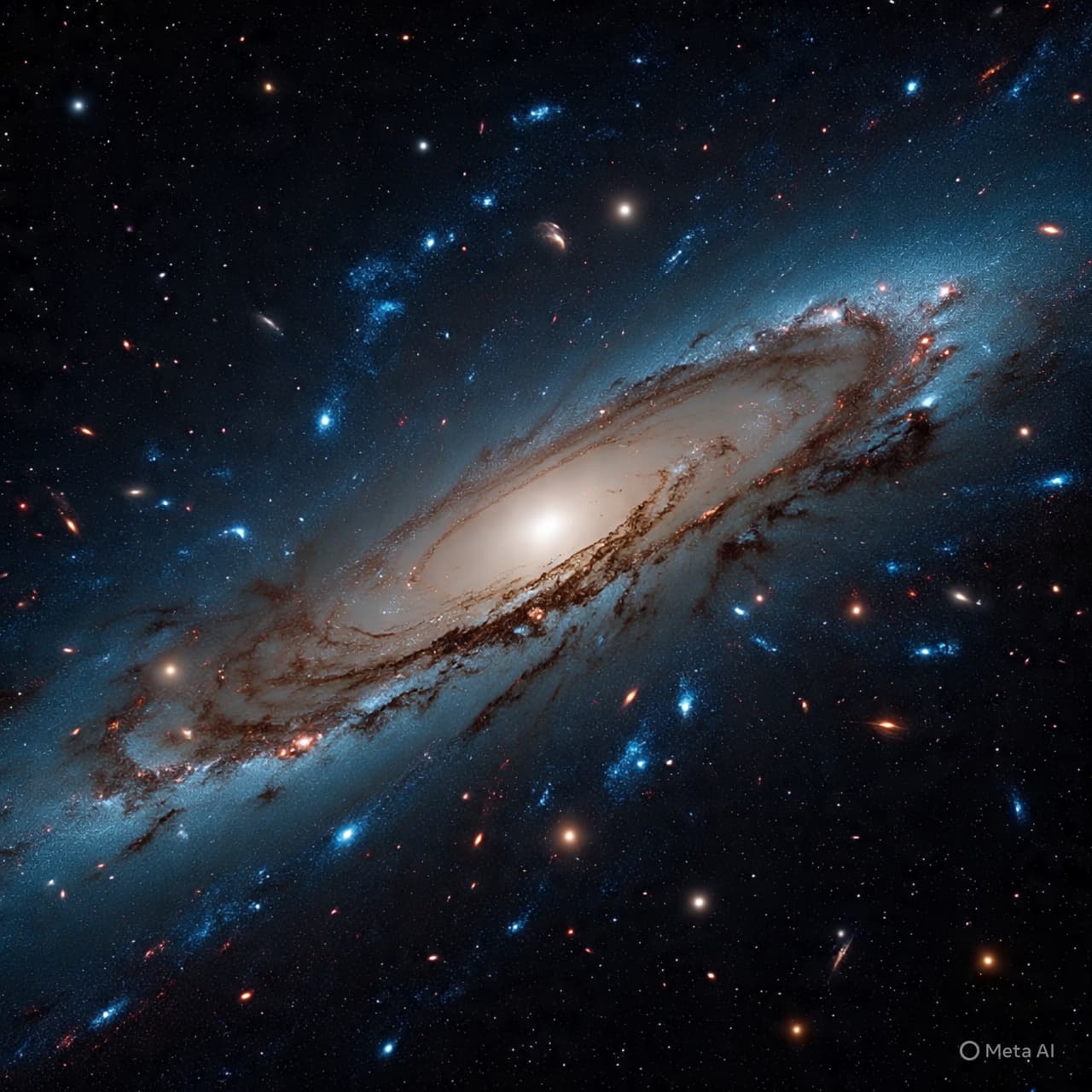
There are moments when the universe seems to pause long enough for us to glimpse its quiet dramas. Light that began its journey billions of years ago finally arrives, carrying with it a story of motion, pressure, and transformation. In that ancient glow, astronomers have now identified a remarkable sight: a “jellyfish galaxy” torn apart some 8.5 billion years ago, its luminous tendrils stretching across space like a cosmic memory frozen in time.
The discovery, made using the powerful vision of the , reveals a galaxy caught in the act of being stripped of its gas as it speeds through a dense galaxy cluster. This process, known as ram-pressure stripping, occurs when the hot, diffuse gas that fills a cluster pushes against a moving galaxy, sweeping away the very material needed to form new stars. The result is a striking structure: a bright galactic core followed by elongated streams of gas and stars, trailing behind like the tentacles of a jellyfish drifting in a cosmic current.
What makes this observation particularly compelling is its age. The light captured by Webb began its journey when the universe was significantly younger. Seeing such a dramatic example of environmental transformation so far back in time suggests that galaxy clusters were already shaping the destinies of their members billions of years ago. Galactic evolution, it seems, has long been influenced not only by internal processes but also by the crowded neighborhoods galaxies inhabit.
Gas is the essential fuel for star formation. When it is stripped away, a galaxy’s ability to create new stars gradually diminishes. Over time, such galaxies can transition from vibrant stellar nurseries to quieter systems dominated by older stars. The jellyfish galaxy provides a vivid illustration of this shift in progress — a system actively losing the material that once sustained its growth.
Webb’s infrared instruments allow astronomers to peer through cosmic dust and detect faint structures with exceptional clarity. Researchers can trace how the gas is being pulled away, measure the rate of star formation within the galaxy, and even determine whether new stars are forming within the trailing streams. In some cases, these turbulent tails become sites of unexpected stellar birth, where compressed gas ignites despite the broader loss.
The finding also strengthens theoretical models predicting that dense cluster environments can accelerate galactic aging. For decades, simulations have suggested that ram-pressure stripping plays a central role in transforming spiral galaxies into more passive, gas-poor systems. Direct observations from deep cosmic time now provide tangible evidence that these mechanisms were active when the universe was roughly half its current age.
Beyond its scientific significance, the image invites reflection on scale and fragility. A galaxy — vast beyond imagination — can nonetheless be reshaped by its surroundings. In the grand architecture of the cosmos, interaction is constant, and change is woven into every orbit.
In direct terms, astronomers report that the James Webb Space Telescope has identified a jellyfish-shaped galaxy undergoing ram-pressure stripping approximately 8.5 billion years ago. The observation offers new insight into how galaxy clusters influenced galactic evolution in the early universe.
AI IMAGE DISCLAIMER Illustrations were produced with AI and serve as conceptual depictions.
SOURCE CHECK
Credible mainstream and science media reporting on this topic: Reuters BBC The Guardian Space.com Associated Press
Published by Banx Network. This article is part of the Banx decentralized media programme, powered by the BXE token on the XRP Ledger.