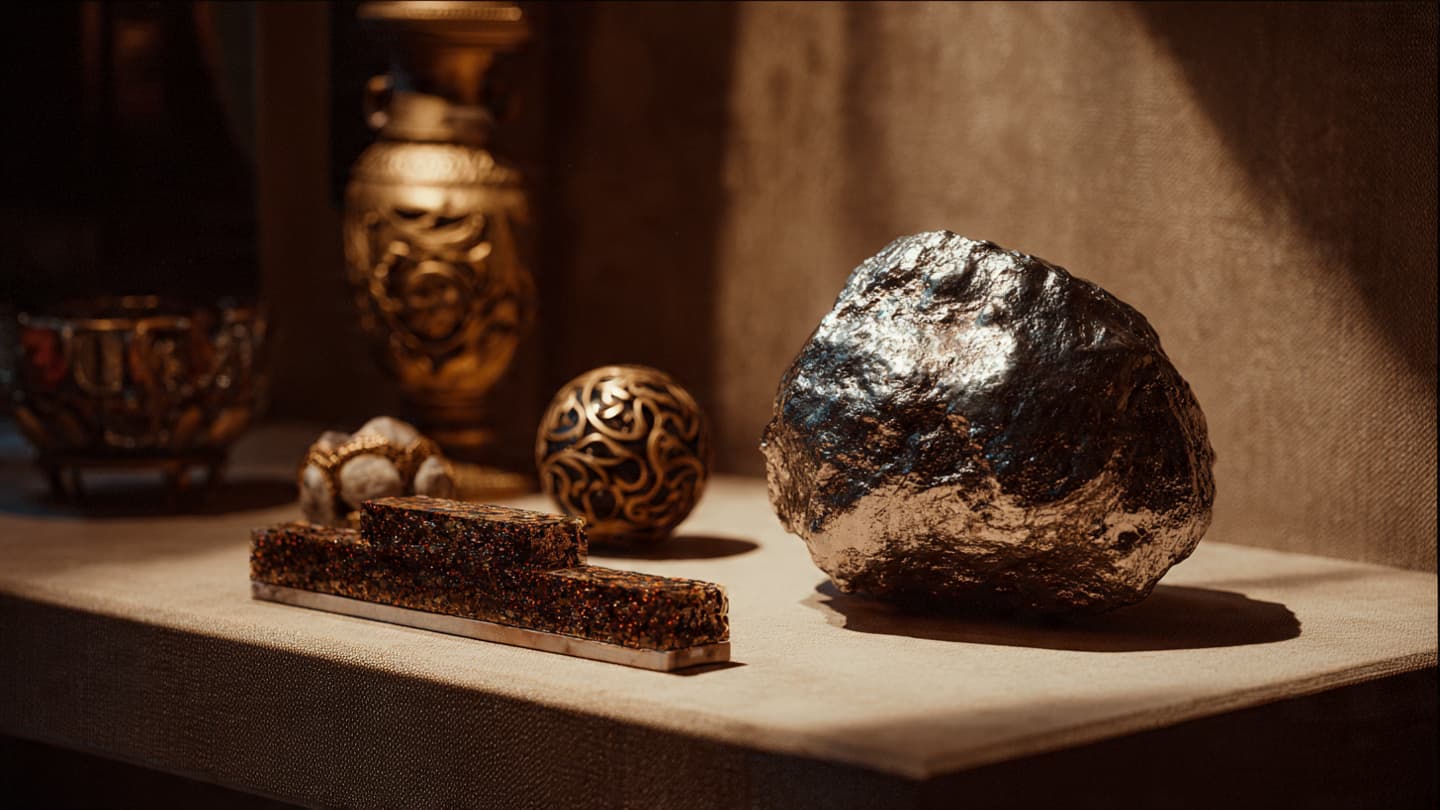
Ancient treasures often resemble messages sealed inside time itself, carrying fragments of forgotten worlds into the present day. Beneath layers of dust, corrosion, and silence, archaeologists sometimes discover objects that reveal not only the artistry of past civilizations but also their relationship with the wider cosmos. In a recent scientific investigation, researchers reported finding an unusual metal within a 3,000-year-old treasure collection, a material described as “alien” because of its likely extraterrestrial origin.
Scientists believe the metal may have originated from a meteorite that fell to Earth long before the treasure was created. Long before industrial mining and modern metallurgy, ancient societies occasionally used meteoritic iron gathered from fallen celestial objects, valuing the material for both its rarity and unusual appearance.
Laboratory analysis reportedly identified chemical signatures rich in nickel and other elements commonly associated with meteorites. These compositions differ from iron typically extracted from terrestrial ores, allowing researchers to distinguish extraterrestrial material from ordinary ancient metalwork.
Historians note that meteoritic metals held deep symbolic and practical importance in several early civilizations. In cultures lacking large-scale iron smelting technology, objects forged from meteorite fragments were often associated with prestige, ritual significance, or divine symbolism connected to the heavens.
The discovery also highlights the remarkable sophistication of ancient craftsmanship. Working with meteoritic iron required skill because the material behaves differently from more commonly processed metals. Researchers say the artifact demonstrates advanced metalworking knowledge for its period.
Archaeologists increasingly combine historical study with modern scientific tools such as isotope analysis and high-resolution scanning technology. These methods allow researchers to uncover details invisible to earlier generations, transforming ancient artifacts into sources of chemical and astronomical evidence.
Beyond its scientific significance, the discovery carries a poetic quality that continues captivating public imagination. A fragment of material born beyond Earth may have passed through the atmosphere thousands of years ago before eventually becoming part of human culture and craftsmanship.
Researchers are expected to continue studying the treasure collection to better understand its origins, trade connections, and cultural context. The finding serves as another reminder that human history and cosmic history have occasionally intersected in unexpected and enduring ways.
AI Image Disclaimer: Some historical and archaeological visuals associated with this article may be AI-generated artistic interpretations based on scientific findings.
Sources: Nature, Smithsonian Magazine, Live Science, Archaeology Magazine, BBC Science
Published by Banx Network. This article is part of the Banx decentralized media programme, powered by the BXE token on the XRP Ledger.