
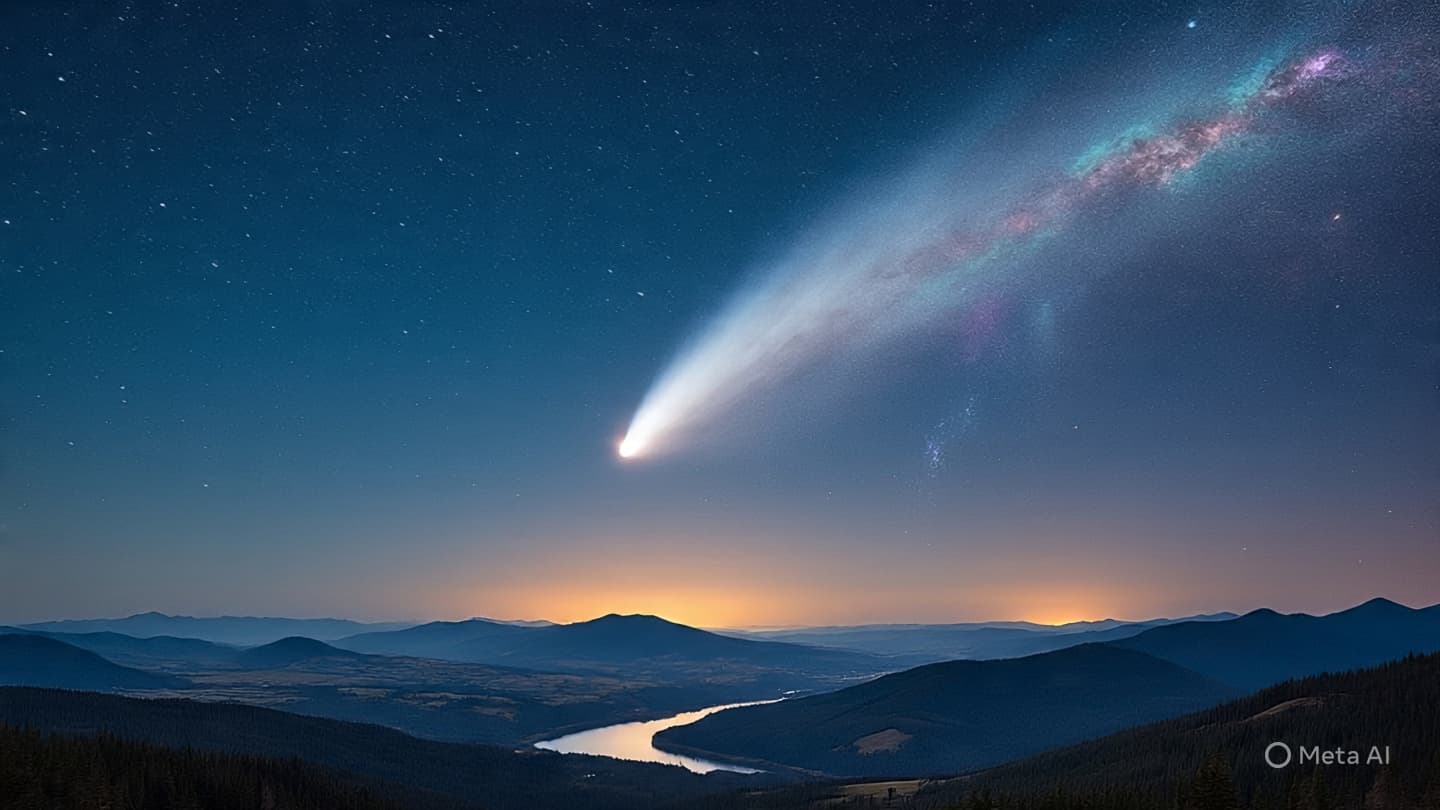
The night sky often offers moments of quiet wonder, but occasionally it promises something more dramatic. A newly observed comet has sparked excitement among astronomers and stargazers alike—though its visibility depends on a critical and uncertain journey past the sun.
Comets are composed largely of ice, dust, and rocky material, making them both visually striking and structurally fragile. As they approach the sun, they heat up, releasing gas and dust that form their characteristic glowing tails. This process is what makes them visible from Earth—but it also puts them at risk of disintegration.
The current comet drawing attention is expected to pass relatively close to the sun, a phase known as perihelion. During this stage, solar radiation and gravitational forces can either enhance the comet’s brightness or cause it to break apart entirely. Predicting the outcome is challenging, even with modern observational tools.
Historically, some comets have survived such encounters and become spectacular sights in the night sky, while others have faded or vanished before reaching peak visibility. The uncertainty adds an element of anticipation for observers, who must wait to see whether this celestial visitor endures.
Astronomers continue to monitor the comet’s trajectory and composition using telescopes and space-based instruments. Their observations will help determine whether it remains intact and bright enough to be seen with the naked eye or simple equipment.
For the public, the potential appearance of a bright comet offers a rare opportunity to connect with the cosmos. Unlike routine astronomical events, comets often carry a sense of unpredictability and wonder, reminding observers of the dynamic nature of the universe.
Whether this comet becomes a dazzling spectacle or fades before reaching its moment, it highlights the delicate balance of forces at play in space. For now, all eyes remain on the sky, waiting to see if this fleeting visitor will survive its solar encounter.
AI Image Disclaimer: Illustrations accompanying this article may include AI-generated depictions of comets and space scenes for visual context only.
Sources: NASA, European Space Agency, Sky & Telescope
Published by Banx Network. This article is part of the Banx decentralized media programme, powered by the BXE token on the XRP Ledger.



