There are moments in science when the past does not whisper—it rearranges the room entirely. A fossil, no larger than a quiet memory pressed into stone, has begun to shift long-held assumptions about how early mammals entered the world. For decades, the story of mammalian birth felt settled, almost like a familiar path worn smooth by repetition. Now, that path bends.
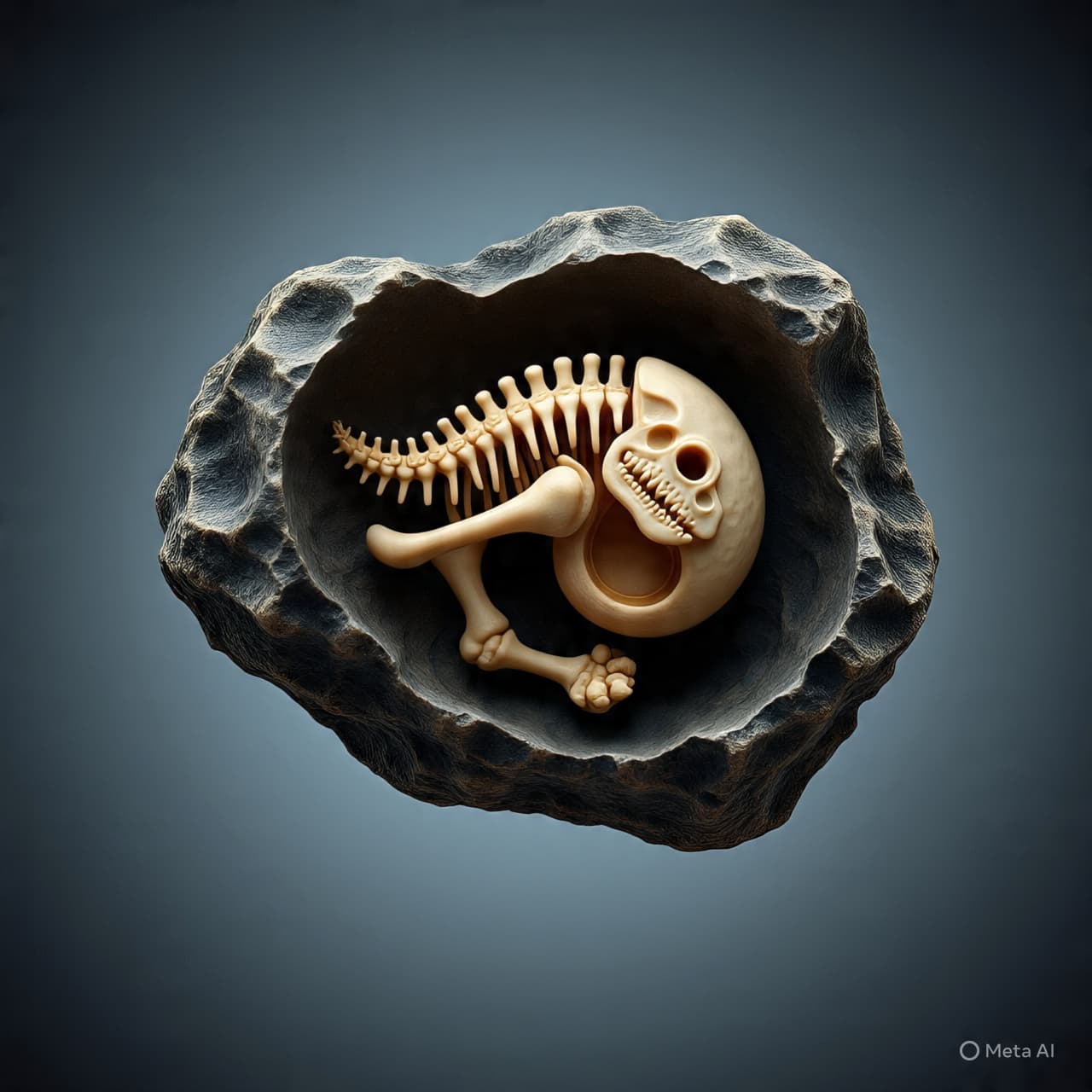
The discovery centers on a remarkably preserved embryo fossil, offering a rare glimpse into reproductive biology from a time when mammals were still emerging from the shadows of their reptilian ancestors. What makes this finding extraordinary is not merely its age, but its implication: early mammals may have reproduced in ways far more diverse than previously believed.
Traditionally, scientists understood early mammals as either egg-laying, like modern monotremes, or live-bearing, like marsupials and placental mammals. This fossil, however, hints at a transitional complexity—an evolutionary bridge that does not fit neatly into existing categories. It suggests that reproductive strategies were not a simple binary but a spectrum of experimentation.
Researchers observed structural details in the fossilized embryo that resemble features associated with internal gestation. At the same time, certain anatomical markers echo traits seen in egg-laying species. This duality raises the possibility that early mammals may have practiced hybrid reproductive strategies, blurring lines once thought distinct.
Such a revelation invites a broader reconsideration of evolutionary timelines. If early mammals were experimenting with reproductive modes, then the divergence between egg-laying and live-bearing species may not have been as abrupt as previously assumed. Evolution, in this light, appears less like a ladder and more like a branching river, with currents flowing in unexpected directions.
The fossil also underscores the rarity of embryonic preservation. Soft tissues and early developmental stages are seldom fossilized, making each discovery disproportionately valuable. In this case, the embryo serves as both artifact and storyteller, carrying biological clues across millions of years.
Beyond biology, the finding speaks to the nature of scientific understanding itself. Knowledge is often built in layers, each generation refining what came before. Occasionally, however, a single discovery does not add a layer—it reshapes the foundation.
For paleontologists, the work ahead involves careful comparison with other fossils and modern species. The goal is not to rush conclusions, but to map this new evidence into a broader evolutionary framework. Each new question becomes part of the process, rather than a disruption of it.
In the quiet persistence of stone and time, this embryo fossil has reopened a conversation about origins. It reminds us that the past is not fixed; it waits patiently for the right moment—and the right evidence—to speak again.
AI Image Disclaimer: Illustrations were produced with AI and serve as conceptual depictions.
Source Check Nature Science BBC The New York Times National Geographic
Published by Banx Network. This article is part of the Banx decentralized media programme, powered by the BXE token on the XRP Ledger.