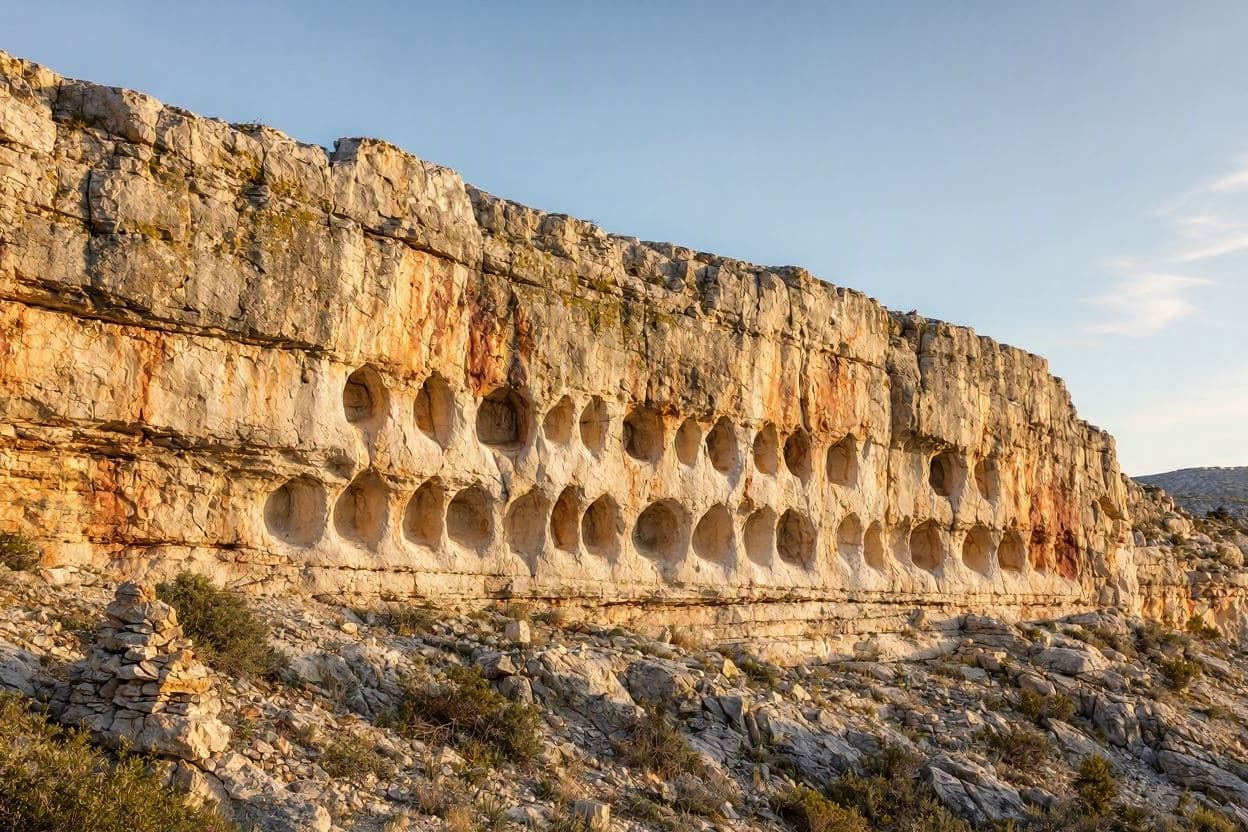
Stone holds memory, though its language is often cryptic and open to interpretation. In the rugged cliffs of Italy, free climbers recently discovered a series of enigmatic markings—over a thousand paddle-like impressions etched into the rock face. These traces, dating back eighty million years, have sparked a lively debate among scientists and enthusiasts alike. What creature, long vanished from the Earth, left these signs? The mystery invites us to peer into the deep past, where the boundaries of knowledge blur and imagination fills the gaps. It is a puzzle written in stone, waiting to be read.
The markings were found in a limestone formation, a type of rock that often preserves fossils and trace evidence of ancient life. Their uniform shape and arrangement suggest they were made by a living organism, possibly through movement or feeding behavior. However, the lack of associated body fossils makes identification difficult. Scientists are left to infer the creator based on the morphology of the marks and the geological context of the site. It is a detective story where the suspect has long since disappeared.
Several hypotheses have emerged to explain the origins of the paddle marks. Some researchers propose they were made by marine reptiles, such as plesiosaurs, dragging their limbs or tails across the sediment before it hardened into rock. Others suggest they could be the result of invertebrate activity, such as large crustaceans or mollusks interacting with the sea floor. Each theory offers a plausible narrative, yet none has secured unanimous acceptance. The ambiguity keeps the scientific community engaged and curious.
The age of the markings, eighty million years, places them in the Late Cretaceous period, a time when dinosaurs roamed the land and diverse marine life thrived in the oceans. Italy was largely submerged under a shallow sea during this era, providing a suitable environment for the preservation of such traces. Understanding the paleoenvironment helps narrow down the list of potential creators, but it does not provide a definitive answer. The context is clear, but the actor remains hidden.
Free climbers, who often explore remote and inaccessible areas, play an unexpected role in paleontology. Their keen observation skills and access to vertical rock faces allow them to spot features that might otherwise go unnoticed. This discovery highlights the value of citizen science and the collaboration between recreational enthusiasts and professional researchers. It shows how curiosity from different fields can converge to expand our understanding of the natural world.
The debate over the markings reflects the broader challenges of interpreting trace fossils. Unlike body fossils, which preserve the physical remains of an organism, trace fossils record behavior. Interpreting behavior from static marks requires careful analysis and often involves a degree of speculation. Scientists must balance creativity with rigor, ensuring that their conclusions are supported by evidence while remaining open to new possibilities. It is a delicate dance between certainty and mystery.
Public interest in the discovery has been high, fueled by the allure of unsolved mysteries and the dramatic setting of the Italian cliffs. Social media and news outlets have spread images of the markings, inviting amateur experts to weigh in. This engagement fosters a broader appreciation for paleontology and geology, encouraging people to look at the landscape with fresh eyes. It turns a scientific question into a shared cultural moment.
As research continues, new technologies such as 3D scanning and comparative analysis may offer fresh insights. By comparing the marks to known traces from other sites, scientists hope to find a match that clarifies their origin. Until then, the paddle marks remain a testament to the complexity of the fossil record. They remind us that the past is full of surprises, and that every stone may hold a secret waiting to be uncovered.
The mysterious paddle marks on an Italian cliff remain a subject of scientific debate, highlighting the intrigue of paleontology. They invite us to appreciate the unknown aspects of Earth’s history. Let curiosity guide our exploration of the past.
AI Image Disclaimer: Please be aware that images used in this context are AI-generated visualizations for illustrative purposes.
Sources: National Geographic Live Science Italian Geological Society
Published by Banx Network. This article is part of the Banx decentralized media programme, powered by the BXE token on the XRP Ledger.