There is a particular kind of courage that does not announce itself, that arrives in the ordinary clothes of a man on his way to work, driving a red pickup truck on a Thursday afternoon in a small Oregon city. Kaylub Giamanco was thirty-six years old, a father of two children who attended Silver Rail Elementary School, and a mechanic by trade. He was not a police officer or a soldier. He was a man in a truck who saw something wrong and decided, in the space of seconds, to do something about it. What he did may have saved lives beyond counting.
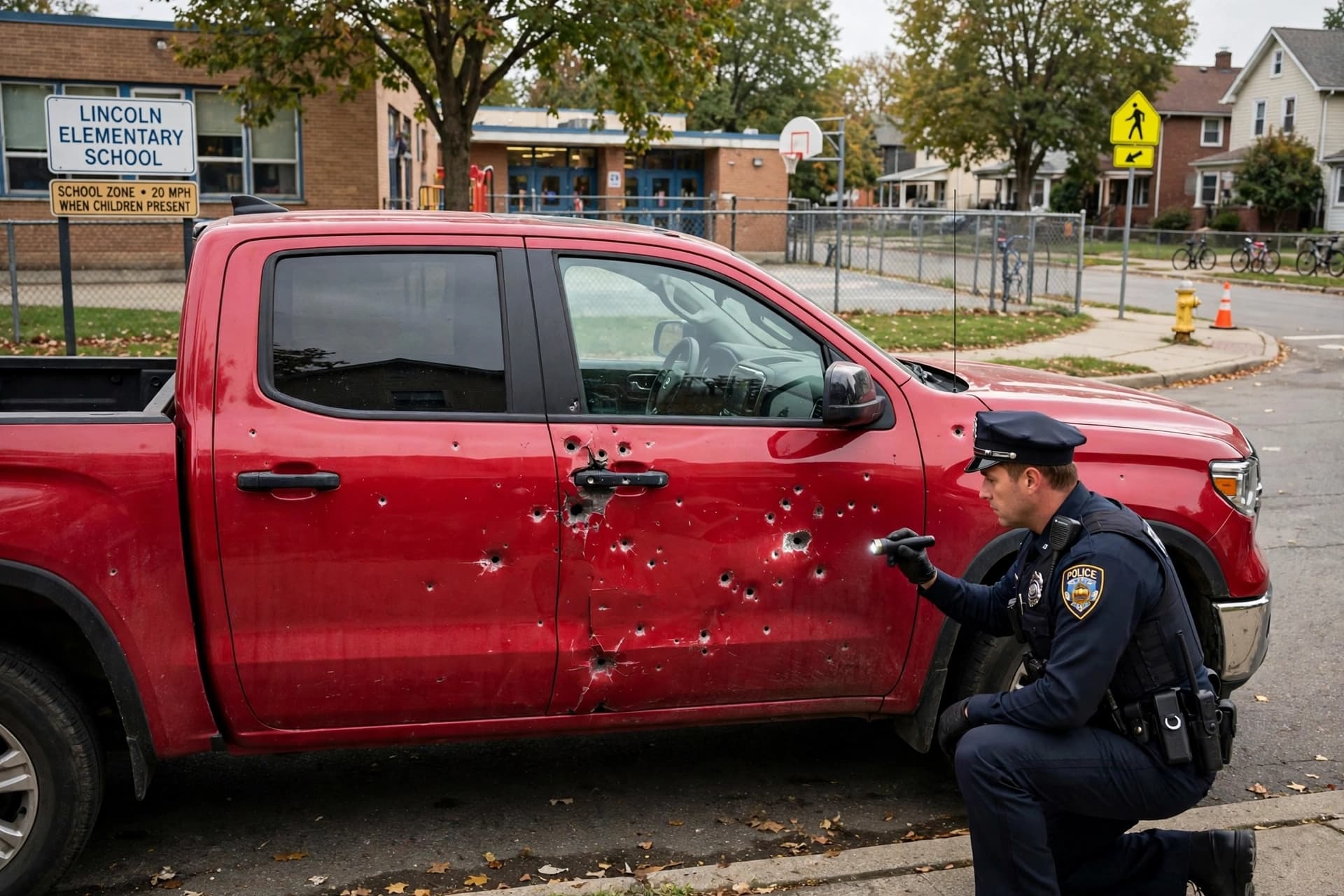
The sequence, as described by Bend Police Chief Mike Krantz, began when Giamanco spotted a figure climbing a fence into the school grounds, a shotgun thrown over ahead of him . Giamanco confronted him verbally. The suspect fired at the pickup at least three times, striking the vehicle. Giamanco drove off and called 911 at 12:59 p.m., the first call that would bring police to the scene . But he did not stop there. After the shooter forced entry into the school by firing into the glass doors and headed toward a special needs classroom, Giamanco followed. He engaged the gunman and killed him with a .40-caliber pistol he kept legally secured in his vehicle .
Inside the school, a teacher had already acted with a courage of her own. As the shooter fired up to fifteen rounds in a classroom for children with special needs, she threw her cellphone at him and tried to tackle him, attempting to wrest the weapon away. She was not injured . Three children—aged five, eight, and eleven—and a twenty-five-year-old teacher were killed. A seven-year-old and a fifty-four-year-old teacher were wounded and hospitalized, their conditions later stabilized . The shooter was identified as Griffin J. John II, a sixteen-year-old former special needs student at the school, armed with a Maverick 88 pump-action shotgun and carrying forty-four additional rounds .
The parents of Bend have spoken of Giamanco with a gratitude that is difficult to measure. He is a member of the community, not an outsider, a man whose children were in the same school system that he protected. At a news conference, Krantz praised his "heroic action," and Governor Tina Kotek addressed him directly: "This action has placed a heavy psychological burden on you, and my heart is with you" . The recognition is deserved, but it also carries an uncomfortable truth. A nation that relies on the luck of an armed bystander in the right place at the right time is a nation that has not yet decided how to protect its children.
There is a broader conversation that has begun, cautiously, in the aftermath. Representative Janelle Bynum, whose district includes Bend, said the community "feels very heavy" but "also feels very preventable." She called for a rethinking of who can have a gun and how to intervene when there are signs that a weapon is "in the hands of the wrong people" or there is a mental health concern. "The laws don't go far enough, fast enough for us to be able to intervene," she said . The investigation into the shooter's motive, and how a sixteen-year-old obtained a shotgun his mother had purchased, continues .
For the families of the three children and the teacher who died, the courage of a mechanic and a teacher who threw her phone cannot undo what happened. It can only stand alongside the grief as a reminder that in the worst moments, some people choose to run toward the danger rather than away. Giamanco has not spoken publicly in detail about what he did. He is, by all accounts, a quiet man who did what he felt he had to do. The parents of Bend will remember him not as a hero in the abstract but as a father who was there, in a red truck, when it mattered.
AI Image Disclaimer: The visuals in this article are generated by artificial intelligence and are for illustrative purposes only.
Sources: CNN, Die Glocke (dpa), Sinovision, Tutto Notizie
Published by Banx Network. This article is part of the Banx decentralized media programme, powered by the BXE token on the XRP Ledger.