There is a particular kind of waiting that settles over a country in the days after an election—a waiting made of partial returns, of results that shift with each new batch of ballots, of the quiet uncertainty that comes when the numbers are still being counted and the outcome is not yet fixed. In Bosnia and Herzegovina, that waiting continues. Preliminary results from Sunday's general elections, the first to use biometric voter identification and optical ballot scanners, point toward familiar outcomes. But the Central Election Commission has not yet declared a final count, and the full picture of who will govern—and how—remains incomplete.
The presidential race, the most closely watched contest, appears to be following the pattern that observers expected. Denis Bećirović, the incumbent Bosniak member of the tripartite Presidency, representing the moderate Social Democratic Party, leads the race for the Bosniak seat with 38.03 percent of the vote, ahead of Bakir Izetbegović of the nationalist Party of Democratic Action, who has 34.25 percent . For the Croat seat, Darijana Filipović of the Croatian Democratic Union leads with 92,854 votes, followed by Slaven Kovačević of the Democratic Front . And for the Serb seat, Željka Cvijanović of the Alliance of Independent Social Democrats is on course for a second term with 55.6 percent of the vote, well ahead of Marinko Božović of the Serb Democratic Party .
The parliamentary results tell a similar story. In the Federation of Bosnia and Herzegovina, the SDA leads with 31.53 percent, followed by the SDP with 15.47 percent and the HDZ with 13.36 percent . In Republika Srpska, the SNSD leads with 40.95 percent, followed by the "Safe Srpska" movement and the SDS . These preliminary results, based on roughly 80 to 88 percent of polling stations processed, show no surprises—the nationalist and moderate parties that have dominated Bosnian politics for years remain dominant .
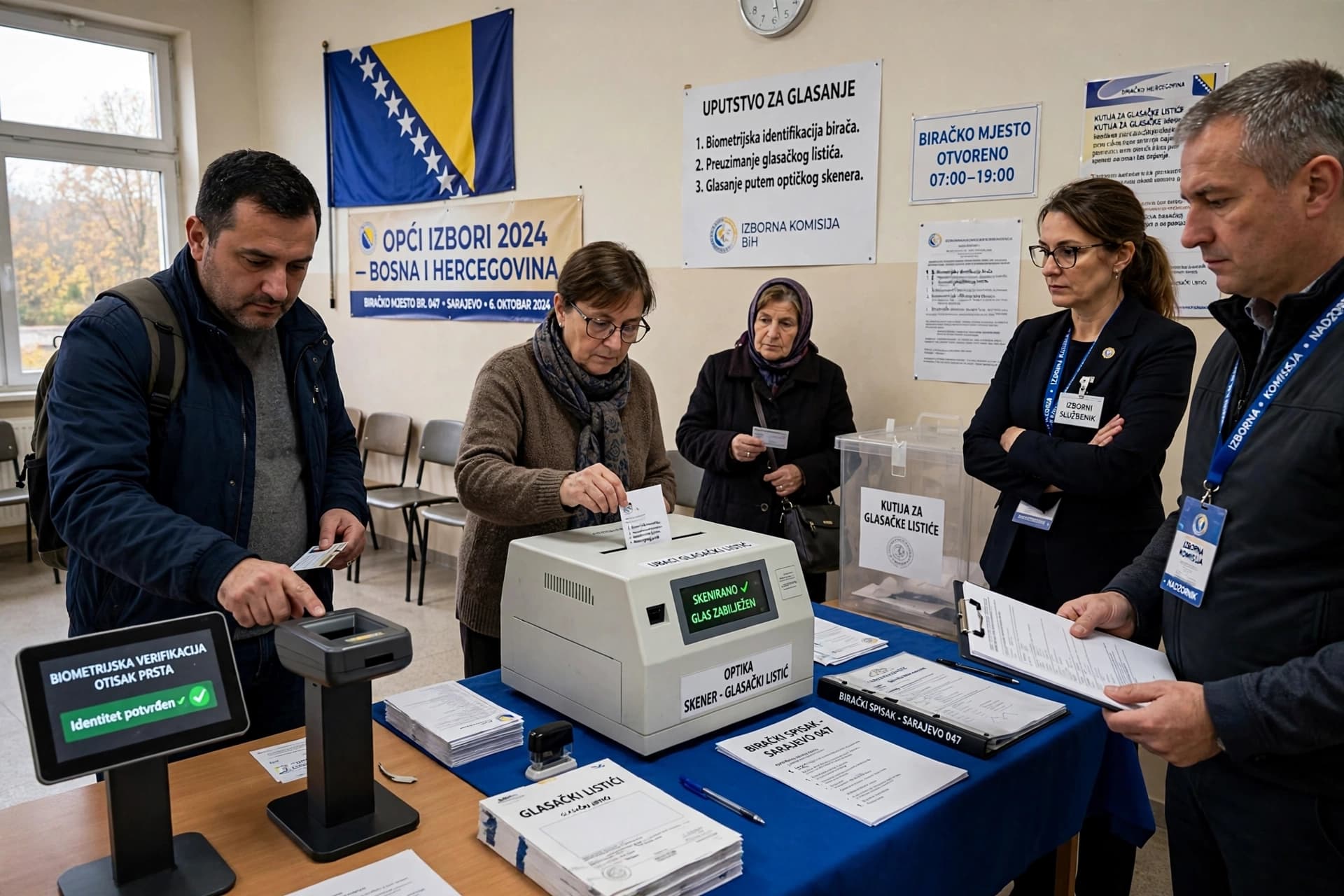
What makes this election notable is not the outcome but the process. For the first time, voters used biometric identification and optical scanners, measures introduced to improve electoral security. The Central Election Commission and political parties ran campaigns to familiarize voters with the new procedures, and 30,000 observers, including 756 foreign observers, were accredited to monitor the vote . Turnout, however, was low—26.88 percent by 3 p.m. on election day, with the final figure still being tallied .
The results are preliminary, and the Central Election Commission is still processing ballots from postal voting and remaining polling stations. The final count will determine the precise distribution of seats and confirm whether any races remain close enough to be contested. For now, Bosnia waits—not for a dramatic shift, but for the formal confirmation of a political landscape that, once again, looks much as it did before.
AI Image Disclaimer: The images accompanying this article were generated by artificial intelligence and are for illustrative purposes only.
Sources: Balkan News Agency (BTA), Klix.ba, Radio Sarajevo, Tanjug, Blic
Published by Banx Network. This article is part of the Banx decentralized media programme, powered by the BXE token on the XRP Ledger.