There are moments in the sky that arrive suddenly, almost without warning, and then recede into memory.
In the year 1901, a new light appeared in the constellation Perseus, bright enough to draw attention across the world. It was not a new star, but a transformation—an eruption that turned an otherwise faint point into something briefly luminous. Known today as Nova Persei 1901, it was one of the brightest novae ever recorded, its flare a reminder that even quiet stars can change without notice.
Over time, its brilliance faded.
What remained seemed, for decades, relatively simple: the expanding remnants of that eruption, a shell of material thrown outward into space, gradually dispersing into the surrounding darkness. Observations traced this outward motion, capturing a system in the slow process of returning to stillness. The story appeared contained—a sudden outburst, followed by a long, quiet aftermath.
But time, as it often does in astronomy, has added another layer.
Recent observations have revealed something more subtle, almost hidden—a vast, faint shell of hydrogen surrounding the nova, extending far beyond the material ejected in 1901. This structure is not easily seen. It does not glow brightly or announce itself. Instead, it exists as a delicate boundary, detectable only through careful imaging and analysis, its presence inferred from the way it interacts with light.
Its origin points further back.
Rather than being part of the nova eruption itself, this outer shell may be the remnant of an earlier phase in the star’s life—what astronomers call a planetary nebula. Despite the name, a planetary nebula has nothing to do with planets. It forms when a star like the Sun reaches the end of its life, shedding its outer layers into space, creating an expanding envelope of gas that can persist for tens of thousands of years.
If this interpretation holds, then the system that produced Nova Persei 1901 is older, more layered, than once thought.
It suggests that long before the dramatic flare observed in 1901, the star had already passed through a phase of transformation—casting off material that now forms this extended hydrogen shell. The nova event, rather than being an isolated moment, becomes part of a longer continuum, one episode in a sequence of changes unfolding over vast stretches of time.
There is a quiet complexity in this realization.
Astronomers studying the system have noted that the structure of the outer shell differs from that of the inner, more recent ejecta. Its scale, composition, and distribution point to a different origin, one that aligns more closely with the behavior of planetary nebulae than with nova remnants. The two shells—one ancient, one relatively recent—exist together, layered in space, each marking a different moment in the star’s history.
It is, in a sense, a form of cosmic memory.
The inner shell recalls the sudden brightness of 1901, the brief transformation that made the star visible across great distances. The outer shell reaches further back, to a quieter but equally significant transition, when the star shed its outer layers and altered its structure in a more gradual way. Together, they form a record not of a single event, but of a life unfolding in stages.
Such findings reshape how astronomers understand systems like this one.
Rather than viewing novae as isolated phenomena, researchers are increasingly considering them within the broader context of stellar evolution, where multiple processes—mass loss, binary interactions, eruptions—intersect over time. The presence of a planetary nebula around a nova system is rare, but not impossible, and it offers a glimpse into how these processes might overlap.
There is no urgency in this work. The structures being observed have existed for thousands of years, their changes measured not in moments, but in epochs. And yet, each new observation brings a kind of clarity, a sense that the sky, even in its stillness, continues to reveal its history.
Astronomers report that a large hydrogen shell detected around Nova Persei 1901 may be the remnant of a planetary nebula predating the nova event. The findings, supported by recent observations and analysis, suggest a more complex evolutionary history for the system, linking the 1901 outburst to earlier stages of stellar development.
AI Image Disclaimer
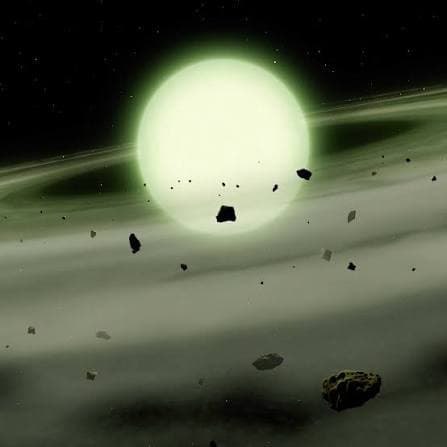
Illustrations were created using AI tools and are not real photographs.
Source Check: NASA, European Space Agency (ESA), Space.com, Sky & Telescope, The Astrophysical Journal
Published by Banx Network. This article is part of the Banx decentralized media programme, powered by the BXE token on the XRP Ledger.