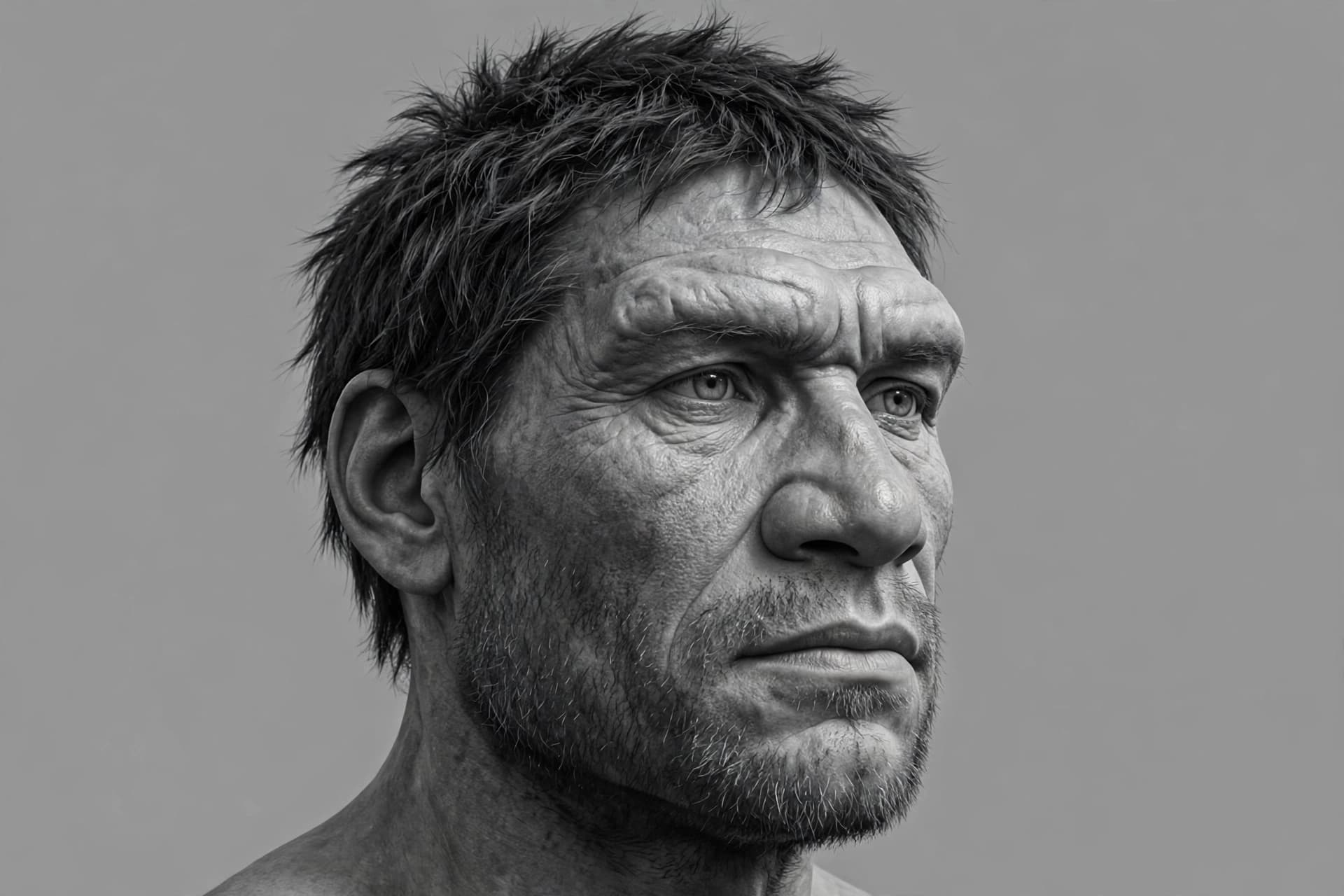
There is something both intimate and estranged in looking at the face of someone who lived 315,000 years ago, someone who walked a landscape that no longer exists, someone whose name and voice and thoughts are forever lost. And yet the face that has emerged from fragments of bone found in Morocco is not entirely unfamiliar. It is a face that carries the deep architecture of our species, assembled from pieces of several individuals, offered not as a portrait but as an approximation—a glimpse of what our earliest known ancestors might have looked like.
The reconstruction is based on fossils from Jebel Irhoud in Morocco, a site that reshaped the timeline of human evolution in 2017 when two papers in Nature classified the remains as Homo sapiens and dated them to approximately 315,000 years ago . The fossils were first unearthed in the early 1960s by a mining worker who found a skull initially identified as an African Neanderthal, believed to be only about 40,000 years old. Improved dating methods pushed that estimate back dramatically .
Because no intact skull was found, an international team led by digital reconstruction expert Cicero Moraes and Dr. Johari Yap Abdullah created a composite. The main component was the Irhoud 1 skull, discovered in 1961, which supplied the cranial vault and upper face. The lower jaw came from Irhoud 11, and parts of the upper jaw and teeth were filled in using specimens Irhoud 10, 21, and 22 from the same archaeological layer . The resulting face, therefore, is not a portrait of any single person but a scientifically informed approximation of a possible appearance .
The reconstruction process combined forensic techniques with digital modeling. The researchers first created a three-dimensional model from published images and video footage, then adapted a digital model of a modern human head derived from a CT scan to match the fossil's structure. Soft tissue thickness was adjusted using reference data from modern humans of African descent . Skin details, hair, and lighting were added in a final stage, producing two versions: one in grayscale without hair or beard to emphasize anatomy, and another in color intended to make the findings accessible to a wider audience .
The face that emerged shows prominent brow ridges, a broad nose, and an elongated head. The overall structure of the eyes, nose, and mouth is already very similar to that of modern humans, while the posterior part of the skull remains elongated and retains archaic characteristics . The cranial cavity volume was estimated at approximately 1,364 milliliters, close to a previous estimate of 1,375 milliliters and well within the range of modern humans . This reinforces the theory that the human face evolved and reached its modern form much earlier than the brain's morphological development .
The researchers are explicit about the limits of their work. Skin tone, hairstyle, and facial hair cannot be reliably reconstructed from the remains; these details are artistic additions rather than features directly supported by the fossils . The composite nature of the skull, drawing from multiple individuals who likely lived at different times, means the reconstruction cannot represent exactly what any one person looked like . "The soft tissues were adjusted to reflect the structure of the ancient skull," the authors note, acknowledging that the method remains anchored to bone shape and measurement data but cannot recover biological details not preserved in the fossil .
What the reconstruction accomplishes is less about a specific face than about method. It demonstrates how transparent techniques and freely available software can produce an anatomically bounded approximation of early human appearance, making the people of Jebel Irhoud more tangible without dissolving the uncertainty that surrounds them . The face is not a photograph. It is a hypothesis rendered visible, a careful negotiation between what the bones say and what they cannot.
AI Image Disclaimer: All visuals associated with this report were created using artificial intelligence and are illustrative in nature.
Sources: Daily Mail, Heritage, Scinexx, Qazinform, Vietnam.vn
Published by Banx Network. This article is part of the Banx decentralized media programme, powered by the BXE token on the XRP Ledger.