For centuries, the question of whether the solar system is stable has occupied the minds of astronomers, from Newton to Laplace to the computational modelers of the present day. The prevailing view in recent decades has been one of relative security: the planets will remain in their orbits for timescales so vast that the universe itself may not last long enough to see their dissolution. But a new study suggests that this comfort may have been misplaced, and that the cause of our eventual undoing is not a passing star or the slow creep of chaos, but the Sun itself.
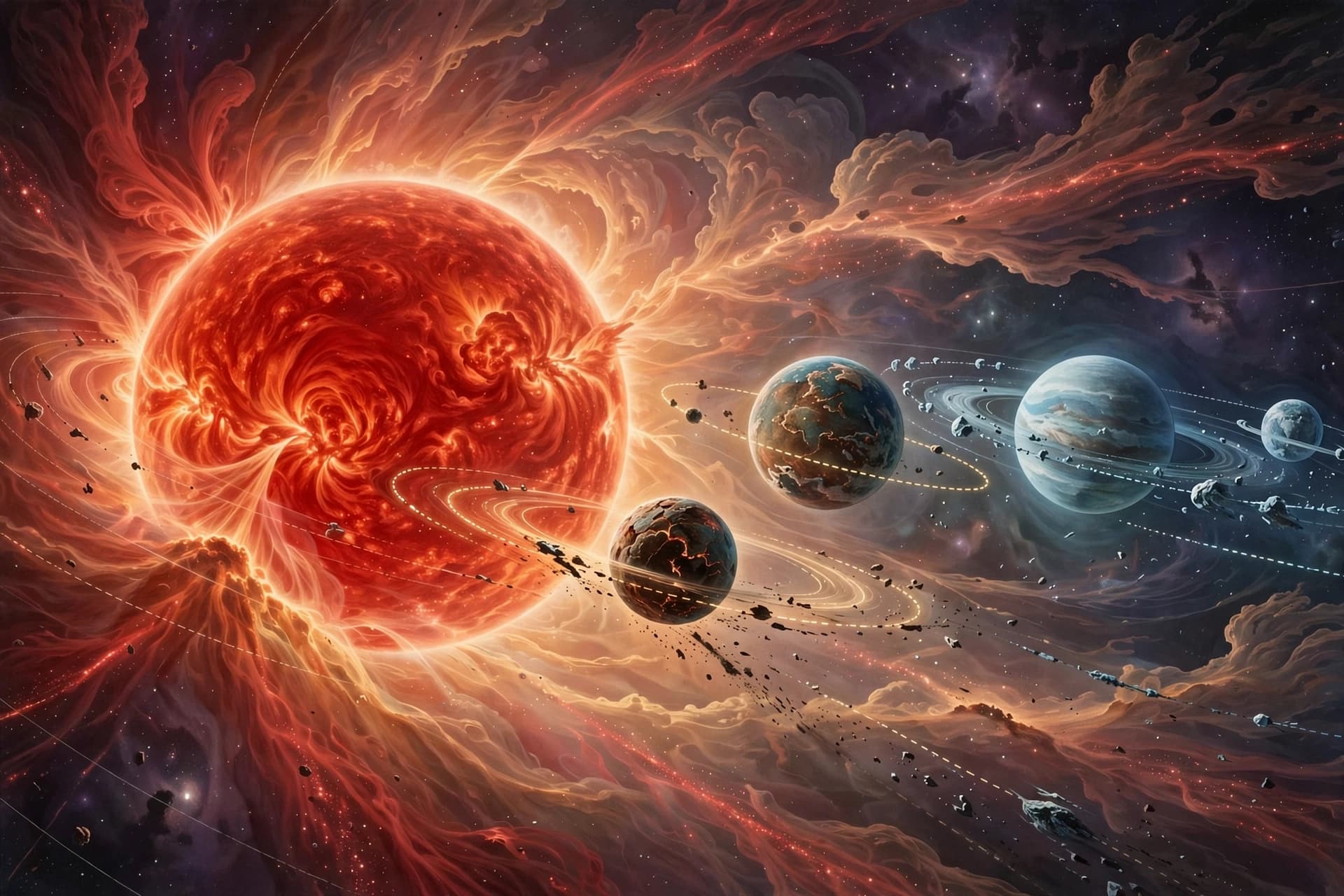
The Sun will eventually run out of hydrogen fuel and expand into a red giant, shedding its outer layers before collapsing into a white dwarf. Previous estimates held that the outer planets—Jupiter, Saturn, Uranus, and Neptune—would survive this process, their orbits expanding but remaining stable for perhaps 10^18 years, a span so long that stellar flybys would likely dismantle the system first. That picture, the new research argues, rests on a false assumption: that the Sun will lose its mass smoothly.
Instead, the study suggests, the Sun will shed its envelope in discrete, asymmetric ejections, each imparting a small "kick" to the star in a random direction. These kicks accumulate over thousands of ejections, creating a stochastic forcing that random-walks the planets' orbits. The result is a far more rapid destabilization than anyone had predicted. In simulations, about 40 percent of realizations underwent disruption or violent scattering while the Sun was still in its red giant phase, and roughly 90 percent disassembled within 3 billion years of white dwarf formation.
The finding reduces the estimated lifespan of the outer solar system by a factor of a billion. What was once measured in quintillions of years is now measured in billions—still an unfathomable stretch of time, but a dramatic revision nonetheless. The mechanism, as described by the researchers, is not the slow seep of chaos but the granularity of the Sun's own death. Each ejection is a small perturbation, but their accumulation restructures the gravitational architecture of the outer solar system.
The implications are largely theoretical, given the timescales involved. Before the Sun becomes a white dwarf, it will first become a red giant, expanding to hundreds of times its current size and likely swallowing Mercury and Venus. Earth's fate is less certain—some studies suggest it may survive if the Sun loses mass rapidly enough, while others conclude it will be engulfed. In either case, the planet will be uninhabitable long before the Sun's final stages, its oceans boiled away and its atmosphere stripped by the intensifying radiation.
The study also returns to a question that Newton himself pondered: whether the solar system's apparent order is permanent or merely a long pause in a process of gradual unraveling. The researchers suggest that Newton's intuition about instability was closer to the truth than the more recent consensus, though the cause is not the gravitational dance between planets but the Sun's own erratic death throes.
For now, the solar system remains in its accustomed configuration, the planets tracing their ancient orbits around a stable star. The end, when it comes, is so distant that it has no practical bearing on human concerns. But the study offers a reminder that stability is not a given, and that the same forces that built the solar system will one day contribute to its dissolution. The Sun, which gives life, will also be the agent of its ending.
---
AI Image Disclaimer: All images in this report were generated by artificial intelligence and are intended for illustrative purposes only.
Sources: The Independent, The Astrophysical Journal Letters, AAS Nova, Caltech
Published by Banx Network. This article is part of the Banx decentralized media programme, powered by the BXE token on the XRP Ledger.