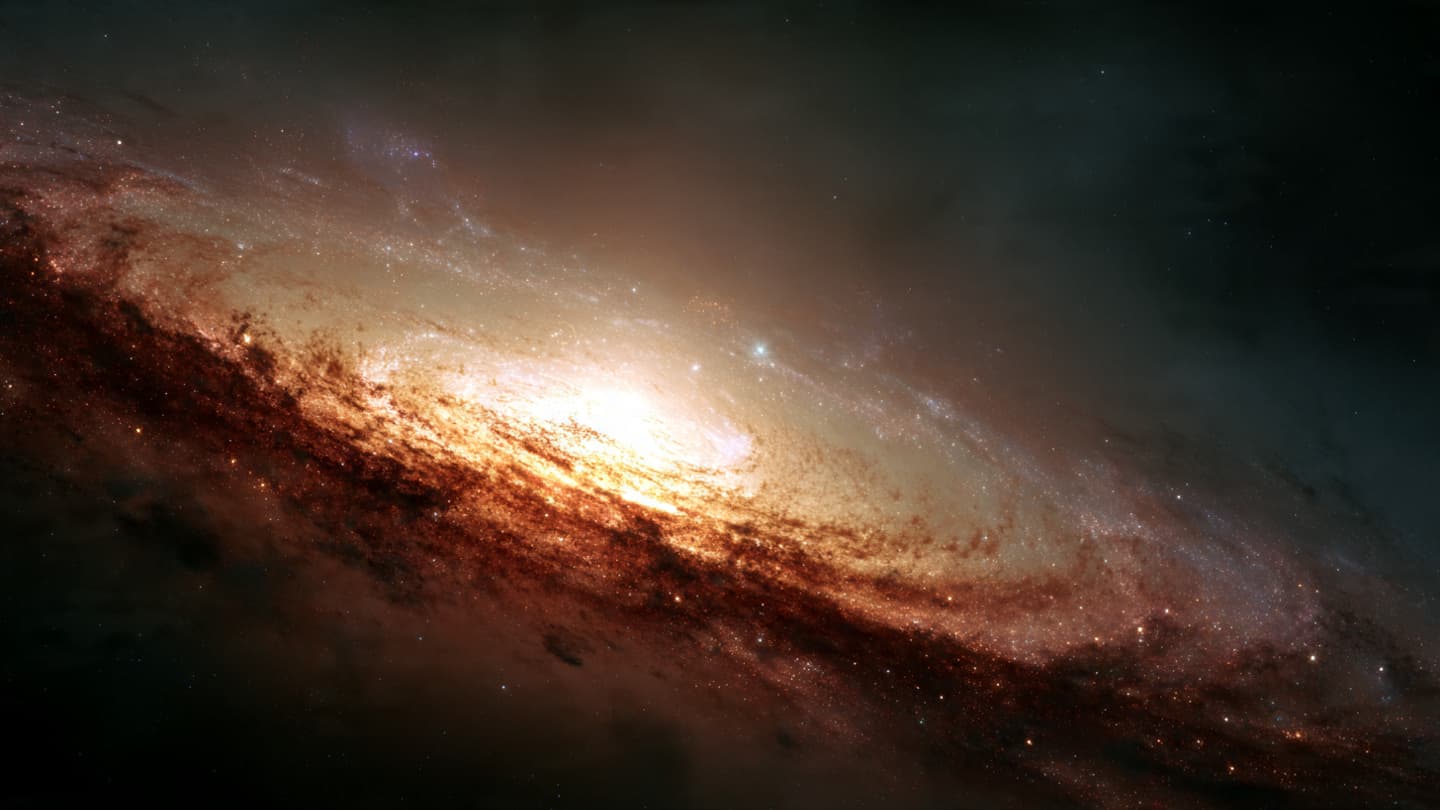
Across the immense distances of the universe, galaxies often appear calm from afar, like scattered islands of light suspended within darkness. Yet deep inside many of them, powerful forces shape structures far more dynamic than the human eye can naturally perceive. Recently, observations revealed an unusual structure at the center of a distant galaxy, drawing significant interest from astronomers seeking to understand how galaxies evolve over time.
Researchers say the strange formation appears unlike many previously observed galactic cores, displaying unexpected patterns in gas, dust, or energetic activity. Because the galaxy lies billions of light-years away, the telescope effectively captured light emitted far back in cosmic history.
The James Webb Space Telescope’s infrared instruments allow scientists to observe regions obscured by dense cosmic dust that older telescopes often struggled to penetrate. This capability has already transformed astronomy by exposing previously hidden details within early galaxies and stellar nurseries.
Astronomers are currently studying whether the newly observed structure may be linked to a supermassive black hole, intense star formation, or unusual gravitational interactions occurring near the galaxy’s center. Several competing interpretations remain under investigation as researchers analyze additional data.
Galactic cores represent some of the most energetic environments in the universe. Many contain black holes millions or billions of times more massive than the Sun, capable of influencing surrounding gas, stars, and radiation across vast distances.
Scientists emphasize that unusual observations are common during periods of technological advancement in astronomy. Each new generation of telescopes often reveals structures and behaviors that existing models cannot immediately explain, prompting refinements in scientific understanding.
The discovery also demonstrates how Webb continues extending humanity’s view deeper into space and further into cosmic history. By capturing ancient light with extraordinary sensitivity, the telescope allows researchers to observe stages of galactic evolution previously hidden from direct study.
Further observations will likely help determine the exact nature of the structure and its significance within broader astrophysical theory. For now, the distant galaxy remains another reminder that the universe still contains countless formations waiting quietly beyond the reach of earlier instruments.
AI Image Disclaimer: Some astronomical illustrations connected to this article may be AI-generated visual interpretations based on telescope observation data.
Sources: NASA, European Space Agency, Space.com, Nature Astronomy, Scientific American
Published by Banx Network. This article is part of the Banx decentralized media programme, powered by the BXE token on the XRP Ledger.