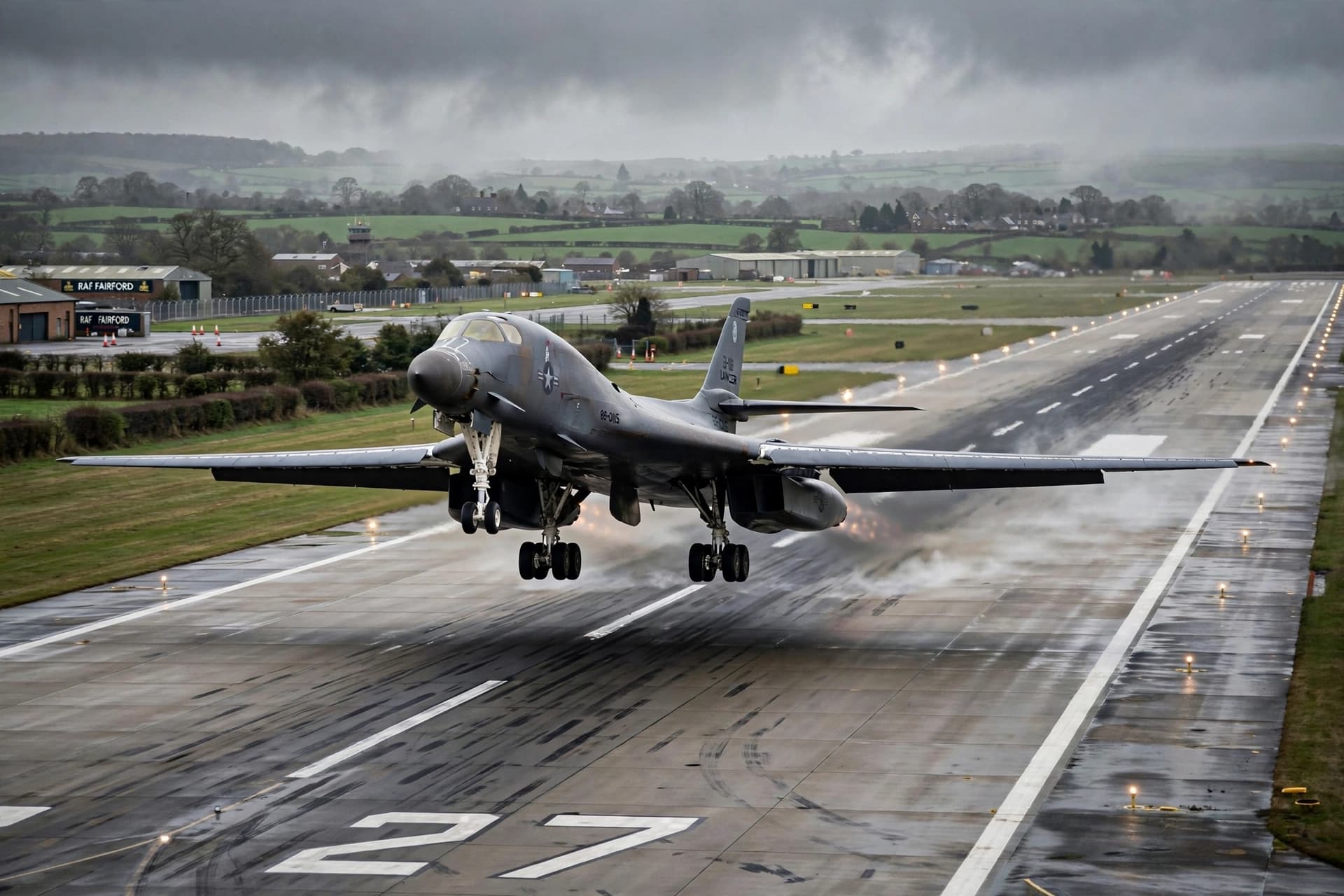
There is a particular quiet that follows the departure of a bomber fleet—a quiet that is not peace but the absence of a specific kind of presence, a return to a baseline that had been altered by the arrival of aircraft designed for long-range strikes. This week, the United States began withdrawing its B-1B Lancer strategic bombers from RAF Fairford in Gloucestershire, England, ending a deployment that had lasted approximately seven months. Ten of the twelve bombers have already departed for the continental United States, with the final two expected to leave shortly, according to international media reports .
The deployment had been the subject of heightened attention in recent weeks, not only because of the bombers themselves but because of an incident at the base. A local farmer called police after spotting a group of masked individuals near the base, prompting a counter-terrorism investigation. Five suspects were arrested with three white vans containing quantities of diesel. Scenarios discussed in the media ranged from a planned terrorist attack to fuel theft. All five were released on bail, a decision that drew criticism from President Donald Trump, who said he would not have released them .
The withdrawal of the B-1 fleet from Fairford comes as the U.S. repositions its strategic aviation assets. According to Greek media reports, B-2A Spirit bombers are based at Whiteman Air Force Base and other CONUS locations, while B-1B Lancers are now concentrated at Minot Air Force Base, Dyess Air Force Base, Anderson Air Force Base in Guam, and other continental U.S. locations . The departure of the bombers from European Command represents a reorganization of U.S. strategic air power in the region.
The B-1B Lancer is a long-range, supersonic bomber capable of carrying a large payload of both conventional and precision-guided munitions. Its presence at Fairford had been interpreted as a signal of American commitment to the region at a time of heightened tensions with Iran. The bombers had been deployed in support of operations related to the U.S.-Iran conflict, which began in February and has continued through the summer and into the fall.
The return of the bombers to the United States does not signal an end to the conflict, but it does mark a shift in posture. The aircraft that had been positioned for potential strikes against Iranian targets are now back at their home stations. Whether the deployment will be repeated, or whether the withdrawal is part of a broader drawdown of American military assets from the region, remains unclear. For now, RAF Fairford returns to its usual state: a quiet airfield in the English countryside, its runways empty of the long, white shapes that had drawn the attention of a farmer and, for a time, the world.
AI Image Disclaimer: All images in this article are AI-generated and are intended for illustrative purposes only.
Sources: Tabnak, Axar.Az, Hamshahri Online, In.gr
Published by Banx Network. This article is part of the Banx decentralized media programme, powered by the BXE token on the XRP Ledger.

.jpg&w=3840&q=75 "Prison Chief in Christa Pike Case Oversaw Five “Botched” Executions, Lawyers Say")