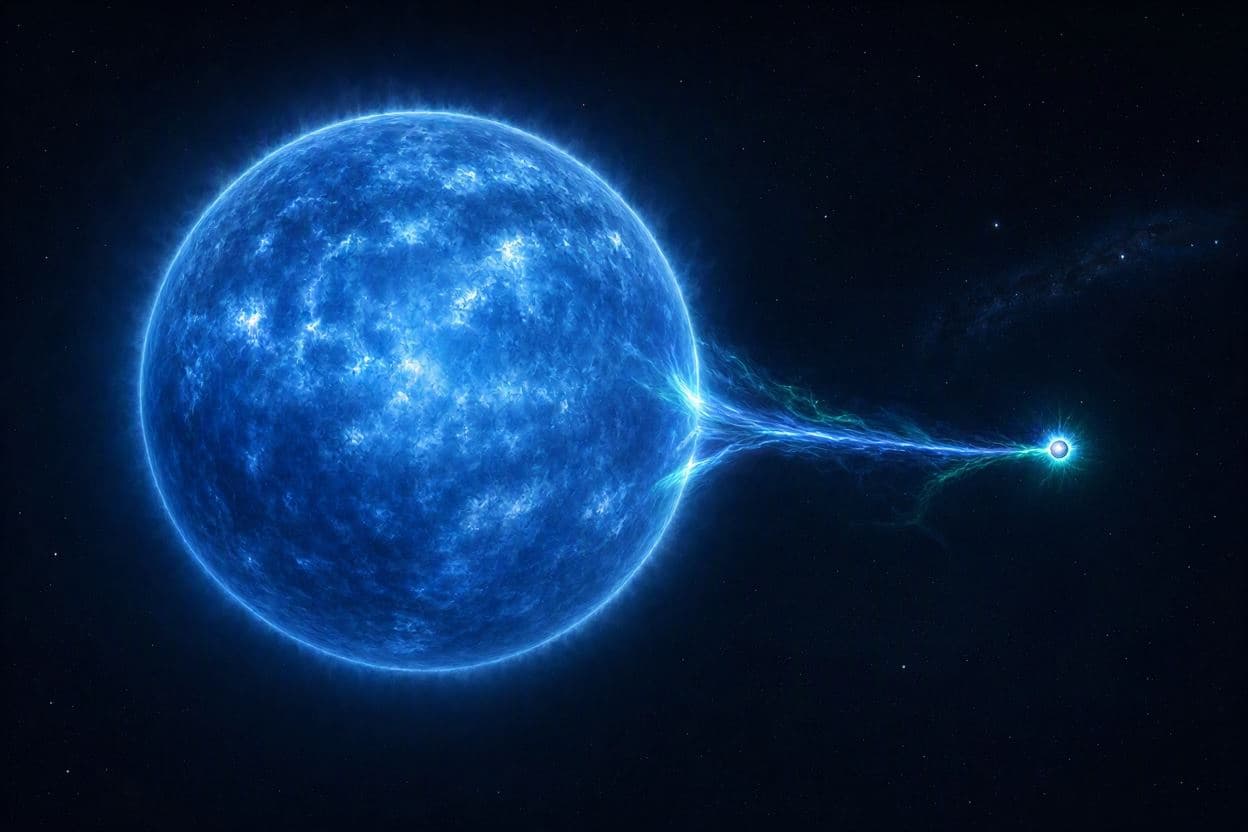
Somewhere in the constellation Centaurus, about 13,000 light-years from Earth, a dead star is caught in a strange and violent dance with its dying partner. The neutron star—a city-sized remnant with the mass of our sun packed into a sphere roughly 12 miles across—spins through space, sending a wobbling beam of X-rays toward us like a lighthouse that never quite keeps time. It is, astronomers say, a zombie: undead, ultradense, and emitting flashes that have puzzled scientists for years. Now, with the help of a new X-ray telescope, researchers have finally glimpsed what drives those flashes—a colossal plume of stellar wind, so concentrated and energetic that scientists have described it with a word more often used in less dignified contexts.
The binary system is known as BP Crucis. It pairs a blue hypergiant star called Wray 977—roughly 60 times larger than the sun—with the neutron star GX 301-2 . The neutron star completes an orbit every 41.5 days, and it experiences intense X-ray flares when it reaches its closest and farthest points from its partner . For decades, researchers suspected those flares were triggered by the neutron star passing through a stream of material blown off the hypergiant. But they had no way to prove it.
That proof came from the X-ray Imaging and Spectroscopy Mission, or XRISM, a space telescope jointly operated by NASA and the Japan Aerospace Exploration Agency. During a 16-hour observation period coinciding with one of the neutron star's flares, XRISM captured highly detailed X-ray spectra showing how a dense stream of plasma acted very close to the neutron star . The data revealed "rapidly changing emission and absorption lines," allowing researchers to simulate exactly how the plasma fell onto and swirled around the passing star .
The culprit is the hypergiant's stellar wind—a single, concentrated plume of ionized gas ejected at roughly 335,000 miles per hour . Scientists believe the plume is shaped into a narrow stream by the gravitational influence of the neutron star itself . When GX 301-2 passes through this plume, material accumulates on its surface. When enough has gathered, the star releases a burst of energy—an X-ray flare bright enough to be detected from Earth.
"This is the first time that researchers have ever detected this type of stellar material interacting with a neutron star, or with any other similar stellar remnant," the study notes . Study co-author Nazma Islam described the observations as "groundbreaking," adding that the clarity of the data meant the analysis had to be especially detailed . The findings were published September 18 in the journal Science Advances.
Astronomers believe BP Crucis offers a unique laboratory for understanding how compact objects interact with the extreme winds of massive stars. The team hopes to use XRISM to observe future flares, building a more complete picture of this peculiar cosmic relationship .
New observations with the XRISM space telescope have revealed that a neutron star in the BP Crucis system flares when it passes through a concentrated plume of stellar wind from its hypergiant companion. The findings, published in Science Advances, mark the first time this type of interaction has been directly detected.
AI Image Disclaimer: The images accompanying this article are generated by artificial intelligence and are intended for illustrative purposes only.
Sources: Live Science, Yahoo News, Science Advances, NASA Goddard Space Flight Center, University of Maryland Baltimore County
Published by Banx Network. This article is part of the Banx decentralized media programme, powered by the BXE token on the XRP Ledger.