The Earth keeps its records in stone, but the handwriting is not always clear. A crater buried beneath the small town of Ames, Oklahoma, has been read one way for decades—as a relic of an ancient meteor shower that coincided with an explosion of life on Earth. New dating suggests the crater tells a different story, one that places it not at a moment of biological flourishing but on the edge of one of the planet's most devastating extinctions.
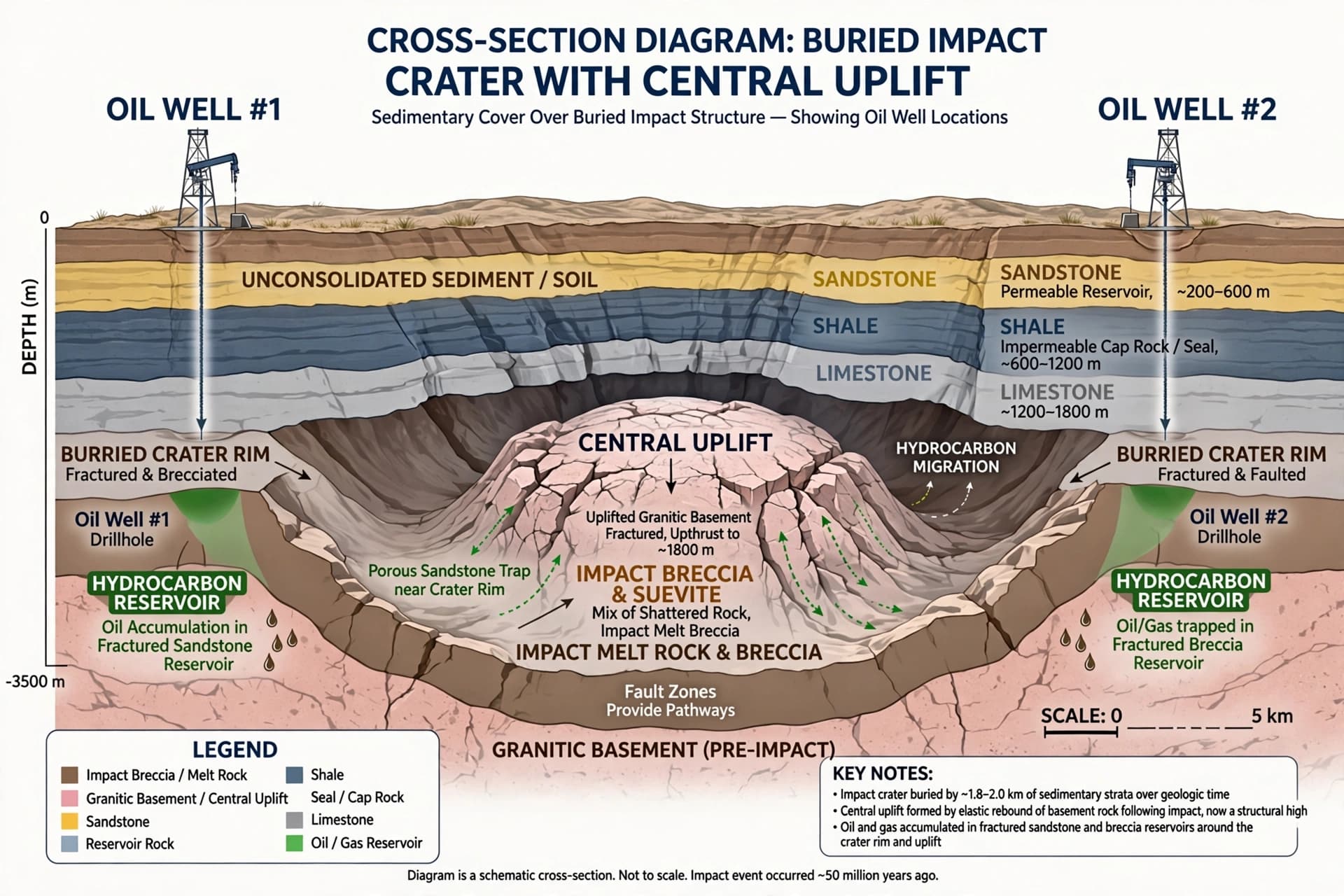
The Ames structure is a complex impact crater with a diameter of roughly 14 to 16 kilometers, hidden beneath sedimentary rock in northern Oklahoma . It was discovered in 1991 by an oil company and has since been studied as part of the Ordovician Meteor Event, a period around 467 million years ago when a shattered asteroid scattered debris across the inner solar system . That event has been linked to the Great Ordovician Biodiversification Event, a time when marine life diversified dramatically .
The new study, published in Meteoritics & Planetary Science, challenges that timeline. Researchers at the University of Texas at Austin dated zircon crystals from the crater's impact-melt rocks using uranium-lead methods, analyzing 37 spots with two independent techniques . The youngest zircons yielded a weighted mean age of approximately 369.7 million years, plus or minus 5.9 million years .
"No matter what technique we used, it was coming back to this younger signal," said lead author Elizabeth Catlos .
If the dating holds, the Ames crater formed during the Late Devonian, nearly 100 million years later than previously believed. That places it squarely within the Frasnian-Famennian mass extinction event, a period around 372 million years ago when vast portions of marine life vanished . The extinction is often attributed to large-scale volcanism, but the new timing raises the possibility that an impact—or a combination of impacts—may have played a role.
The previous dating relied on conodont fossils found in the crater fill. Conodonts were tiny, eel-like creatures whose teeth-like elements are useful for dating ancient rocks. But the new analysis suggests those fossils may have been millions of years old when the meteor struck, swept up in the debris rather than marking the time of impact . "The teeth were likely already millions of years old when the asteroid struck Ames, and likely just got jumbled around in the mix," Catlos explained .
The Ames crater is not alone in its revised age. Several other North American impact structures, including Flynn Creek and Nicholson Lake, also have Devonian dates . If more craters are reclassified from the Ordovician to the Devonian, scientists may need to rethink the chronology of impacts during both periods—and the role those impacts played in shaping life on Earth.
"With this research, we're basically taking a major pawn out of the Ordovician Meteor Event and dumping it into the Frasnian-Famennian event," Catlos said. "This is where this impact belongs" .
The Ames crater is only about 15 kilometers wide—large enough to devastate a region but far too small to drive a global extinction on its own. The Frasnian-Famennian extinction, one of the five largest in Earth's history, killed off roughly 75 percent of marine species . Its primary cause remains debated, with volcanic activity in what is now Siberia a leading candidate. But a well-timed impact, even a regional one, could have added stress to ecosystems already struggling.
For geologists, the lesson is not that one crater solves a mystery but that the timeline itself is being redrawn. The rocks beneath Ames have been read again, and the story they tell has shifted by 100 million years.
AI Image Disclaimer: All visuals associated with this article were created by AI and are illustrative in nature.
Sources: Gizmodo, University of Texas at Austin Jackson School of Geosciences, Meteoritics & Planetary Science, Wiley Online Library, Scinexx
Published by Banx Network. This article is part of the Banx decentralized media programme, powered by the BXE token on the XRP Ledger.