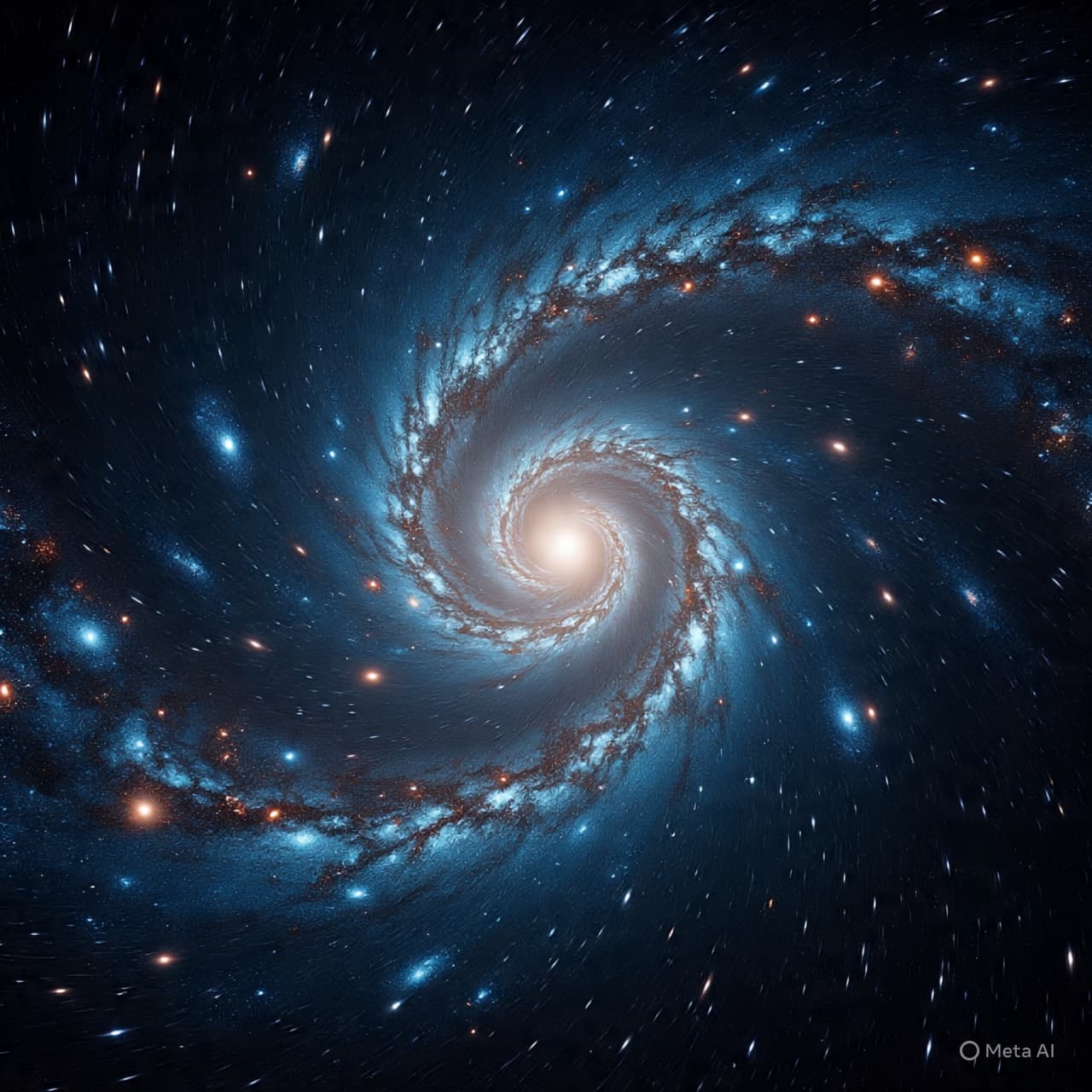
At the heart of our galaxy, where light bends and time seems to hesitate, something appears to be keeping rhythm. Astronomers peering toward the center of the Milky Way have detected a mysterious, repeating signal—an astronomical ticking—emanating from near the supermassive black hole known as . In a region often described as chaotic and extreme, the idea of a steady pulse feels almost poetic.
The Milky Way’s core is a crowded and energetic environment. Clouds of gas swirl at immense speeds. Stars weave intricate orbits under crushing gravitational influence. At the center sits Sagittarius A*, a black hole about four million times the mass of our Sun. It does not shine by itself, yet the matter spiraling around it glows intensely, creating a luminous and turbulent neighborhood.
Researchers report that near this gravitational giant, a recurring signal—described as a rhythmic flicker or periodic burst—has been observed. While black holes are known for variability in brightness, this pattern stands out for its apparent regularity. It suggests that something, perhaps a compact object or structured flow of matter, is orbiting close to the event horizon and producing emissions in a repeating cycle.
Scientists have proposed several possibilities. One explanation is that a small star or dense stellar remnant, such as a neutron star, could be orbiting near Sagittarius A*, generating periodic radiation as it interacts with surrounding material. Another possibility involves hot spots in the accretion disk—regions of superheated gas that circle the black hole and flare at predictable intervals.
The discovery does not imply an imminent cosmic event, nor does it signal instability in our galaxy’s center. Instead, it offers a rare opportunity. Regular signals in such extreme environments can serve as natural clocks, helping astronomers test theories of gravity and black hole physics. In a place where Einstein’s general relativity governs the choreography, even a subtle rhythm becomes scientifically valuable.
Observations from advanced radio and X-ray telescopes have made it possible to detect patterns that would have been invisible just decades ago. The Event Horizon Telescope’s historic image of Sagittarius A* demonstrated how far imaging technology has come. Now, timing analysis adds another layer of insight, revealing dynamic processes unfolding near the black hole’s edge.
The Milky Way’s center has long fascinated scientists because it represents both familiarity and mystery. It is our galaxy’s anchor, yet it behaves in ways that challenge intuitive understanding. A repeating signal, like a faint heartbeat, underscores that even in extreme gravity, there can be structure amid apparent disorder.
Astronomers caution that further observations are needed to confirm the source and stability of the ticking pattern. Repeated monitoring will help determine whether the signal persists and what physical mechanism drives it. For now, the discovery adds a new dimension to our portrait of Sagittarius A*—not just a devourer of matter, but a system capable of rhythm.
The research team plans continued observation using multiwavelength instruments to refine their measurements. No immediate threat or dramatic change to the galaxy has been suggested. Instead, the finding deepens scientific understanding of the environment surrounding the Milky Way’s supermassive black hole, inviting further exploration into one of the universe’s most compelling regions.
AI Image Disclaimer Visuals are created with AI tools and are not real photographs.
Source Check (Credible Media Coverage Found): Reuters BBC News The Guardian Space.com Scientific American
Published by Banx Network. This article is part of the Banx decentralized media programme, powered by the BXE token on the XRP Ledger.