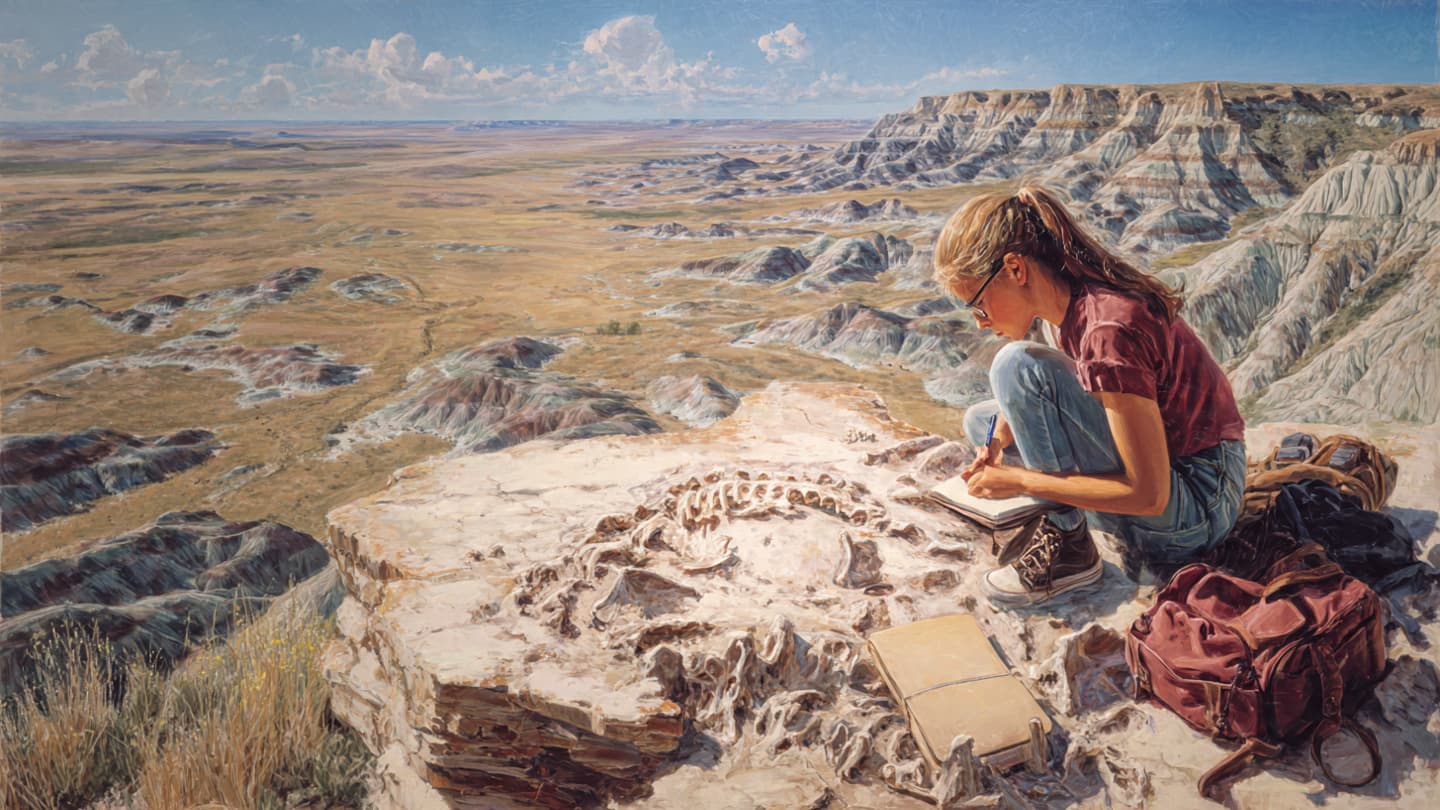
Sometimes the past reveals itself not through grand expeditions or sophisticated machines, but through a moment of curiosity. Beneath layers of rock that have rested undisturbed for millions of years, a remarkable discovery emerged during a geology field trip in Kansas, where a young participant helped uncover the fossil remains of an ancient marine reptile that once swam through a vanished sea.
The discovery was made in western Kansas, a region famous among paleontologists for preserving evidence of the Western Interior Seaway, a vast body of water that divided North America during the Late Cretaceous Period. What is now dry prairie was once covered by warm ocean waters filled with diverse marine life.
Researchers identified the fossil as belonging to a mosasaur, a large marine reptile that dominated ancient seas roughly 85 million years ago. Measuring approximately 15 feet in length, the animal would have been an effective predator, equipped with powerful jaws and streamlined features suited for life in the water.
According to reports from scientists involved in the excavation, the fossil was first noticed by a young participant during a supervised geology outing. The finding quickly attracted attention because portions of the skeleton appeared to be exceptionally well preserved within the surrounding rock.
Kansas has produced many important marine fossils over the decades, including giant fish, ancient turtles, and other mosasaurs. Each discovery contributes to a broader understanding of ecosystems that existed long before modern landscapes took shape.
The fossil will undergo careful preparation and analysis before researchers can determine additional details about the animal's species, age, and possible cause of death. Paleontologists often spend months or even years studying newly recovered specimens.
Beyond its scientific value, the discovery highlights the educational role of field programs that introduce students to geology and paleontology. Such experiences often provide firsthand encounters with scientific investigation and the natural history of Earth.
For many observers, the story serves as a reminder that important discoveries can still emerge from unexpected places. Ancient clues remain hidden beneath familiar ground, waiting for attentive eyes to notice them.
Scientists continue examining the specimen, and further research may reveal additional insights into the marine environment that covered Kansas millions of years ago.
AI Image Disclaimer: This article includes AI-generated illustrations created to visualize the discovery and are not photographs of the actual fossil excavation.
Sources Verified: Live Science, Associated Press, Smithsonian Magazine, University of Kansas research materials
Published by Banx Network. This article is part of the Banx decentralized media programme, powered by the BXE token on the XRP Ledger.