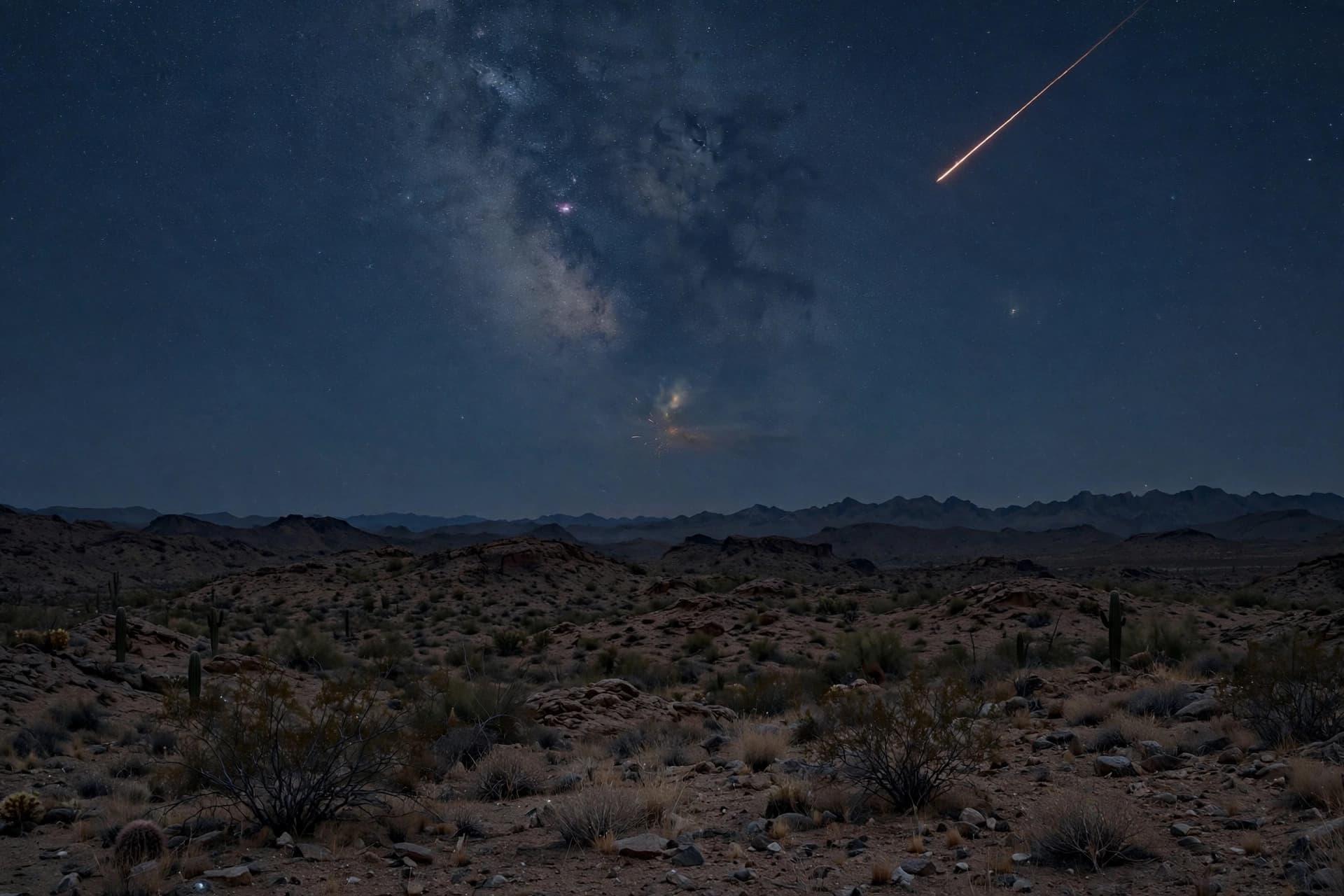
On a still winter evening, when the year’s earliest hours stretch between night and dawn, the sky begins its gentle performance like an unwritten poem glimmering just above the horizon. In these quiet hours of early January, long after the bustle of holiday revelry has softened into memory, the cosmos offers a subtler, tender spectacle: a meeting of stardust and lunar light, visible to all who lift their gaze skyward. This quiet dance between meteor and moon invites us not only to observe but to wonder at the vast tapestry overhead, where time seems both infinite and fleeting.
In the earliest days of 2026, two natural phenomena the Quadrantid meteor shower and the first supermoon of the year will share the same celestial stage. The Quadrantids are one of the year’s first major meteor showers, known for its sharp and intense peak that lasts only a few hours. Normally, these swift streaks of light might flash dozens of times per hour, weaving bright threads across the night’s dark fabric. Yet this year, a bright Wolf Supermoon rises nearly at the same moment, its radiant glow poised to soften the sky and temper the visibility of the fainter meteors. This creates a subtle paradox: the very brightness that makes the moon a compelling beacon in the night may gently veil other sparks of light, urging patience and care from viewers below.
For dedicated skywatchers, the timing is both a challenge and a gift. According to astronomy guides and meteor societies, the peak of this ephemeral shower occurs around the night of January 3–4, 2026, a narrow window when Earth passes through the stream of debris left by a distant space object. Under perfect conditions, the Quadrantids can produce up to hundreds of meteors per hour bright fireballs that dazzle even casual observers. In 2026, however, the full supermoon’s brilliance may reduce visible rates, often to just a handful of meteors per hour, depending on local light conditions.
The moon, in its supermoon phase, will appear slightly larger and more luminous than a typical full moon because it will be near its closest point to Earth. This enhanced glow, dubbed a “supermoon” by skywatchers, often appears more striking near the horizon, where it can shimmer with warmth and depth before climbing higher into the nocturnal dome. Though this glow competes with the faint streaks of meteors, there is a simple invitation here: look not only for flashes of light but for the subtle harmony of sky and story.
To witness these dual displays in the best possible way, enthusiasts suggest finding a dark, open sky away from city lights, and settling in a comfortable spot with an unobstructed view toward the northeast—where the meteors often radiate from the region near familiar star patterns. Let your eyes adjust as the night deepens, and let the slow rise of the supermoon become part of the rhythm of waiting. Even if only the brightest meteors break through the lunar glow, the experience connects us to the gentle pulse of nature’s rhythms.
As the hours pass and the supermoon arcs across the sky, this rare coincidence of spectacle invites reflection: that under the same sky, across continents and cultures, we share moments both fleeting and eternal. These celestial whispers remind us that time, like the night sky, can be both vast and intimate something to watch with calm eyes, even amid light and shadow.
Gentle Closing (Straight News Tone, No Harsh Judgment) In the coming nights, skywatchers in the Northern Hemisphere may find themselves drawn outdoors, binoculars in hand or simply lying back under dark skies. While the supermoon’s glow might make spotting every shooting star challenging, the few bright meteors that do appear will serve as quiet reminders of the intricate dance between Earth and the wider cosmos. Whether seen by seasoned observers or curious observers catching their first glimpse, this celestial pairing offers a gentle, unhurried beginning to the new year.
AI Image Disclaimer (rotated wording) Visuals are created with AI tools and are not real photographs.
credible sources:
LiveNOW from FOX Associated Press (AP News) People.com Astronomy.com (via live news) NBC DFW / PBS News science
Published by Banx Network. This article is part of the Banx decentralized media programme, powered by the BXE token on the XRP Ledger.