There is a particular warning that travels across oceans when a nation's streets erupt in violence over conditions that exist elsewhere too—when the grievances are not foreign or exotic but familiar, and the escalation is not a distant curiosity but a possible preview. In France this week, student protests that began peacefully over overcrowded classrooms, teacher shortages, and crumbling school buildings have spiraled into what the government now describes as "urban violence." Hundreds of schools have been closed. Fires have been set. Teachers have been doused with petrol. Police have made nearly 2,000 arrests in a single day. And observers in the United States, watching from across the Atlantic, are asking whether the same conditions—underfunded schools, frustrated students, a political system that seems unable to respond—could produce a similar result closer to home.
The numbers from France tell a story of rapid escalation. On Thursday alone, police and gendarmes made 1,949 arrests, and 305 officers were injured. More than 400 schools were closed on Friday, with many others shifting to remote learning. The Auvergne-Rhône-Alpes region estimated damages at between €25 million and €30 million . The protests began in the Paris suburbs last week, driven by grievances that are concrete and widely shared: classrooms of thirty-five students, temperatures that reach unbearable levels in summer, inadequate facilities, and a chronic lack of resources. A seventeen-year-old student in Strasbourg, speaking to ABC News, described a building "falling apart," a cafeteria "too small," and "zero budget, zero resources, not enough supervisors" .
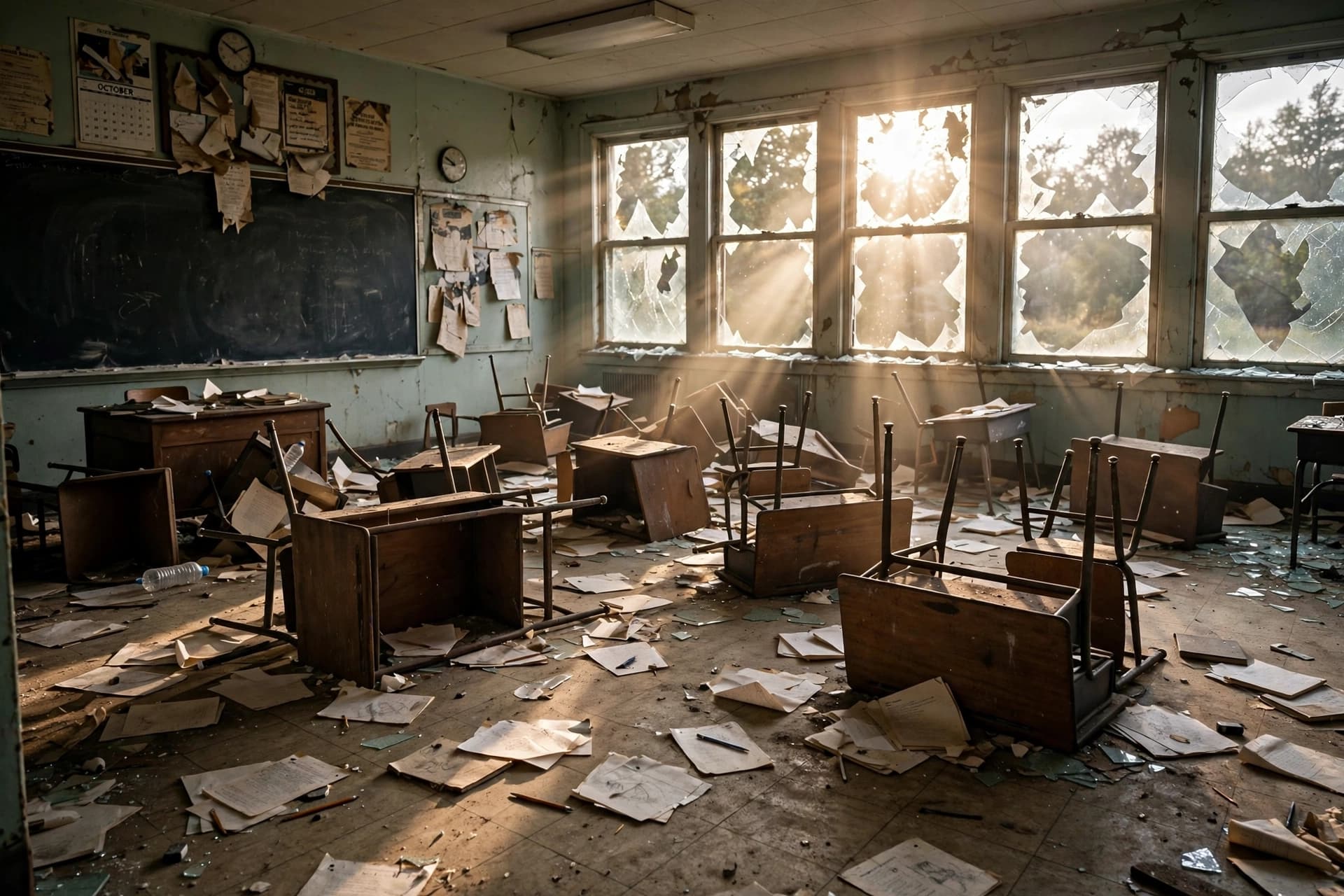
What began as blockades and demonstrations has since transformed. In Marseille, a school principal and his deputy were splashed with petrol. In Nantes, two high schools were set on fire; one will remain closed for a month due to the extent of the damage. In Strasbourg, trams were halted to restrict the movement of rioters. In Toulouse, hundreds of young people flooded tram tracks, toppling trash cans and starting fires. In Lille, protesters destroyed the glass of a bus stop . The government has accused the hard-left party La France Insoumise of orchestrating the violence; the party denies the claim, with Jean-Luc Mélenchon calling for "non-violent methods of struggle" .
For American observers, the French crisis carries a particular resonance. The United States has its own underfunded schools, its own teacher shortages, its own aging infrastructure. It has its own political polarization, its own simmering anger. The difference, so far, is one of degree. But the French experience suggests that when legitimate grievances meet institutional unresponsiveness, the result can be a rapid slide from protest to violence—from blockades to fires, from frustration to destruction. As one commentator described it, France has become "a cautionary tale" for a country that shares many of the same underlying conditions but has not yet seen them produce the same result.
The protests are expected to continue, with a second round of mobilization called for October 6. The government has banned demonstrations near schools nationwide. The schools remain closed, the streets remain tense, and the question that lingers is whether a movement that began with legitimate demands can reclaim its voice from the violence that has come to define it—or whether the violence has become the point, the message, and the only thing anyone will remember.
AI Image Disclaimer: The visual elements in this article were created using AI generation tools and are intended for illustrative purposes only.
Sources: ABC News, Anadolu Ajansı, Radio France, Central News Agency Taiwan, Rti
Published by Banx Network. This article is part of the Banx decentralized media programme, powered by the BXE token on the XRP Ledger.