There are moments when the universe seems to hold up a mirror to its own past. In the quiet darkness between stars, light travels not only across distance, but across time. When astronomers look deep into space, they are not merely observing other worlds; they are glimpsing earlier chapters of cosmic memory. And sometimes, that memory resembles something familiar.
Recently, astronomers have identified a massive stellar bubble surrounding a young Sun-like star—an immense cavity carved into surrounding interstellar material by powerful stellar winds. Reported by outlets including BBC News, Reuters, and Space.com, and discussed within scientific circles contributing to journals such as Nature and Science, the finding offers a rare window into what our own Sun may have looked like in its earliest days.
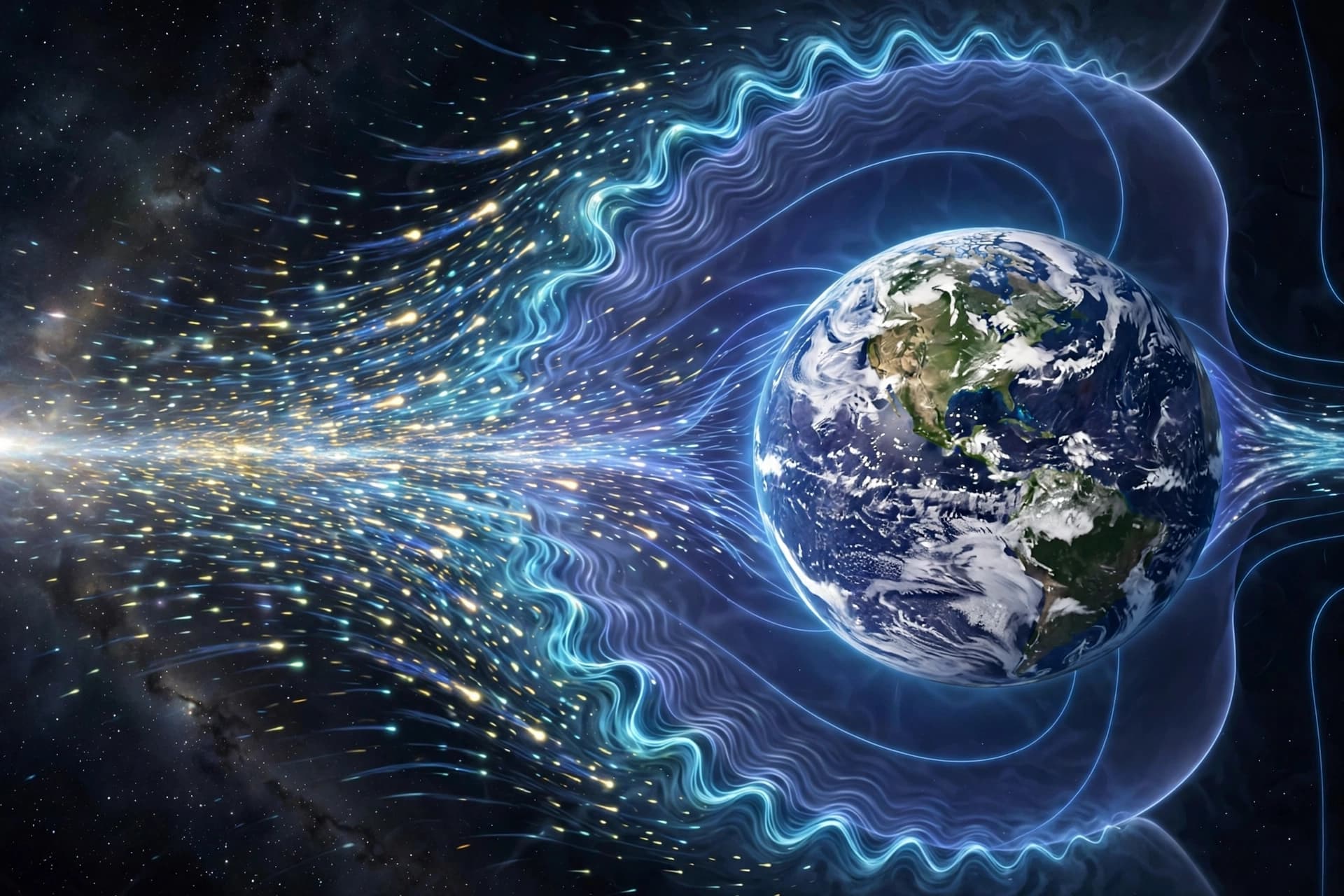
A stellar bubble forms when intense streams of charged particles, known as stellar winds, push outward from a star at high speed. Over time, those winds sweep away gas and dust, hollowing out a cavity in the surrounding molecular cloud. In this case, the bubble is far larger than previously observed around comparable stars, suggesting that youthful Sun-like stars may exert stronger influence on their environments than once thought.
The star at the center of this structure shares key characteristics with the Sun—similar mass, temperature, and composition—but is significantly younger. Where our Sun is approximately 4.6 billion years old, this stellar counterpart is in an earlier developmental stage, still interacting vigorously with the remnants of the cloud from which it formed. Observations indicate that the bubble spans vast distances, potentially shaping the formation of nearby material and influencing any emerging planetary systems.
The discovery carries implications for understanding the early solar system. If the young Sun once generated similarly powerful winds, those outflows may have shaped the distribution of gas and dust in the protoplanetary disk—the swirling material that eventually coalesced into planets. Such winds could have affected how volatiles, including water-bearing compounds, were transported and preserved.
Astronomers used a combination of radio and infrared observations to detect the bubble’s structure. Subtle variations in gas density and emission patterns revealed a hollowed region consistent with sustained stellar wind activity. These techniques allow researchers to map invisible processes that unfold over millions of years.
What makes the finding especially compelling is its scale. Stellar bubbles are not uncommon around massive, short-lived stars. But seeing such a pronounced cavity around a Sun-like star challenges assumptions about the intensity and reach of solar-type stellar winds in youth. It suggests that stars similar to our own may begin life more dynamically than previously modeled.
There is also a broader perspective to consider. Stellar winds play a role not only in shaping planets but in influencing habitability. Powerful outflows can strip atmospheres from young planets—or alternatively, help clear away excess gas that might otherwise prevent stable planetary orbits. Understanding the balance of these forces helps scientists refine models of planetary system evolution.
Researchers emphasize that further observations are needed to determine how typical such large bubbles are among Sun-like stars. If similar structures are found elsewhere, it could signal a revision in how astronomers interpret early solar evolution.
For now, the stellar bubble stands as both structure and story—a reminder that stars are not static points of light but active architects of their surroundings. As monitoring continues, scientists hope to deepen insight into the processes that once shaped our own cosmic neighborhood.
According to research teams cited in recent reports, ongoing surveys with advanced telescopes aim to identify additional young Sun analogues exhibiting similar features. The findings contribute to a growing body of work exploring stellar infancy and the environmental forces that precede planet formation.
AI Image Disclaimer Illustrations were produced with AI and serve as conceptual depictions.
Sources
BBC News Reuters Space.com Nature Science
Published by Banx Network. This article is part of the Banx decentralized media programme, powered by the BXE token on the XRP Ledger.