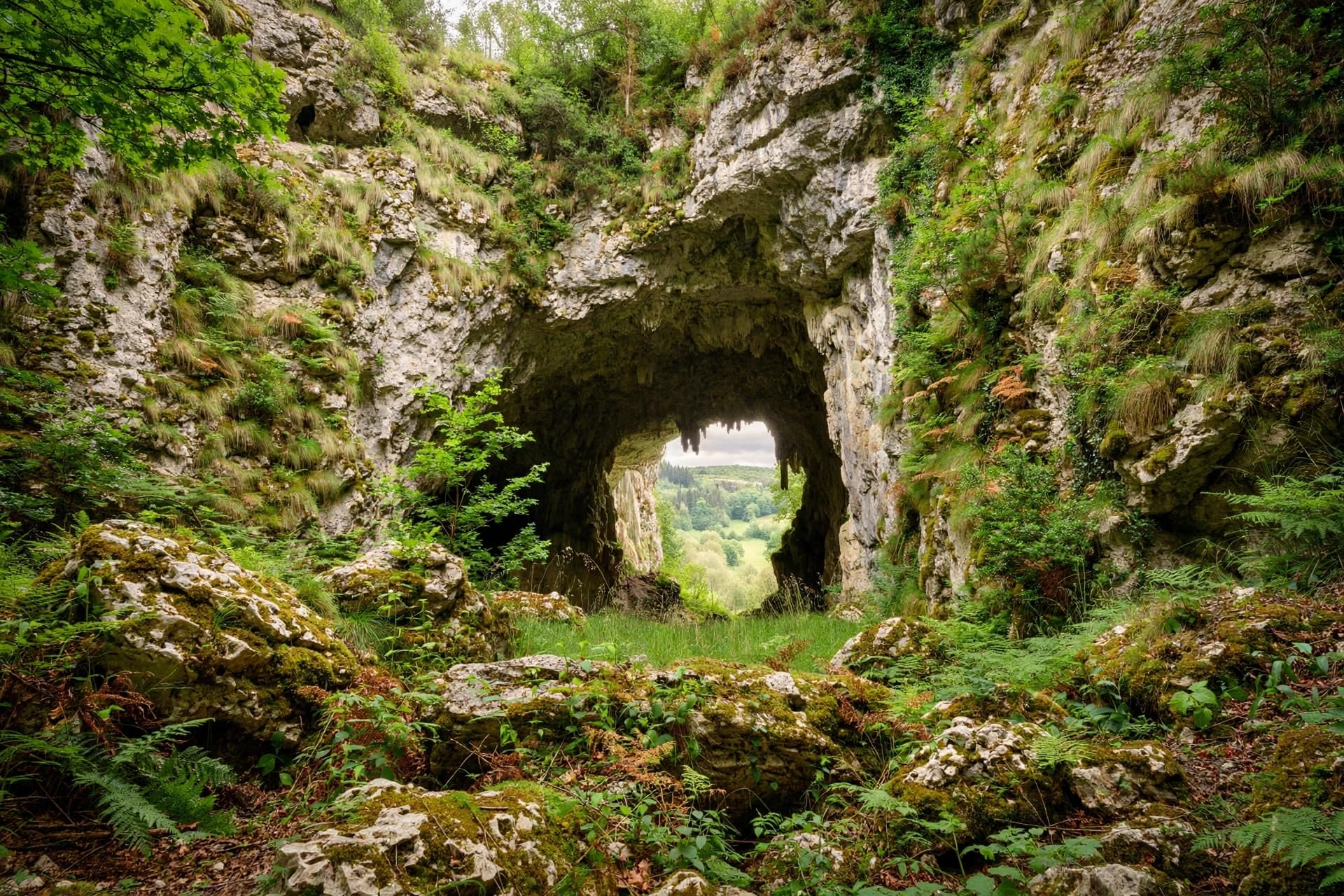
A cave in southwestern France has long been a place of passage. Isturitz Cave, carved into the foothills of the Pyrenees, was occupied off and on for tens of thousands of years—by Neanderthals, by early modern humans, by generations who left behind tools, art, and bones. It sits at a critical threshold between the European continent and the Iberian Peninsula, a doorway through which people and ideas have moved for millennia. A single fragment of bone, recovered from its depths, has now opened a window onto that movement.
Scientists have sequenced the genome of a woman who lived approximately 30,000 years ago, whose remains were found in Isturitz Cave. The DNA revealed something unexpected: she carried a mixture of Western and Eastern European ancestry, evidence of gene flow between populations that researchers had previously believed were largely isolated from one another during the Gravettian period . The finding, published in Science Advances, challenges assumptions about how Stone Age communities were connected across the continent.
The Gravettian culture spread across Europe between roughly 34,000 and 25,000 years ago, shortly after Neanderthals disappeared. Its people left behind portable art—Venus figurines, carved ivory, painted surfaces—that speaks to a shared symbolic world. But ancient DNA from this period has been scarce, recovered from only about two dozen skeletons. From that limited sample, experts had concluded that Western and Eastern groups lived largely separate lives .
The woman from Isturitz told a different story. Her genome was most similar to previously known Western European populations, but it carried an unmistakable signature of Eastern and Central European ancestry. The researchers dated this "pulse" of gene flow to approximately 31,500 to 32,500 years ago, suggesting that people moved westward during the Gravettian, carrying their genes with them . "Our results show that eastern and western European populations were not as genetically isolated as previously assumed," said Pere Gelabert, the study's first author and an evolutionary anthropologist at the University of Vienna .
Two other genomes sequenced for the study, from individuals in Spain and Italy, also revealed close biological connections to Western European groups. All three had dark skin, dark hair, and dark eyes. Notably, none had parents who were closely related to each other—a detail suggesting that these populations actively avoided inbreeding, a social behavior with implications for how communities were organized and how they understood kinship .
The cave itself may have been more than a shelter. Its position at the crossing between continental Europe and Iberia made it a natural gathering point, a place where people passed through and perhaps stayed. The DNA evidence supports archaeological theories that Isturitz served as a cultural and biological hub for tens of thousands of years, a node in a network that stretched farther than anyone had imagined .
What the bone reveals is not a story of isolated tribes but of movement and mixture. People traveled. They met. They had children together. The Stone Age, it seems, was more connected than the silence of millennia has allowed us to see. A woman who died 30,000 years ago, her bones settled into the floor of a cave, carried within her the evidence of a world that was already, in its own way, global.
The images in this article are AI-generated and are not photographs of the cave or the remains described.
Sources: Live Science, Science Advances, University of Vienna
Published by Banx Network. This article is part of the Banx decentralized media programme, powered by the BXE token on the XRP Ledger.