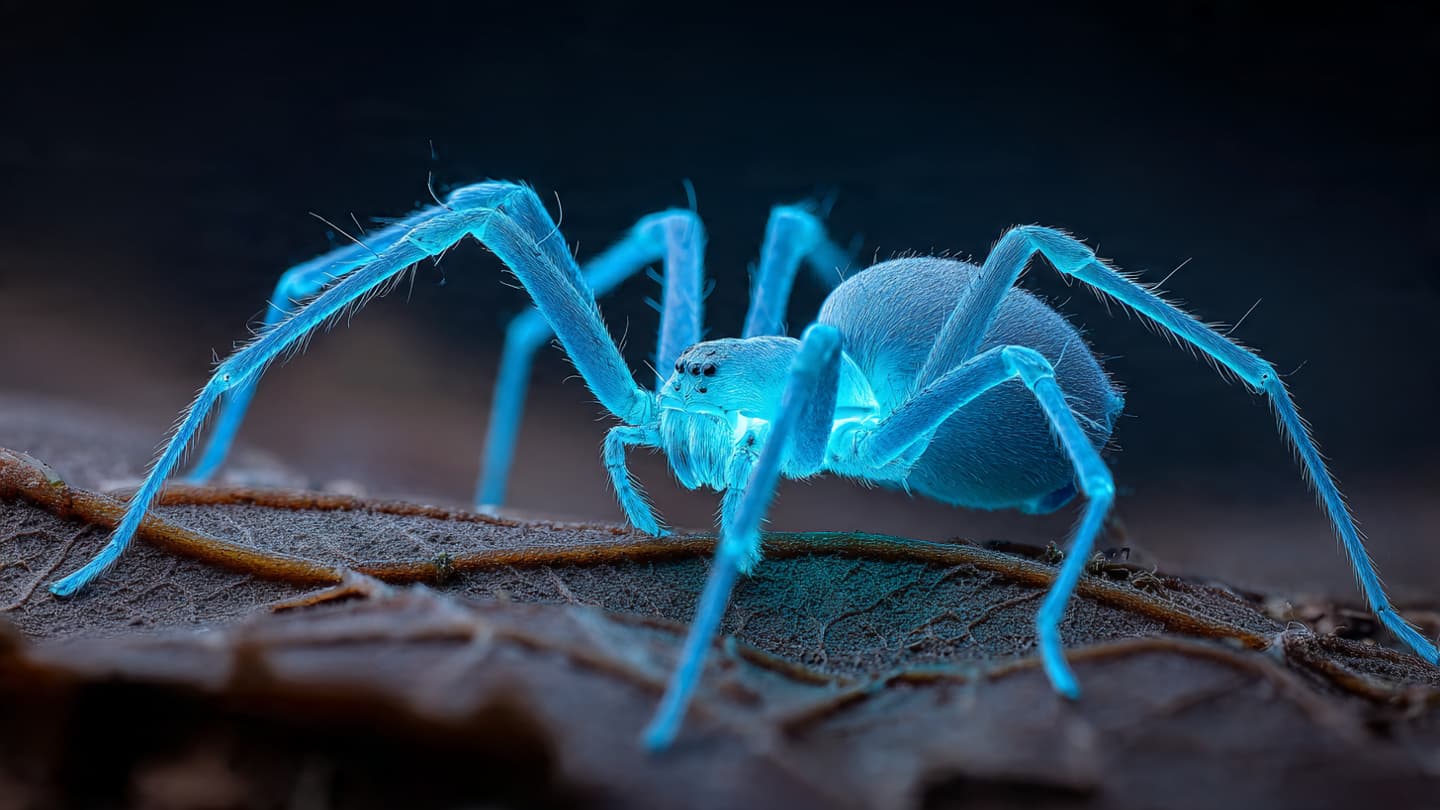
Science often advances through careful observation, but occasionally a discovery arrives with a touch of visual wonder. Such was the case when researchers studying biodiversity in Angola documented a spider that emits a striking blue fluorescence under ultraviolet light.
The unusual arachnid was identified during a scientific expedition in the country's highland ecosystems. While fluorescence is not entirely unknown in nature, the vivid appearance of the spider immediately attracted attention among researchers examining local wildlife.
Fluorescence occurs when certain substances absorb light at one wavelength and emit it at another. In many organisms, this phenomenon remains poorly understood, particularly among species that have received limited scientific study.
Scientists believe the discovery may offer insights into evolutionary adaptation and biological signaling. Whether the fluorescence serves a practical function or represents a byproduct of biological processes remains an area of ongoing investigation.
The spider belongs to a broader group of arthropods that continue to surprise researchers with their diversity. Although spiders are among the most studied invertebrates, new species and unusual traits are still being documented around the world.
Researchers emphasize that discoveries like this underscore the value of biodiversity surveys. Small organisms are often overlooked despite playing essential roles within ecological systems, including pest control and nutrient cycling.
The finding also highlights how advanced imaging techniques and specialized equipment can reveal characteristics that are invisible under normal conditions. Modern field science increasingly combines traditional observation with technological tools.
Public fascination with the fluorescent spider has extended beyond scientific circles. Images of the glowing arachnid quickly captured international attention, illustrating how unusual discoveries can inspire broader interest in biology and conservation.
As further studies continue, scientists hope to learn more about the spider's behavior, habitat, and evolutionary history. For now, the glowing blue creature stands as another reminder that the natural world remains filled with unexpected phenomena waiting to be understood.
AI Image Disclaimer: The visuals associated with this article are AI-generated representations inspired by scientific observations and are not actual research photographs.
Source Verification Check Verified sources:
Reuters New York Post National Geographic Smithsonian Magazine
Published by Banx Network. This article is part of the Banx decentralized media programme, powered by the BXE token on the XRP Ledger.