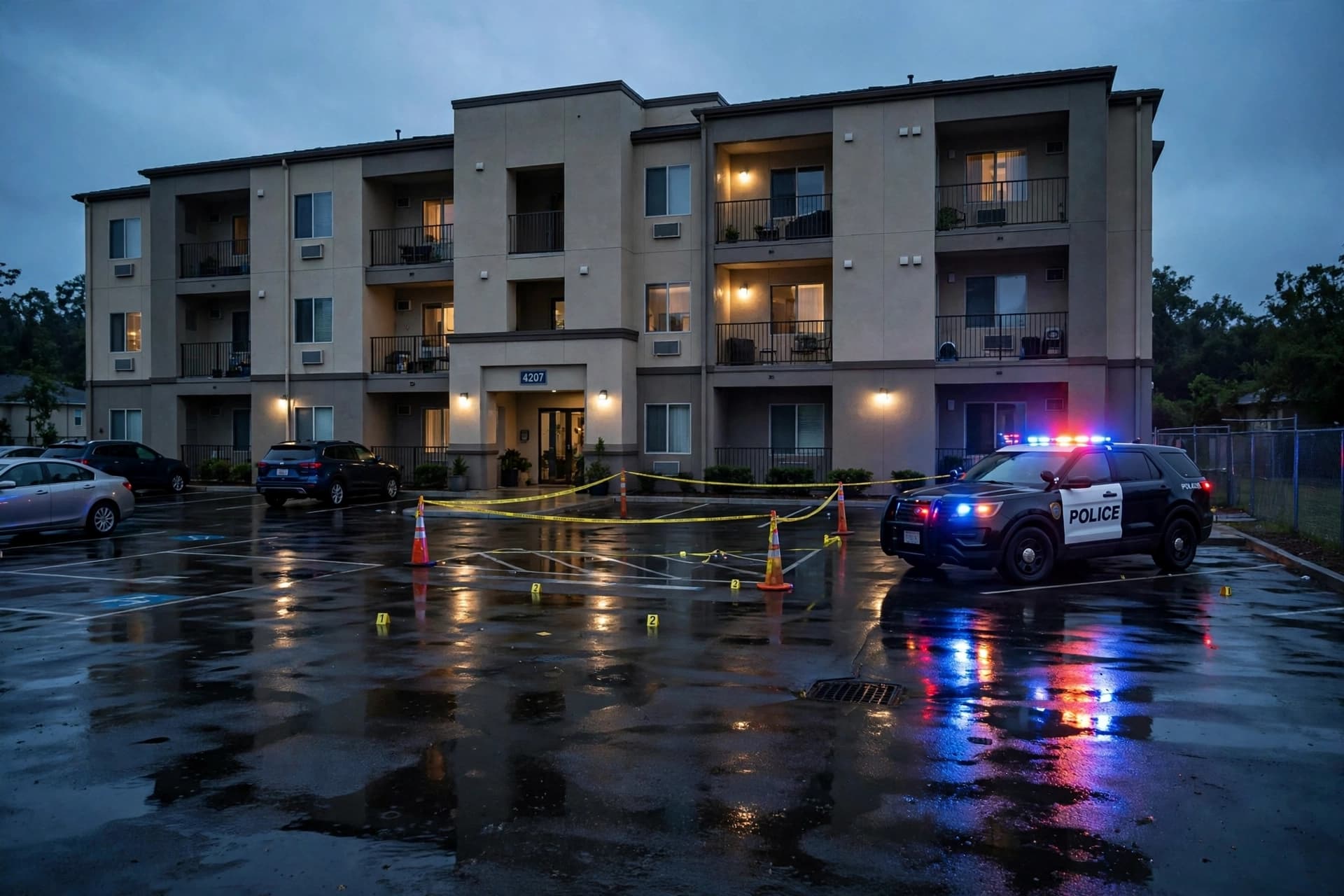
There is a kind of death that arrives with an unsettling sense of closure—not the closure of answers, but the closure of questions. Shortly after 4 p.m. on Saturday, Toronto police responded to a call at an apartment parking lot near Bathurst Street and Finch Avenue West. They found an adult woman with obvious stab wounds, her injuries life-threatening. She was taken to the hospital and later pronounced dead. Police have not released her name, nor have they described what passed between her and the other person at the scene. They said only one thing: the two knew each other, there was no other suspect outstanding, and the public was not at risk.
Cases like this carry a particular silence. Not because information is scarce, but because what information points to is too private. A relationship, whatever shape it took, reached an irreversible endpoint on a Saturday afternoon. Police did not describe the scene, the argument, or how the knife came to be there. They recorded only the outcome: one person dead, one person assessed and not transported, and the homicide unit taking over the investigation.
A parking lot is a strange place to die. It belongs neither fully to the public nor entirely to the private; it is a transitional space where people move from their cars toward their homes, from the outside world toward the life inside. At just past four o'clock that afternoon, someone ended another person's life there. In the apartment buildings around them, people may have been doing ordinary Saturday things, until the sirens broke the ordinary.
A Toronto police spokesperson told CP24 that the victim and the suspect were known to each other, though the exact relationship was not immediately clear. That sentence holds much that goes unsaid. In cases of domestic or intimate-partner violence, such phrasing is often official language's simplification of a deeply complex human relationship. It does not explain motive, assign blame, or narrate what happened. It states only a fact: they were not strangers.
Police were not looking for other suspects. That usually means one of two things: either a suspect is already in custody, or the suspect is the person assessed at the scene and not taken to the hospital. Police did not elaborate. The homicide unit's involvement means the investigation has moved from the initial emergency response into a longer phase of evidence gathering and interviews. That process can take weeks, months, or longer.
For those living near Bathurst and Finch, the weekend left a mark. Not the kind that changes a city's face, but something quieter: the knowledge that an ordinary parking lot had been the site of something extraordinary, that a woman's life ended there, and that who she was and what she endured may never be fully known to the public.
The investigation continues. No charges have been announced, and no further details have been released. The woman is dead, and the person who took her life—whoever that is—remains in this world, carrying the memory of that Saturday afternoon. The law will try to make sense of it, in its language, its procedures, its rhythms. But some things lie beyond the law's reach: the void left by a life's disappearance, and the world that those who knew her must now face, no longer whole.
Image Disclaimer: The visual accompanying this article was generated by artificial intelligence and is not a photograph of the actual scene.
Sources: CP24, CBC News, Toronto Police Service
Published by Banx Network. This article is part of the Banx decentralized media programme, powered by the BXE token on the XRP Ledger.