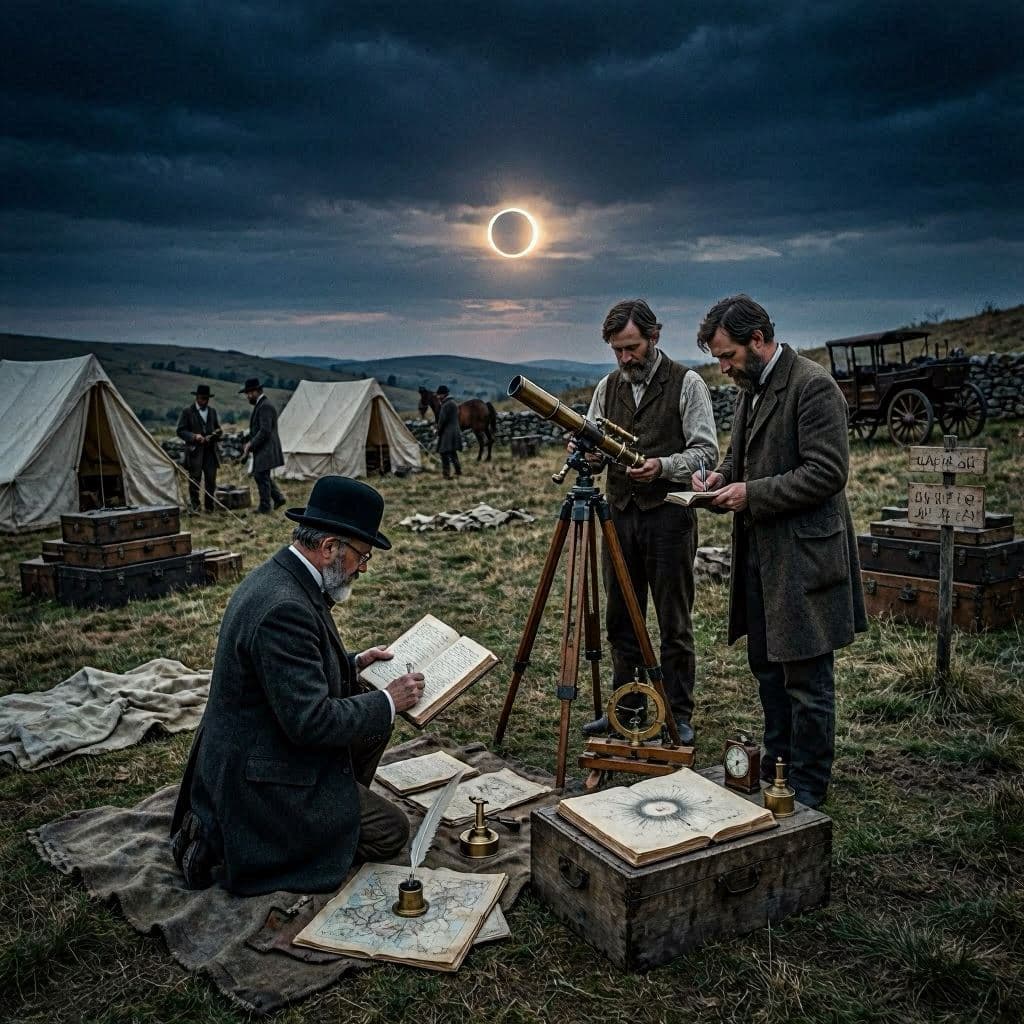
History is often preserved in unexpected places. Ancient writings, careful observations, and handwritten records can become valuable scientific resources centuries after they were first created. What once served as a simple account of the sky may now help answer questions about the Earth itself.
Researchers have published a study analyzing documented solar eclipse observations from the sixteenth century to better understand long-term changes in Earth's rotation. Historical astronomical records continue providing valuable information that complements modern scientific measurements.
Solar eclipses have been carefully observed by civilizations for centuries. Because the timing and location of these events can be calculated with remarkable precision, historical records offer scientists an opportunity to compare ancient observations with present-day models.
The research examines how slight differences between predicted and recorded eclipse observations may reveal gradual variations in Earth's rotational speed. These tiny changes occur naturally over long periods due to interactions involving the Moon, oceans, and the Earth's internal structure.
Scientists emphasize that Earth's rotation is not perfectly constant. Although daily changes are extremely small, precise measurements remain important for astronomy, satellite navigation, and the maintenance of international timekeeping systems.
Historical documents from multiple regions have become increasingly valuable as researchers digitize archives and compare records from different cultures. Modern technology allows these centuries-old observations to contribute meaningfully to contemporary scientific analysis.
The study also demonstrates how history and science often complement one another. Records originally created for cultural, religious, or observational purposes can later become essential evidence for entirely different scientific questions.
Astronomers continue integrating historical observations with satellite data, atomic clocks, and advanced computational models. This combination provides a more complete understanding of Earth's long-term physical behavior.
The research illustrates that scientific discovery sometimes begins by revisiting the past. Even centuries-old observations continue offering insights into the dynamic planet that humanity calls home.
AI Image Disclaimer: The accompanying image was generated using AI to illustrate the historical scientific research described in this article.
Source Verification Check: arXiv, Nature Astronomy, Royal Astronomical Society, European Space Agency
Published by Banx Network. This article is part of the Banx decentralized media programme, powered by the BXE token on the XRP Ledger.