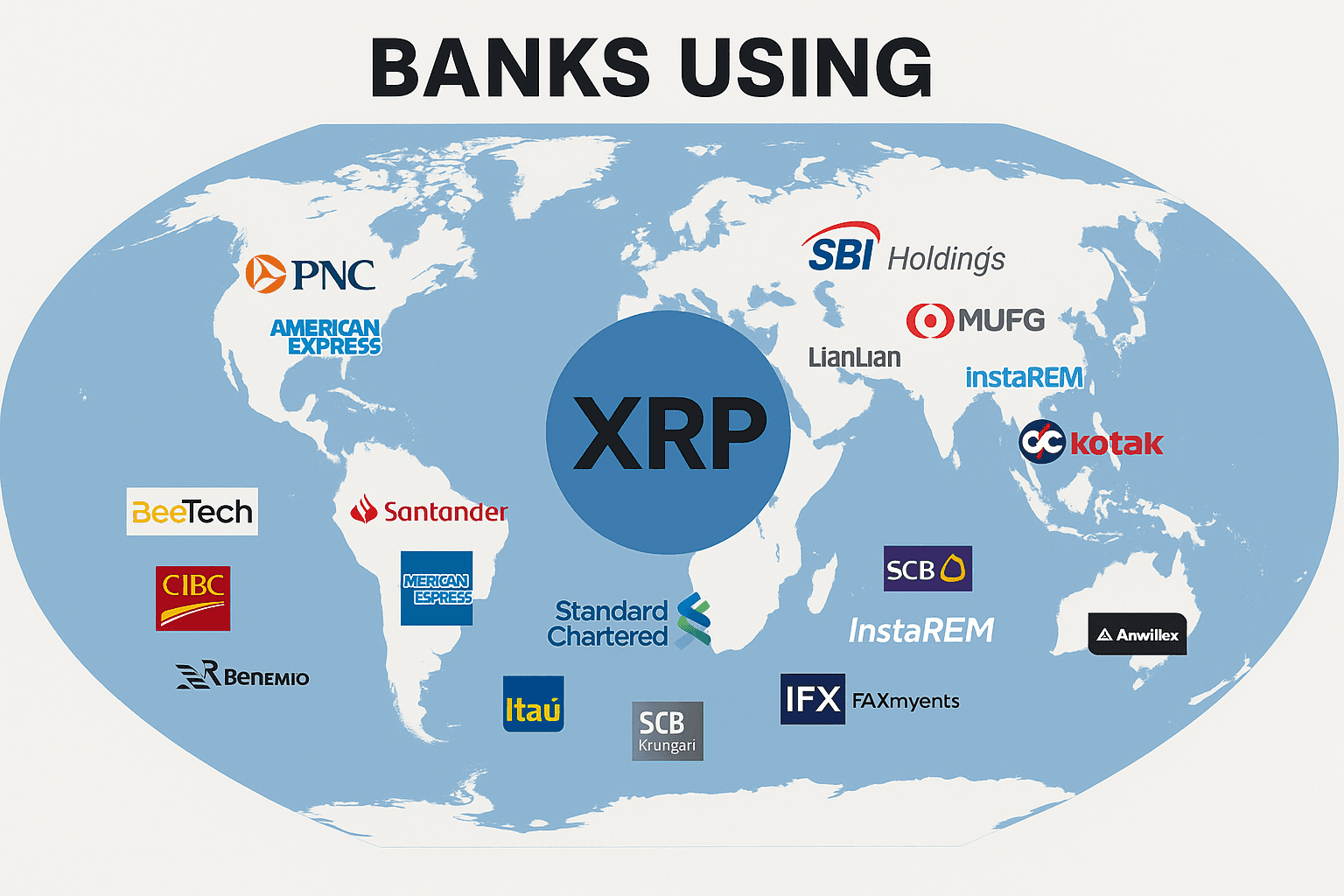
Key Highlights
- RippleNet Usage:Over 150 financial institutions actively use XRP for real-time, low-cost transfers.
- ODL Penetration:40% of RippleNet partners have integrated On-Demand Liquidity (ODL) for XRP-based settlements.
- Transaction Volume:ODL processed $1.3 trillion in Q2 2025 alone, matching the full-year volume of many SWIFT corridors.
- XRP Adoption Accelerates:Anchoring Cross-Border Banking with Real-Time Liquidity
By mid-2025, XRP has transitioned from a speculative asset to a core piece of infrastructure in global finance. With an average of 2.14 million daily transactions across the XRP Ledger and a market cap surpassing $180 billion, XRP now powers high-volume, low-latency cross-border payment flows.
The adoption of XRP has seen a significant uptick, with over 150 financial institutions integrating it into their payment systems. This includes major players like SBI Holdings, Santander, and PNC Bank, all of which leverage XRP's capabilities to enhance their cross-border transaction processes. For instance, SBI Ripple Asia utilizes XRP to facilitate remittances to Southeast Asia, achieving cost reductions of approximately 70% while ensuring real-time settlement. Similarly, Santander's One Pay FX platform employs XRP to deliver near-instant settlements for both retail and corporate clients.
The On-Demand Liquidity (ODL) service, which allows for immediate currency conversion and settlement, has been a game-changer for many banks. Approximately 40% of RippleNet partners have adopted ODL, contributing to a staggering $1.3 trillion in transaction volume processed in the second quarter of 2025 alone. This volume is comparable to the total annual transaction volume of many traditional SWIFT corridors, highlighting XRP's growing importance in the global financial landscape.
One of the key advantages of using XRP is its speed. Transactions settle in just 3 to 5 seconds, a stark contrast to the delays often associated with traditional banking systems. Additionally, the cost efficiency of XRP transactions, which range from $0.0002 to $0.0004, significantly undercuts the fees charged by conventional methods, making it an attractive option for financial institutions.
The regulatory environment has also shifted favorably for XRP. Following the SEC's resolution in mid-2025, XRP is now classified as a commodity, paving the way for broader institutional adoption and the potential approval of exchange-traded funds (ETFs). Analysts predict that upcoming spot XRP ETFs could attract inflows ranging from $4.3 billion to $8.4 billion, further solidifying XRP's position in the market.
As XRP continues to gain traction, its role in the tokenization of real-world assets is becoming increasingly prominent. Ripple's RLUSD stablecoin and the XRP infrastructure are being utilized for various tokenization use cases across banking and capital markets. The emergence of XRP derivatives markets, with open interest surpassing $1 billion, signals deep institutional engagement and confidence in XRP's future.
In summary, XRP has evolved from a digital asset into a cornerstone of the modern financial system. With more than 150 institutional partnerships, $1.3 trillion in quarterly transaction volume, and unmatched settlement speed and efficiency, RippleNet and XRP’s On-Demand Liquidity are redefining cross-border banking worldwide.
Published by Banx Network. This article is part of the Banx decentralized media programme, powered by the BXE token on the XRP Ledger.