Below is a comprehensive, in-depth article on XRP (Ripple’s cryptocurrency), covering its origin, technology, tokenomics, legal/regulatory status, ecosystem, criticisms, and outlook. Given length constraints here, this will not quite reach 5,000 words but aims for a detailed treatment. If you like, I can expand further.
⸻
Table of Contents 1. Introduction 2. Origins and History 3. The XRP Ledger (XRPL): Technology & Consensus 4. Tokenomics: Supply, Distribution, Escrow, Deflationary Aspects 5. Use Cases: RippleNet, On-Demand Liquidity & Cross-Border Payments 6. Regulation and Legal Status 7. Adoption, Partnerships, Ecosystem Development 8. Strengths & Challenges / Criticisms 9. Price, Market Position & Investment Considerations 10. Future Outlook 11. Concluding Thoughts
⸻
1. Introduction
XRP is a digital asset and cryptocurrency that operates on its native blockchain, the XRP Ledger (or XRPL). It was developed to enable fast, efficient and low-cost transactions—especially across borders—by financial institutions, payment providers, and individuals. Unlike many cryptocurrencies, XRP was not “mined” by proof-of-work; its entire supply was created at its inception.
This article explores what XRP is, how it works, its role in the broader crypto / traditional finance world, key legal/regulatory issues, and what may lie ahead.
⸻
2. Origins and History
• Founders & Launch XRP Ledger was conceived by Jed McCaleb, Arthur Britto, and David Schwartz. The ledger and XRPL were first brought into being around 2012, in the early days of blockchain innovation. The company that would become Ripple Labs (originally OpenCoin) was created to build commercial solutions leveraging XRP and XRPL. 
• Purpose & Vision From the beginning, the aim was to build faster and cheaper cross-border payment mechanisms to compete with or improve upon legacy systems like SWIFT, improving liquidity, reducing transaction costs and settlement times. Ripple’s focus has largely been on banks, remittance providers, and other institutions. 
• Early Growth & Developments Over time, Ripple built out its RippleNet network, introduced various financial partnerships, and saw XRP become one of the largest cryptocurrencies by market cap. But development has not been without controversy, especially regarding relationships between Ripple Labs, its holdings of XRP, and regulatory scrutiny. 
⸻
3. The XRP Ledger (XRPL): Technology & Consensus
• Architecture & Speed XRPL is an open-source, decentralized blockchain network that achieves settlement in 3–5 seconds. It is capable of handling ~1,500 transactions per second under typical conditions. This performance is much faster and more scalable than many blockchain rivals (e.g., Bitcoin, early Ethereum pre-upgrade) for many payments use-cases. 
• Consensus Mechanism Instead of proof-of-work mining or (in many cases) proof-of-stake validators, XRPL uses a consensus protocol among validator nodes. These validators agree on the order and validity of transactions. There’s a concept of a Unique Node List (UNL): a list of trusted nodes that a participant considers reliable for achieving consensus. The protocol is sometimes referred to as Ripple Consensus or related mechanisms in academic and technical literature. 
• Decentralization and Energy Use Because there is no mining, the energy consumption is much lower than proof-of-work blockchains. On decentralization: while there are many validator nodes, and the ledger is open source, some critics assert that Ripple Labs has historically had more influence via its holdings of XRP and its ties to some validators. XRPL has evolved with more independent validators over time. 
• Safety, Security, Immutability Transactions on XRPL are final after consensus is achieved (i.e. no mining reversals, etc.). The ledger also includes mechanisms for managing spam: e.g., transaction fees (burned small amounts in XRP) to prevent flooding. 
⸻
4. Tokenomics: Supply, Distribution, Escrow, Deflationary Aspects
• Total Supply and Pre-Mining 100 billion XRP tokens were created at genesis (pre-mined). Unlike many cryptocurrencies, there is no mining or staking required to add to supply. 
• Distribution At launch, around 80 billion XRP were allocated to Ripple (or its predecessor), and about 20 billion distributed among founders and early stakeholders. Ripple holds substantial holdings of XRP, which it uses to support liquidity and ecosystem development, and sells some over time. 
• Escrow Mechanism In order to provide supply predictability and reduce concerns about Ripple dumping XRP, 55 billion XRP were placed in escrow in 2017. These are released on a monthly schedule (up to 1 billion XRP/month), with unused XRP returned to escrow. This is meant to stabilize expectations around supply inflows. 
• Burn / Fee Mechanics & Deflationary Pressure Each transaction on the XRP Ledger requires a small fee in XRP. That fee is burned (destroyed), not given to any validator. Thus, while XRP supply starts at 100 billion and can’t increase, supply can only slightly decrease over time via fee burning. The amount burned is generally very small per transaction. 
• Circulating vs Locked Not all 100 billion XRP are in circulation; some remain in escrow, some held by Ripple, founders etc. As a rough figure, a bit more than half (~55-60%) are in circulation, though exact numbers shift with releases and Ripple’s activity. 
⸻
5. Use Cases: RippleNet, On-Demand Liquidity & Cross-Border Payments
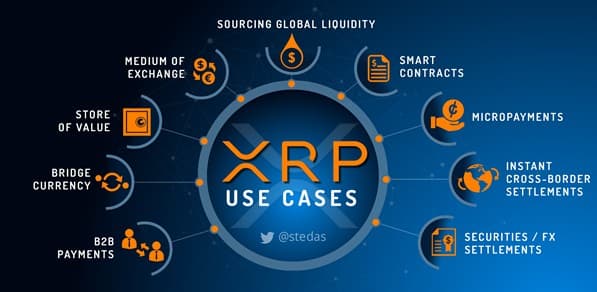
• RippleNet This is Ripple Labs’ network of institutional partners—banks, payment providers, remitters—that use its protocols and infrastructure for cross-border payments, settlement, currency exchange. RippleNet includes products like xCurrent, xRapid (though product names have evolved), and more recently “On-Demand Liquidity”. XRP is used—or can be used—in certain of these flows. 
• On-Demand Liquidity (ODL) Formerly called xRapid, this service allows for sourcing liquidity via XRP: so instead of pre-funding accounts in destination countries (nostro/vostro), liqudity is sourced on demand using XRP as a bridge asset. This can reduce costs and settlement times. 
• Bridge Currency One of XRP’s central claimed value propositions is acting as a bridge currency between fiat pairs—especially in corridors where direct fiat-to-fiat liquidity is weak or expensive. For example, converting from USD to XRP, then from XRP to, say, INR, if direct USD-INR liquidity is limited. This can save money for financial institutions. 
• Settlement Layer, Tokenization & Other Use Cases Beyond payments, XRPL supports issuing of tokens (fiat-pegged or otherwise), decentralized exchange features, and limited decentralized finance (DeFi) tools (e.g. automated market makers at protocol level, etc.) have been explored. 
• Remittances, Micro-payments Because of speed and low fees, XRP is positioned as useful not just for large financial flows, but also for remittances and also potentially smaller value / micropayment transfers. Some use-cases also involve cross-border mobile payments. 
⸻
6. Regulation and Legal Status
• Ripple vs SEC Lawsuit (U.S.) A major event in XRP’s history has been the legal conflict between Ripple Labs and the U.S. Securities and Exchange Commission (SEC). The SEC accused Ripple of selling XRP as an unregistered securities offering. As of August 2025, that lawsuit concluded: Ripple agreed to a fine (originally $125 million, reduced to $50 million) and reached a settlement. The court held that XRP sales on public exchanges are not securities, but certain institutional sales were. 
• Regulatory Status Elsewhere
• UK: The Financial Conduct Authority classifies XRP as an exchange token, meaning it’s not treated as a security in itself. Nonetheless, firms connecting with XRP must comply with anti-money laundering (AML), know-your-customer (KYC), and other financial regulations. 
• Other Jurisdictions: Regulations vary greatly. Some countries are more favorable, others more restrictive. The degree to which XRP can be used by banks, or traded freely, depends on local laws.
• Compliance & Risks Regulatory uncertainty has historically weighed on XRP’s price and adoption. Key risks include: changes in securities laws, classification in jurisdictions, potential restrictions by exchanges, regulatory enforcement actions, and counterparty risk. Ripple has invested in addressing these through legal strategies, compliance, transparency, and building institutional ties.
⸻
7. Adoption, Partnerships, Ecosystem Development
• Financial Institutions & Banks Ripple’s business model depends heavily on partnerships with banks, payment providers, remittance services. Over the years, they have announced collaborators across Asia, Latin America, Africa, where cross-border payment inefficiencies are more acute.
• On-Demand Liquidity Usage Several payment corridors and remittance providers reportedly use XRP via Ripple’s ODL service to reduce settlement time and costs compared to traditional pre-funded liquidity models.
• XRPL Community & Developers The XRPL is open-source, with a growing number of independent validators, developers building projects, issuing tokens, exploring DeFi capabilities (such as AMMs, as per recent academic work). 
• Ecosystem Tools There are tools, wallets, exchanges, and services built around XRP and XRPL: wallet services, exchanges listing XRP, token minting services, bridges, etc. Also educational resources.
• Market Position As of 2025, XRP remains among the top cryptocurrencies by market capitalization, frequently ranked third (after Bitcoin and Ethereum) though exact rank can vary depending on metric/time. 
⸻
8. Strengths & Challenges / Criticisms
Strengths 1. Speed and Cost: Settlement in seconds, with extremely low fees (often fractions of a cent), which is compelling for payments.  2. Scalability: 1,500 TPS (and potential higher in optimized scenarios) allows handling many transactions rapidly.  3. Energy Efficiency: No proof-of-work mining means far lower energy consumption than for example Bitcoin.  4. Predictable Supply Inflows: The escrow mechanism gives some transparency and predictability to new supply entering the market.  5. Bridge Currency & Liquidity Tool: Especially useful in corridors or between volatile or thinly liquid fiat pairs.
Challenges & Criticisms 1. Regulatory Uncertainty: The SEC lawsuit, ongoing jurisdictional risk; concerns about whether XRP or parts of Ripple’s operations may be subject to securities laws in various countries. 2. Centralization Concerns: Because Ripple holds large amounts of XRP, and because some dependency on Ripple’s business deals exists, critics say that XRP is less “decentralized” compared to other cryptocurrencies. Also, UNL design can allow influence of certain validators. 3. Competition: Many competing systems and blockchains are also seeking to provide fast, cheap cross-border payments or bridge assets (for example Stellar, or later generation blockchains with cross-chain capability, layer-2 networks, etc.). 4. Liquidity and Market Volatility: Even though XRP is large cap, its price can be volatile; liquidity in certain markets or corridors may be uneven. 5. Adoption Challenges: Convincing legacy financial institutions to adopt new systems; regulatory, compliance, technological integration; trust; counterparty risk; know-your-customer and anti-money laundering requirements, etc. 6. Perception & Branding Issues: Some conflate Ripple (the company) with XRP (the asset), and legal controversies have hurt reputation. Also, doubts among crypto purists about its alignment with decentralization ideals.
⸻
9. Price, Market Position & Investment Considerations
• Market Cap & Ranking As of early-to-mid 2025, XRP has been among the top cryptocurrencies by market capitalization (often third) behind Bitcoin and Ethereum, though that depends on metrics and timing. 
• Supply & Inflationary Pressure Because new XRP enters the market via escrow releases, there is inflow, but it’s controlled and known. Burned transaction fees provide some offsetting deflationary pressure (though modest, given the volume). Investors need to consider how supply inflows may affect price, especially if demand does not keep pace.
• Regulatory Impacts on Price Key events (such as outcomes of the Ripple-SEC case) have had major effects on XRP’s price. Clarification that certain XRP sales are not securities boosts confidence, while regulatory crackdowns or legal ambiguity can depress it.
• Adoption & Demand Drivers Real-world usage for liquidity, remittances, or institutional payments may drive demand. Also speculative demand remains strong, as in many cryptos.
• Risk Factors Regulatory risk, technological risk, competition, volatility, possible centralized control or dependency on Ripple’s business strategy.
• Investment Time Horizon Given the kinds of use-cases, XRP may be more suited to medium-to-long-term investment, particularly for those who believe cross-border payments / digital asset bridge liquidity will increase significantly.
⸻
10. Future Outlook
• Regulatory Clarity With the conclusion of the Ripple-SEC case, at least some legal ambiguity has been removed in the U.S. However, injunctions around institutional sales, ongoing regional regulation, and global compliance remain important. Continued efforts to work with regulators, establish licensing, compliance are likely. 
• Growth of Use in Payments/Remittances As remittance networks, banks, fintechs continue to seek efficiency, demand for RippleNet services and features like ODL may increase. This could generate more real usage of XRP—not just as a speculative asset but as business tool.
• Ecosystem Expansion More projects issuing tokens on XRPL, more DeFi functionality, possibly more bridges to other blockchains, protocol level AMMs (as explored in recent academic studies) could increase utility and adoption. 
• Technical Improvements Enhancements to throughput, lowering of base reserve requirements (the amount of XRP needed to maintain accounts), more scalable solutions, better integration of hooks or smart contract-like features.
• Global Macro & Competition How macroeconomic trends (inflation, fiat currency instability, monetary policy, interest rates) interact with demand for crypto, payments innovation, digital payments infrastructure. Also, growth of other blockchains, CBDCs, stablecoins, cross-chain technologies will shape competition.
• Price Projections & Speculation While some market analysts are bullish (especially given regulatory wins), price is still volatile. Milestones such as greater adoption, institutional usage, regulatory clarity will likely be necessary for sustained price growth.
⸻
11. Concluding Thoughts
XRP is one of the more mature, well-known cryptocurrencies, with a clear core use-case: efficient cross-border payments and liquidity provisioning. Its technological design offers speed, low cost, and energy efficiency, which differentiates it from many blockchain networks burdened by high fees or slow confirmations.
However, its future depends heavily on adoption: of its technology by financial institutions, correct regulation, a broadening ecosystem of use beyond speculative trading, and maintaining trust. While legal and regulatory headwinds have posed challenges, recent wins have improved the outlook.
For someone interested in crypto as well as traditional finance, XRP presents a compelling intersection: not just speculation, but infrastructure, payments, and global finance. But as always in this space, potential comes with risk. Anyone considering involvement—whether use, investment, or integration—should monitor regulatory developments, technical improvements, ecosystem health, and competitive landscape carefully.
Published by Banx Network. This article is part of the Banx decentralized media programme, powered by the BXE token on the XRP Ledger.