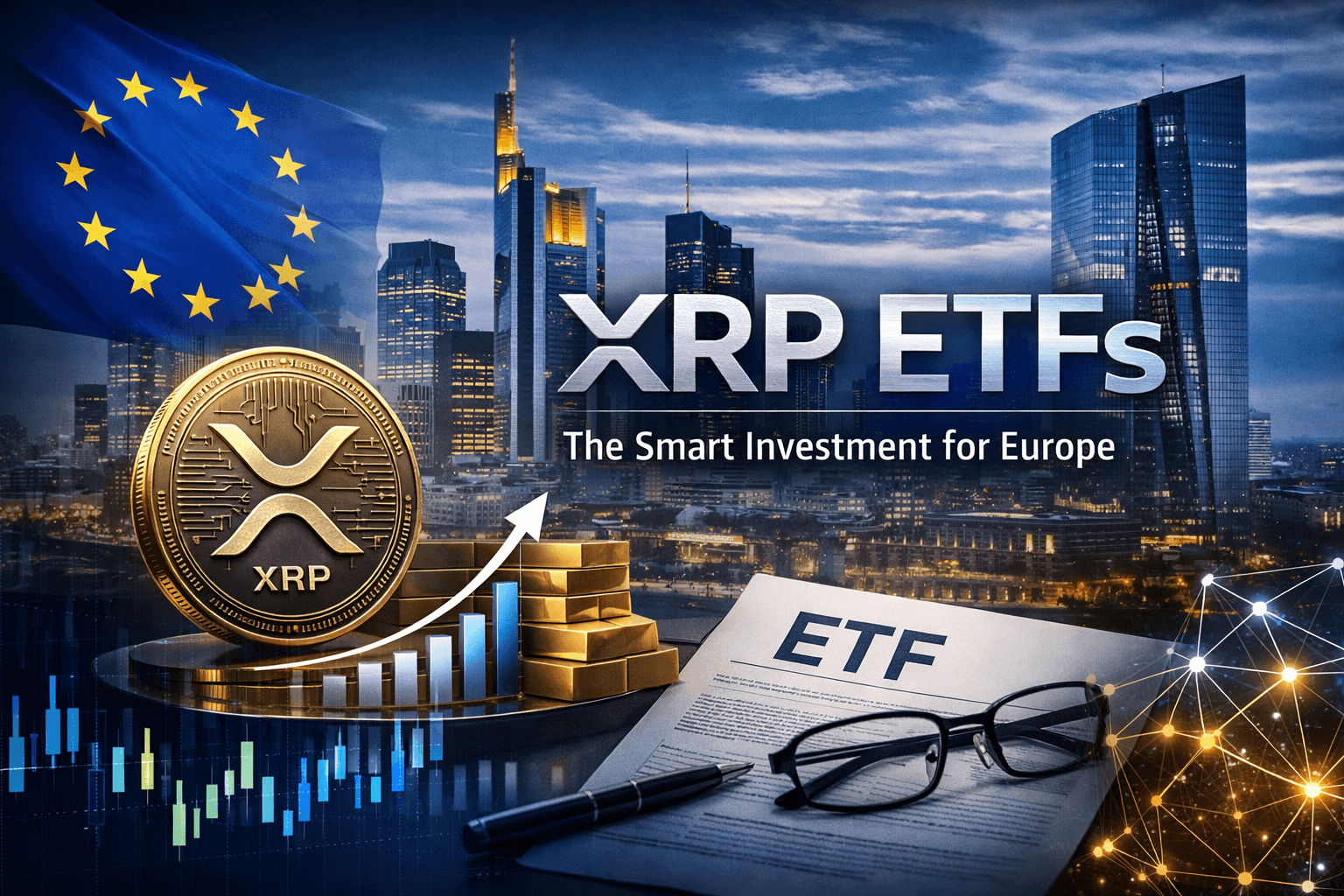
Anyone who truly understands Europe’s financial markets from the inside knows one thing: capital here does not chase hype. It moves toward structure, legal clarity, and regulatory continuity. That is precisely why XRP ETFs are not a speculative side bet of the crypto world, but a logical extension of Europe’s financial architecture.
Start with the hard reality. European investors—especially institutions—want exposure to digital assets, but not to private-key risk, wallet management, offshore exchanges, or regulatory gray zones. The EU capital market is not a playground. It is a rule-based system. XRP ETFs fit that system with surgical precision.
XRP is not an anonymous experiment or a short-lived narrative token. It is a digital asset with over a decade of operational history, designed for payments, liquidity management, and financial interoperability. For European investors, this distinction matters. Function beats ideology. Efficiency beats storytelling.
The ETF wrapper resolves the core contradiction. It transforms a technically complex asset into a familiar, investable security. No wallets. No self-custody risk. No improvised tax treatment. Instead: ISINs, prospectuses, regulated custodians, daily NAVs. In short, the language European capital already speaks fluently.
Regulation reinforces this logic. With MiCA, the European Union has created the first harmonized framework for crypto-assets. This was never about suppressing innovation. It was about filtering it. What survives is institutionally usable. XRP ETFs benefit twice: operational risk disappears, and regulatory clarity becomes investability.
There is another layer—one visible only to those who actually watch liquidity flows, settlement mechanics, and balance-sheet constraints. XRP is optimized for speed and capital efficiency. In an environment defined by higher interest rates and tighter liquidity, that is not a footnote. It is a structural advantage. ETFs amplify this effect by aggregating demand, deepening liquidity, and dampening excess volatility.
For European investors, the equation becomes unusually clean: A liquid digital asset + a regulated ETF structure + a clear real-world use case = innovation without systemic disruption.
XRP ETFs are therefore not a bet against the financial system. They are an upgrade to it. They allow banks, asset managers, and sophisticated private investors to participate in the next evolution of global payments—without breaking their own compliance frameworks.
From an insider’s perspective, the conclusion is almost boring in its clarity: XRP ETFs are compelling not because they are “crypto,” but because they behave like a traditional European financial product.
And that is exactly what makes them so powerful.
Quiet. Structured. Uncomfortably efficient
Published by Banx Network. This article is part of the Banx decentralized media programme, powered by the BXE token on the XRP Ledger.