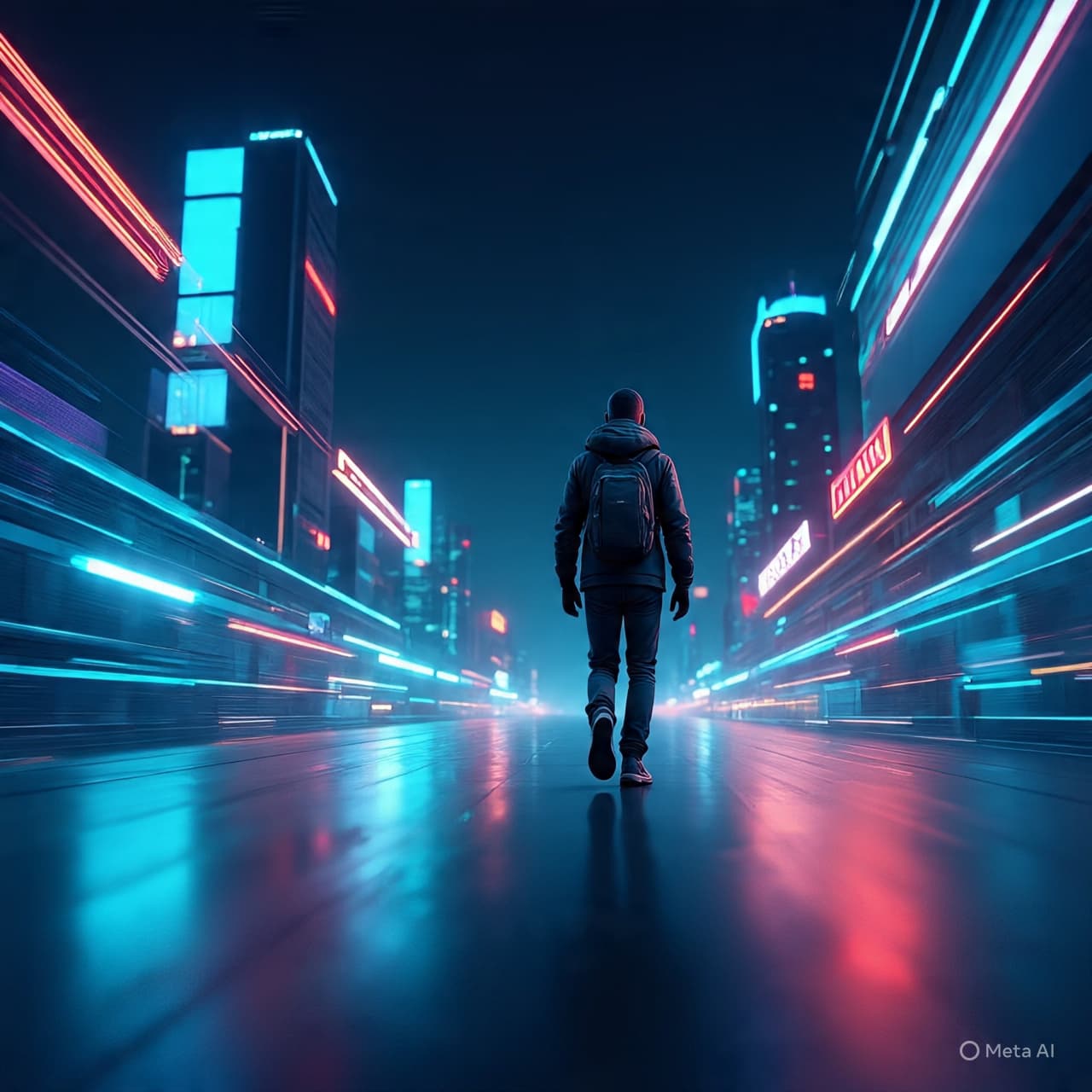
There is something instinctively human about wandering without an endpoint. Long before maps were complete, movement itself was meaning enough. In digital spaces, however, worlds have always been bounded—by memory limits, by design choices, by the quiet certainty that somewhere, the edge will appear. Project Genie begins from a different assumption.
Project Genie is an experiment in creating infinite, interactive worlds that unfold continuously as users move through them. Rather than relying on pre-authored maps or fixed environments, it generates space dynamically, responding in real time to interaction. Each step forward becomes not just traversal, but creation.
At the center of the project is a shift in how virtual environments are conceived. Instead of building worlds as static containers, Project Genie treats them as processes. Landscapes are not loaded; they are inferred. Objects are not merely placed; they are contextual. The result is an environment that feels less like a level to be completed and more like a place that remembers.
Interactivity, here, is not limited to buttons or scripted responses. The system observes movement, action, and presence, allowing the world to evolve accordingly. Paths subtly adapt, spaces reconfigure, and continuity is preserved even as novelty persists. The infinite is not chaotic; it is coherent, guided by internal logic rather than authored constraint.
This approach carries philosophical weight. Infinite worlds challenge the idea of mastery that underpins most digital experiences. There is no final objective, no perfect route, no definitive ending. Progress becomes experiential rather than measurable. Time spent is not preparation for completion; it is the point itself.
Project Genie also gestures toward a future where creation and exploration blur. If worlds can be generated as they are lived in, authorship becomes shared between system and user. The environment is neither fully designed nor fully discovered. It exists in the space between intention and response.
There are limits, of course—technical, conceptual, unresolved. Infinite systems must still feel meaningful, and interactivity must avoid dissolving into repetition. Project Genie does not claim to have solved these tensions. Instead, it treats them as terrain to explore, much like the worlds it generates.
In doing so, it reframes what digital space can be. Not a destination, not a challenge, but a companion to movement. A place where the horizon recedes not because it is unreachable, but because it is still becoming.
AI Image Disclaimer Visuals are AI-generated and serve as conceptual representations.
Sources Project Genie research materials Generative environment studies Interactive AI systems literature
Published by Banx Network. This article is part of the Banx decentralized media programme, powered by the BXE token on the XRP Ledger.