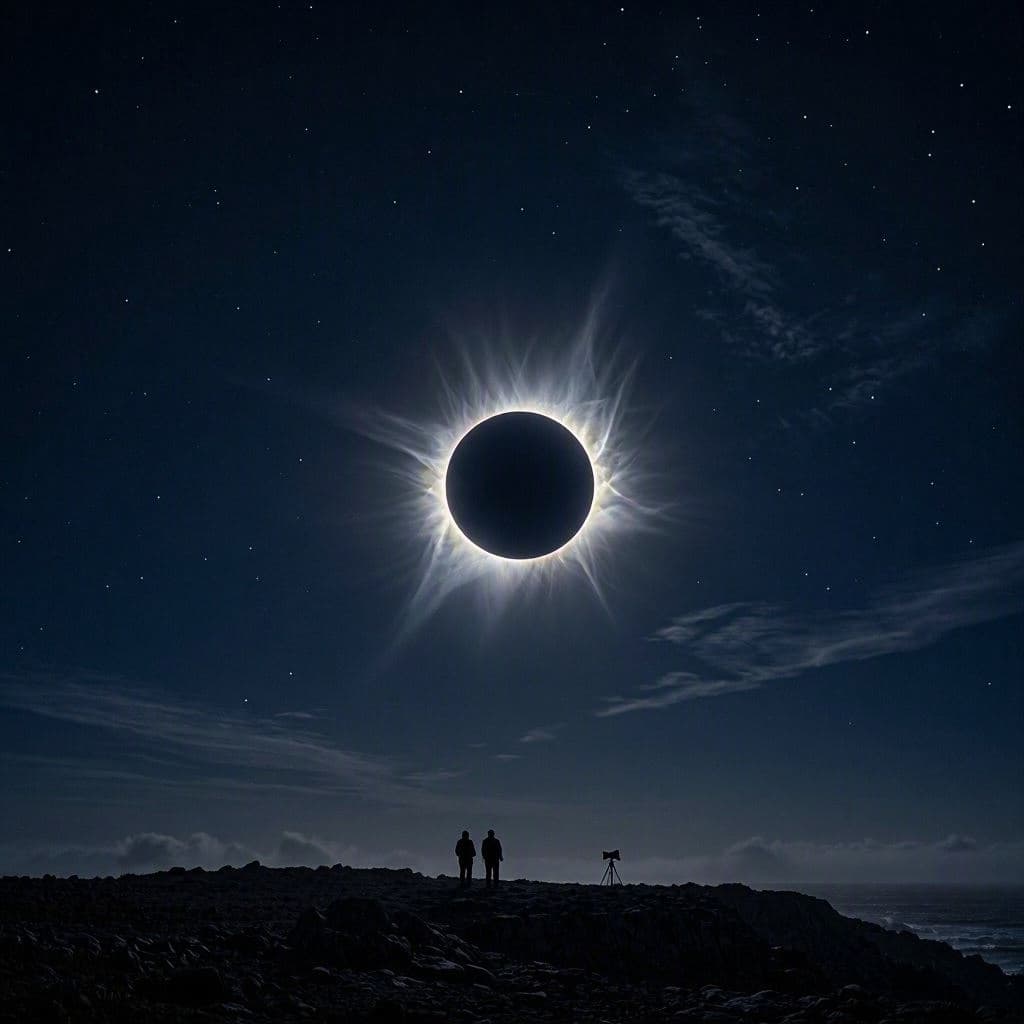
There are moments in nature that suspend time, drawing our gaze upward in collective wonder. A total solar eclipse is one such event, a celestial alignment that transforms day into twilight and reveals the sun’s ethereal corona. On Wednesday, August 12, 2026, this phenomenon will grace the skies over parts of Europe and the North Atlantic, offering a rare spectacle for observers. This occasion invites reflection on the precision of cosmic mechanics and the human desire to witness the extraordinary. It is a reminder that we share this planet with a universe of rhythmic beauty.
The path of totality will sweep across Iceland, Spain, and several other regions, providing a brief window of complete darkness. For those within this narrow band, the sun will be entirely obscured by the moon, allowing for a direct view of the solar atmosphere. Outside this path, viewers will experience a partial eclipse, where the sun appears as a crescent. The duration of totality varies by location, lasting only a few minutes but leaving an impression that endures for a lifetime.
Preparation is key to enjoying the event safely. Experts emphasize the importance of using certified eclipse glasses or solar viewers during the partial phases. Looking directly at the sun without protection can cause permanent eye damage. Only during the brief moments of totality is it safe to view the eclipse with the naked eye. Safety ensures that the memory remains positive.
For travelers planning to visit the path of totality, logistics require attention. Accommodations in popular viewing spots may be limited, so early planning is advisable. Weather forecasts will play a crucial role, as cloud cover can obscure the view. Flexibility in location choice can increase the chances of clear skies. Patience is often rewarded.
Communities along the path are preparing for an influx of visitors, turning the event into a festival of science and culture. Schools and museums are organizing educational programs to explain the astronomy behind the eclipse. These initiatives foster a deeper appreciation for the natural world. Learning enhances the experience.
Photographers and astronomers are setting up equipment to capture the event, but experts remind us to also take time to simply look up. The emotional impact of witnessing an eclipse is profound, connecting us to generations of observers who have marveled at the same sight. Presence matters more than pixels.
A total solar eclipse will occur on Wednesday, August 12, 2026, visible primarily in Iceland and Spain. Observers are advised to use proper eye protection and check weather conditions. The hope is for clear skies and a memorable celestial display.
AI Image Disclaimer: The visual elements accompanying this report are AI-generated interpretations designed to reflect the astronomical and observational context of the story.
Sources: Time and Date NASA Eclipse Website European Space Agency
Published by Banx Network. This article is part of the Banx decentralized media programme, powered by the BXE token on the XRP Ledger.