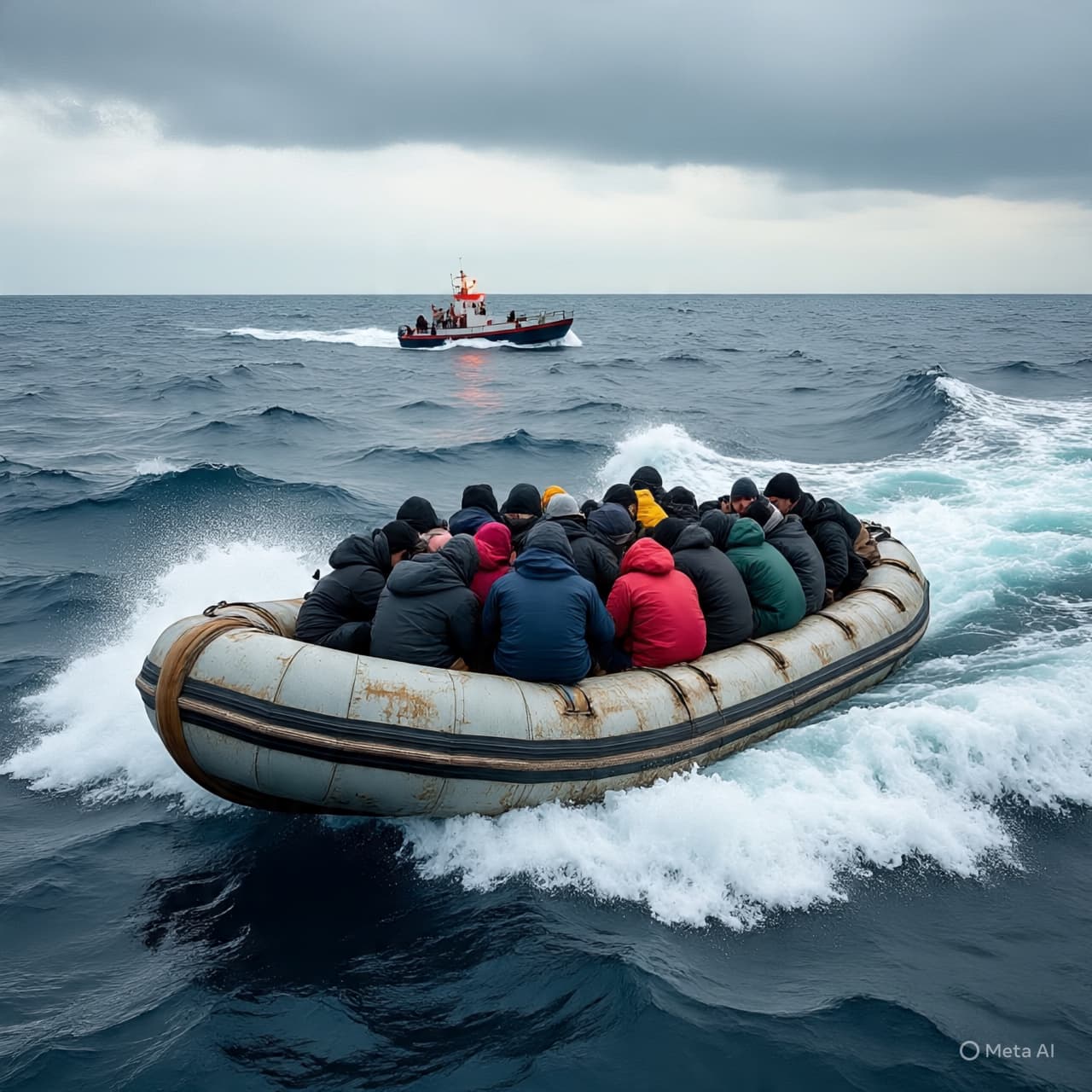
Winter settles differently over the Mediterranean. The sea, often imagined in summer light, turns steel-gray under low clouds, its surface unsettled by wind that pushes northward with quiet force. Along the shifting routes between North Africa and southern Europe, boats continue to depart — fragile silhouettes against a horizon that offers both promise and peril.
In recent weeks, humanitarian agencies have reported that migrant deaths in the Mediterranean have surpassed 600 this year, as winter storms alter smuggling routes and steer more vessels toward Italy’s southern shores. Rough seas and sudden weather changes have compounded the risks of already precarious crossings, particularly along the Central Mediterranean corridor, one of the world’s deadliest migration routes.
Authorities and aid organizations say that deteriorating conditions at sea have forced traffickers to adjust departure points and landing trajectories, increasing arrivals in southern Italy, including Sicily and Calabria. The same storms that redirect the boats also heighten the danger: overcrowded dinghies, limited navigation equipment, and long stretches without rescue support leave passengers vulnerable to capsizing and exposure.
Search-and-rescue operations have continued despite difficult weather. The Italian Coast Guard and non-governmental rescue groups have reported multiple interceptions and emergency responses in recent weeks, pulling survivors from vessels adrift in heavy swells. Yet for many journeys, help arrives too late. Bodies recovered at sea or along the coastline offer only partial accounting of lives lost; others vanish without record beneath open water.
Migration across the Mediterranean reflects pressures that extend far beyond the shoreline. Conflict, economic instability, and political repression in parts of sub-Saharan Africa and the Middle East continue to drive departures. Smuggling networks adapt quickly, exploiting gaps in enforcement and shifting patrol patterns. As land borders tighten and agreements with transit countries fluctuate, maritime crossings remain a persistent route despite mounting risks.
Italy, long at the frontline of European migration flows, has renewed calls for broader European Union coordination, arguing that arrivals concentrated on its southern coast strain local resources and reception systems. Debates continue within the EU over burden-sharing mechanisms, asylum processing, and external partnerships aimed at reducing departures.
Humanitarian groups emphasize that weather alone does not account for the rising death toll. Limited legal pathways for asylum, they argue, leave many with little choice but to attempt irregular crossings. Each statistic, they note, represents an individual story — a family decision made under constraint, a calculation of danger weighed against uncertainty at home.
As winter advances, the Mediterranean remains in motion. Storms pass; new ones gather. Patrol boats cut through choppy waters while fishing vessels resume their routines along the same currents. On Italy’s southern shores, arrivals step onto wet sand carrying what remains of their journey — documents sealed in plastic, a spare change of clothes, a memory of those who did not reach land.
The sea does not distinguish between seasons of tourism and seasons of flight. It carries both with the same tide. And as the number of recorded deaths climbs beyond 600, the question persists across capitals and coastlines alike: how to reconcile border policy with the human cost that unfolds, wave after wave, in the narrow channel between continents.
AI Image Disclaimer These visuals are AI-generated representations created for illustrative context.
Sources International Organization for Migration UNHCR Italian Coast Guard Reuters Associated Press
Published by Banx Network. This article is part of the Banx decentralized media programme, powered by the BXE token on the XRP Ledger.