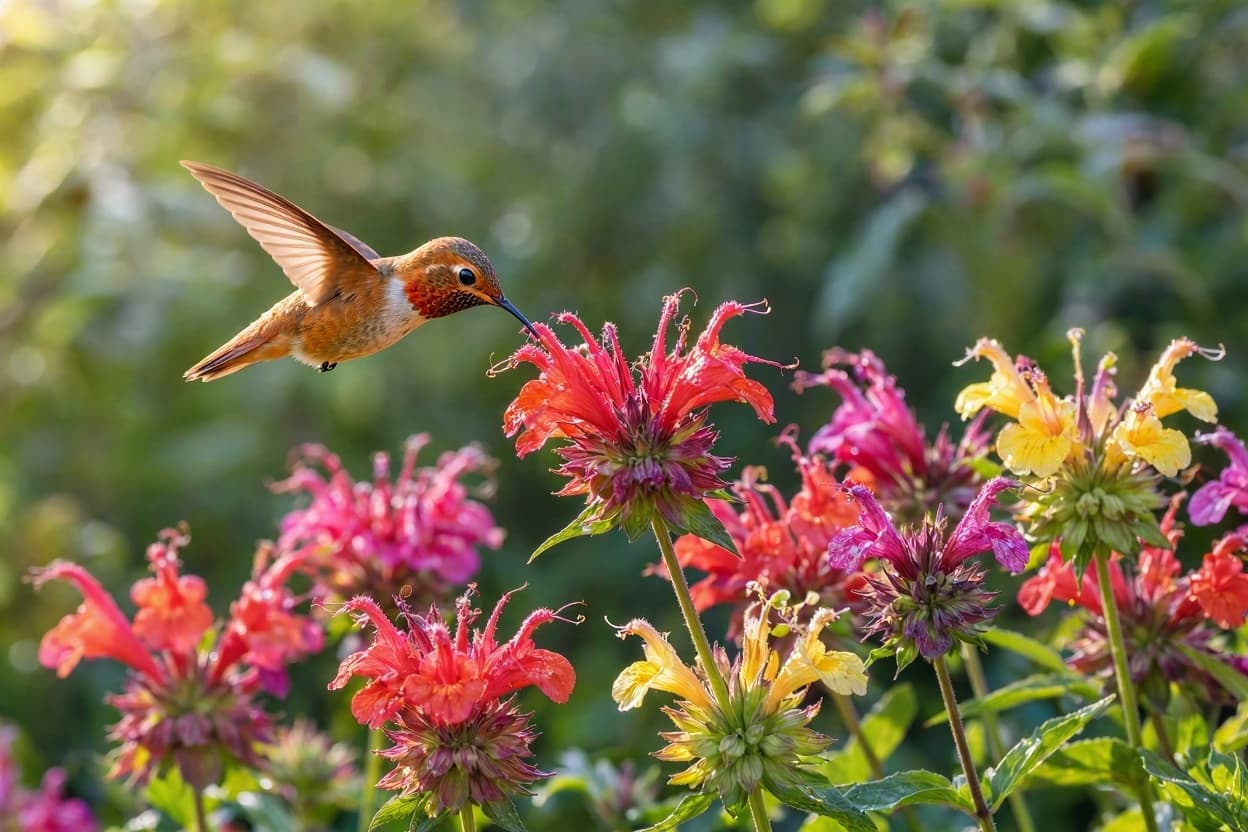
In the vibrant dance of a garden, where hummingbirds hover like jewels in the air, there is more than mere instinct at play. Beneath the iridescent feathers and rapid wingbeats lies a mind capable of surprising cognitive feats. A study conducted in 2020 revealed that wild rufous hummingbirds possess the ability to count and remember the sequential order of flowers. Even when only one in ten blossoms offered a reward, these tiny avians consistently returned to the correct location, demonstrating a numerical competence that challenges our understanding of animal intelligence.
The research, led by scientists at the University of Calgary, involved setting up arrays of artificial flowers in the birds’ natural habitat. Each flower was identical in appearance, but only specific ones contained sucrose solution, arranged in a predictable sequence. The hummingbirds quickly learned to visit the flowers in the correct order, ignoring the empty ones. This behavior suggested that they were not just relying on scent or color cues, but were actively tracking the position of each flower in the series.
What makes this finding remarkable is the complexity of the task. Counting requires working memory and the ability to distinguish between quantities and positions. For a bird with a brain the size of a grain of rice, this is a significant computational achievement. It suggests that numerical cognition may be more widespread in the animal kingdom than previously thought, evolving independently in different lineages to solve specific ecological problems.
For hummingbirds, the ability to remember flower sequences is likely an adaptation to their high-energy lifestyle. Nectar is a fleeting resource, and efficient foraging is essential for survival. By remembering which flowers have been visited and in what order, the birds minimize wasted energy and maximize intake. This cognitive map allows them to navigate complex floral landscapes with precision, turning a chaotic environment into a structured menu.
The study also highlights the importance of field research in understanding animal behavior. Laboratory experiments often lack the ecological validity of natural settings. By observing wild birds in their own territory, researchers gained insights into how cognitive abilities function in real-world contexts. This approach reveals the practical applications of intelligence, showing how mental skills are shaped by environmental pressures.
Furthermore, the findings contribute to the broader debate on the evolution of number sense. While primates and some birds like crows are known for their mathematical abilities, discovering similar traits in hummingbirds expands the scope of this capability. It suggests that the need to track resources may be a powerful driver of cognitive development, regardless of brain size or phylogenetic distance.
The implications extend to conservation and ecology. Understanding how pollinators interact with plants helps us appreciate the complexity of these relationships. If hummingbirds rely on spatial and numerical memory, changes in floral distribution due to habitat loss or climate change could disrupt their foraging efficiency. Protecting the structural integrity of their environment is thus crucial for their survival.
The discovery that rufous hummingbirds can count flower order is a testament to the hidden depths of animal intelligence. It reminds us that even the smallest creatures possess sophisticated minds adapted to their unique challenges. As we continue to explore the cognitive lives of birds, we gain a deeper respect for the intricate web of life that surrounds us.
AI Image Disclaimer: Visuals accompanying this article are AI-generated illustrations designed to complement the narrative and do not depict real-time events.
Sources: University of Calgary Science Daily National Geographic Proceedings of the Royal Society B Smithsonian Magazine
Published by Banx Network. This article is part of the Banx decentralized media programme, powered by the BXE token on the XRP Ledger.