We are taught that stars come in a limited palette: the cool orange of Betelgeuse, the warm white of our Sun, the searing blue of Rigel. Temperature dictates color, and color tells us something about heat. But in the quiet afterlives of stars, where white dwarfs smolder as dense remnants of what once was, a different rule seems to apply. There, color is not a matter of temperature alone. It is a matter of chemistry, of density, and of what a dying star has swallowed.
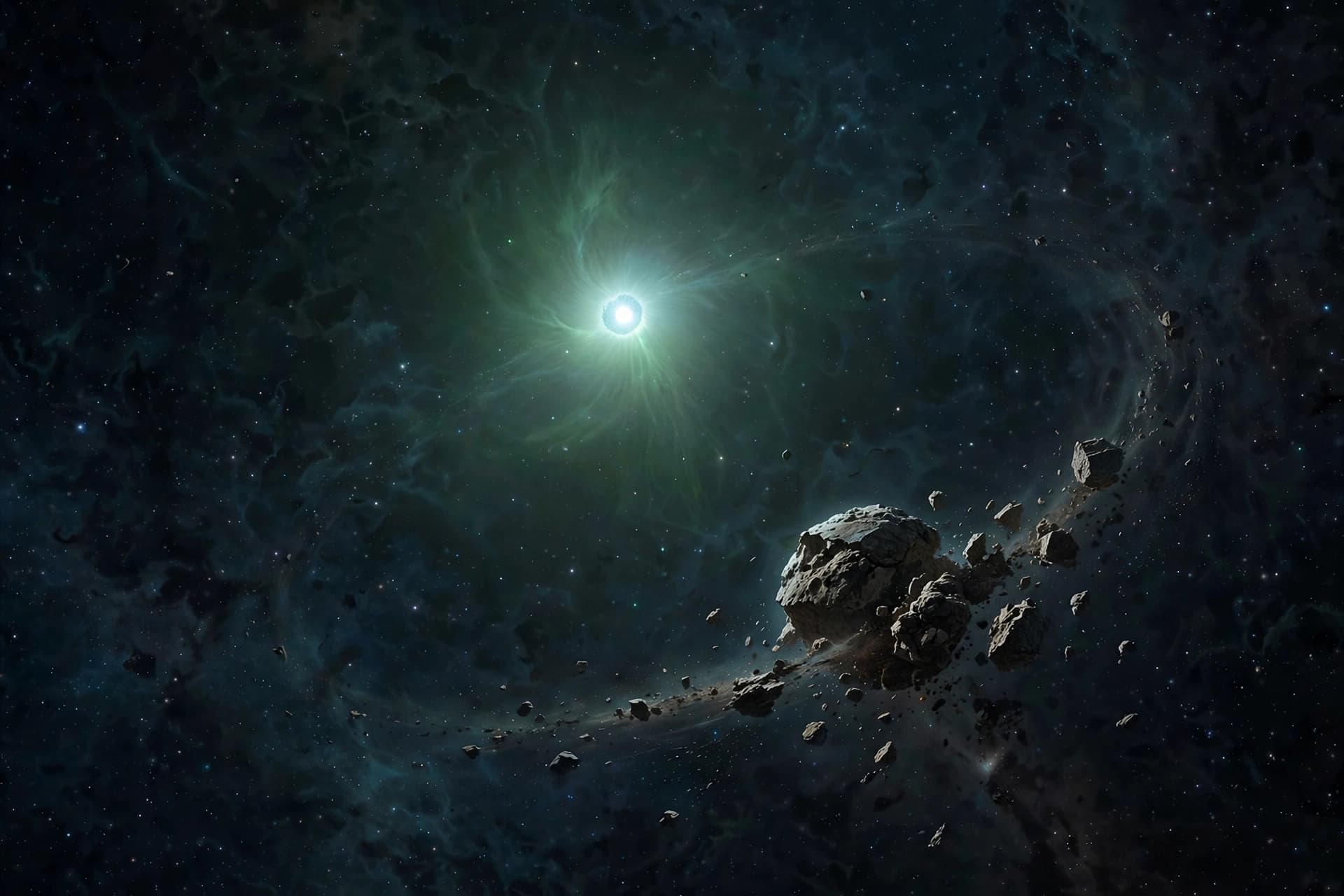
Astronomers at the University of Warwick have identified what they believe to be the first green star ever credibly recorded, along with the reddest star known. The green star, designated WD J1330+6435, sits about 284 light-years from Earth and has a surface temperature of roughly 4,000 degrees Celsius. Its unusual chartreuse hue comes from traces of sodium in its atmosphere, which absorb the orange part of the spectrum and leave behind a ghostly green glow. "Imagine standing on a planet and looking up at a green star," said Dr. Mark Hollands, who led the study. "It feels like something out of science fiction".
The reddest star, WD J1011+2845, is even closer—just 48 light-years away. Its deep salmon-pink color results from carbon dredged up from its core to its surface, distorting its light so that almost all of it is squeezed into longer wavelengths. Together, these two outliers challenge a long-held assumption that white dwarfs, like most stars, follow the familiar temperature-color relationship.
The key, researchers found, lies in the extraordinary density of white dwarf atmospheres. They can reach about the density of water—roughly one gram per cubic centimeter—millions of times denser than the Sun's outer layers. Under such conditions, trace elements like carbon, calcium, and sodium interact with the surrounding helium plasma in ways they would not at lower densities, absorbing light across a broader spectrum and shifting the star's apparent color.
The findings emerged from an analysis of 151 white dwarfs within about 65 light-years of Earth. Most, the researchers confirmed, would appear white to the human eye. But about one in thirty showed unusual coloring—pink, purple, yellow, cyan, or in one remarkable case, green. "One in 30 white dwarfs not being white might not sound like much," said physicist Boris Gänsicke, a co-author. "But given the enormous population, it means there are still plenty of stars out there with strange colors".
The study, published in RAS Techniques and Instruments, also corrects a long-standing misconception. Astronomers had generally believed white dwarfs to be blue, but that skew was caused by the fact that blue examples are brighter and therefore visible from greater distances. The reality, it seems, is more varied and more interesting—a reminder that even in the quietest corners of the cosmos, there is more color than we expected to find.
AI Image Disclaimer: This article’s image is AI-generated and does not depict an actual astronomical observation.
Sources: Yahoo Tech, Popular Science, bdnews24.com, heise online
Published by Banx Network. This article is part of the Banx decentralized media programme, powered by the BXE token on the XRP Ledger.