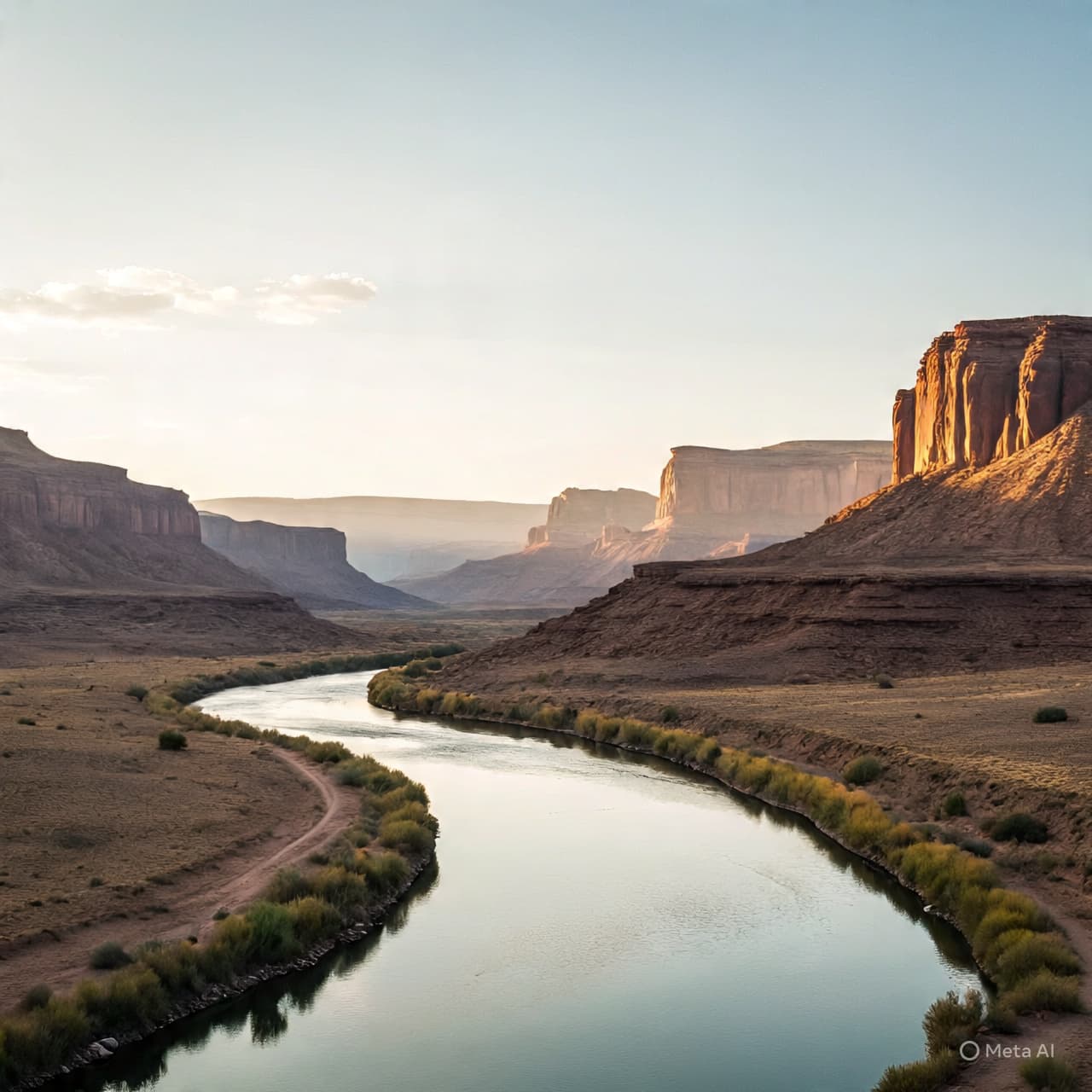
Some rivers carry more than water; they carry stories older than the mountains that cradle them. They wind through time like silver threads, etching their paths into the earth, whispering tales of ancient landscapes long vanished. Among these enduring lifelines, one river quietly claims the distinction of being the oldest known: the Finke River of central Australia. Its meandering course, threading through the ancient ranges of the MacDonnell Ranges, has witnessed the slow unfolding of eons, a silent observer to the shifting of continents and the rise of deserts.
Geologists suggest the Finke River may have originated over 350 million years ago, long before the rise of the Rockies or the Himalayas. Its bends and loops are not merely accidents of nature but remnants of a primordial landscape, preserved even as tectonic plates shifted and climate sculpted the surrounding terrain. Unlike youthful rivers racing to the sea, the Finke flows in a contemplative rhythm, tracing pathways carved in the Devonian period, when life on land was only beginning to explore its potential.
Yet, the Finke is not alone in this silent testimony of time. The Nile, the Meuse, and the Yellow River carry their own ancient echoes, each with layers of history interwoven with human civilization. But what sets the Finke apart is its endurance in a land that has seen fire, drought, and the slow drift of geological upheavals, yet still maintains the curves of its ancient heart. It reminds us that rivers are not merely channels of water; they are carriers of memory, conduits connecting the present to the deep past.
As one traces the river’s dry and wet stretches, its story unfolds like a manuscript written in stone and sediment. The dry riverbeds, sometimes meandering without water for months, are still maps of an age when Australia’s landscapes were vastly different. Rainfall breathes life into its channels briefly each year, reviving a rhythm set hundreds of millions of years ago. For scientists and explorers alike, the Finke is both a puzzle and a revelation — a tangible reminder of Earth’s unfathomable age.
In reflecting on the river’s longevity, we glimpse a larger narrative about resilience and continuity. The Finke River survives, quietly asserting that some natural entities outlast human lifetimes, empires, and even continents. Its enduring flow encourages a soft, contemplative awe: a pause to recognize that while human history is fleeting, the natural world has its own vast timelines, often measured in millions of years.
From a distance, the river might seem modest, even fragile, meandering through dry plains. Yet, it is a keeper of secrets, a flowing archive that preserves the whispers of geological time. Standing on its banks, one might feel a rare humility, sensing that the river has witnessed epochs that we can scarcely imagine, and will continue to trace its path long after our own stories fade.
The Finke River is a testament to endurance, a gentle reminder that the world holds wonders far older than our fleeting perspective. In the quiet of its bends, it offers both history and serenity — a silent, flowing chronicle of the Earth’s memory.
AI Image Disclaimer “Illustrations were produced with AI and serve as conceptual depictions, not actual photographs.”
Sources Live Science Wikipedia (Finke River) IFLScience IDN Times Oldest.org
Published by Banx Network. This article is part of the Banx decentralized media programme, powered by the BXE token on the XRP Ledger.