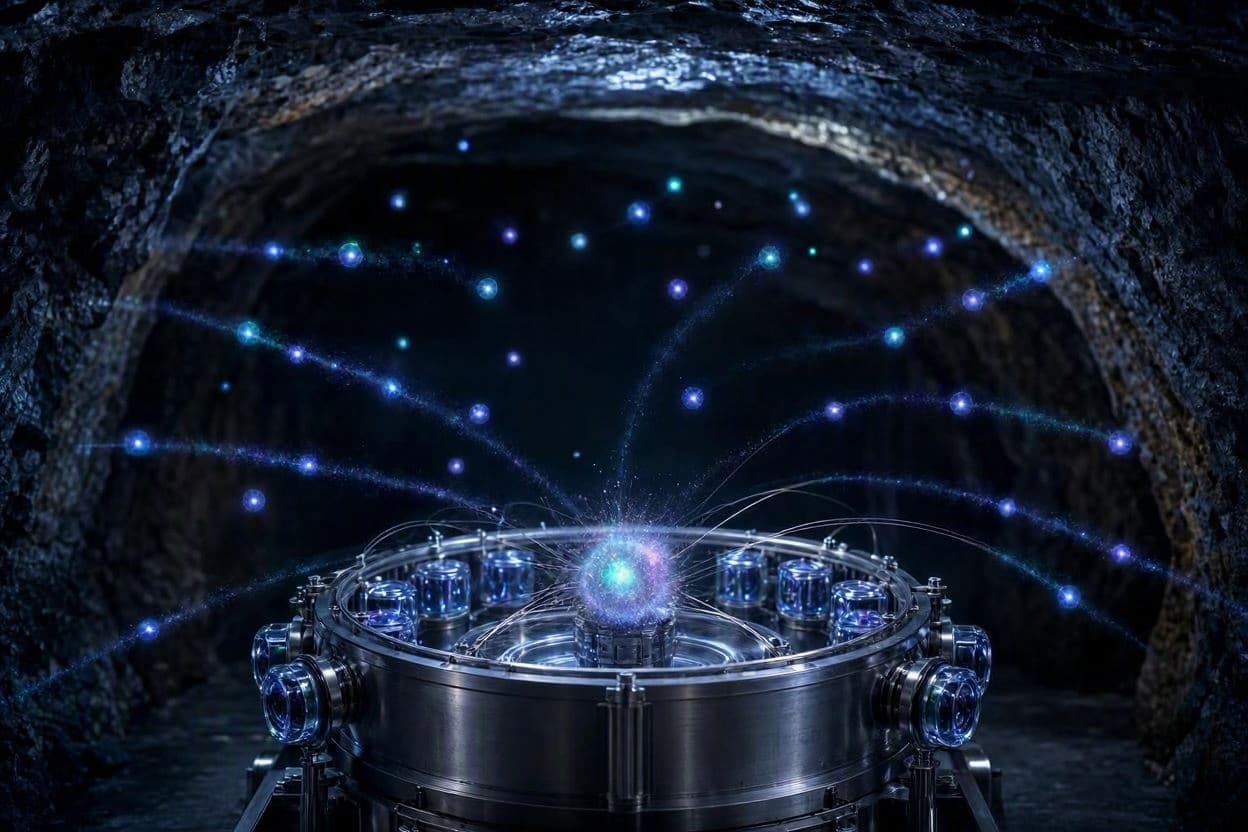
In the quiet depths of underground laboratories, where cosmic rays cannot penetrate, scientists are listening for the faintest whispers of the universe’s most mysterious component: dark matter. Recent data from sensitive detectors has revealed potential signals that could indicate the presence of this elusive substance, sparking a wave of cautious optimism in the physics community. While not yet confirmed, these findings represent a significant step forward in the decades-long quest to understand what makes up the majority of the universe’s mass.
Dark matter does not emit, absorb, or reflect light, making it invisible to traditional telescopes. Its existence is inferred from its gravitational effects on visible matter, such as the rotation of galaxies and the bending of light from distant stars. Despite comprising about 85 percent of the matter in the universe, its fundamental nature remains unknown. Leading theories suggest it may be composed of Weakly Interacting Massive Particles (WIMPs), which would rarely interact with normal matter but could be detected through precise instruments.
The recent potential detection comes from experiments designed to capture these rare interactions. By using ultra-pure materials and shielding detectors from background radiation, researchers hope to isolate the tiny energy deposits left by dark matter particles colliding with atomic nuclei. The signals observed are consistent with some theoretical models, though they could also be explained by unknown background noise or other physical phenomena.
This ambiguity is typical in the field of particle physics, where extraordinary claims require extraordinary evidence. Scientists are now working to verify the results through independent experiments and further data analysis. Replication is key to confirming any discovery, and multiple teams around the world are racing to either validate or refute the new findings. The process is slow and meticulous, reflecting the high stakes of such a monumental discovery.
If confirmed, the detection would revolutionize our understanding of the cosmos. It would provide the first direct evidence of dark matter’s particle nature, opening new avenues for research in physics and cosmology. It could also help explain the formation of large-scale structures in the universe and the behavior of galaxies over billions of years. The implications would extend far beyond the laboratory, touching on the fundamental questions of existence.
However, skepticism remains healthy and necessary. Past claims of dark matter detection have sometimes been disproven by more rigorous analysis or better experimental controls. The scientific community remains vigilant, ensuring that any announcement is backed by robust statistical significance and peer review. This caution ensures that when a true discovery is made, it will be undeniable.
For now, the hope generated by these potential signals serves as fuel for continued exploration. The search for dark matter is a testament to human curiosity and ingenuity, pushing the boundaries of technology and knowledge. Whether these signals prove to be the long-sought particle or another puzzle piece, the journey itself brings us closer to unlocking the secrets of the invisible universe.
AI Image Disclaimer: The images used in this report are AI-generated visuals created to illustrate the concepts of dark matter detection and particle physics.
Sources: Nature Physics, CERN, Scientific American
Published by Banx Network. This article is part of the Banx decentralized media programme, powered by the BXE token on the XRP Ledger.