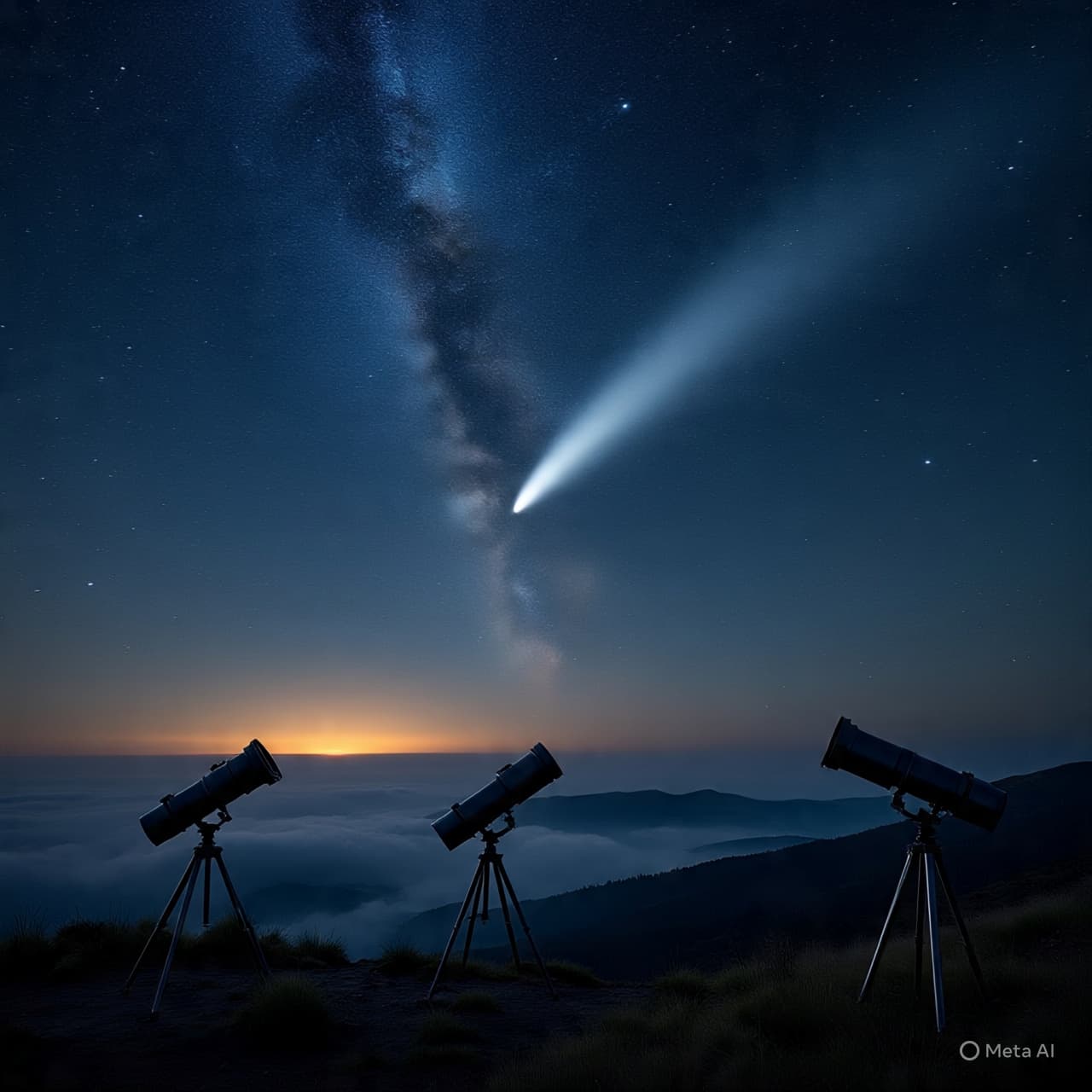
There are moments when the quiet of our night skies seems to whisper secrets — pale threads of ice and dust that journey through the cosmos like ancient pilgrims. These celestial wanderers, born in distant corners of our solar system’s frontier, become messengers of time and space, reminding us of the vastness beyond the rhythm of days and seasons. In the gentle hours before dawn and just after dusk, skywatchers often pause, hearts lifted, eyes turned upward, as if listening for a cosmic sigh.
In the unfolding months of 2026, astronomers invite us to witness one such visitor: Comet C/2025 R3 (PanSTARRS). Discovered in September 2025 by the Pan-STARRS survey telescope in Hawaii, this icy wanderer is gracefully arcing toward the inner solar system, its path traced carefully by scientists and enthusiasts alike. If predictions hold true, the comet will make its closest approach to the Sun — a moment called perihelion on April 20, 2026, drawing nearer to our star than the orbit of Venus. Shortly thereafter, around April 27, it is expected to come within roughly 44 million miles (70.8 million kilometers) of Earth.
Observers around the world, from northern backyard telescopes to southern hemisphere skies, will be watching. There is cautious optimism that C/2025 R3 could brighten enough to be visible without optical aid under dark skies a rare treat that might draw people outside to share a moment of wonder under the stars. Yet like all things celestial, such possibilities hinge on the interplay of sunlight and dust, motion and light, making each appearance unique and a little unpredictable.
This potential spectacle follows a remarkable year of cosmic encounters. In late 2025, the interstellar comet 3I/ATLAS, only the third known object from beyond our solar system, passed through our cosmic neighborhood. Though it maintained a safe distance of about 1.8 astronomical units (roughly 170 million miles) from Earth and posed no danger, it offered a rare glimpse into material forged around another star system.
As Earth continues its slow orbit around the Sun, these icy sojourners remind us of our place in the grand weave of the universe small but observant, attuned to moments when distant mysteries come into view.
Looking skyward in April 2026, whether with a telescope, binoculars, or simply a curious gaze, we may witness comets that paint the night with subtle brilliance, underscoring both the precision of science and the poetry of the night sky.
AI Image Disclaimer (Rotated) “Visuals are created with AI tools and are not real photographs.”
Sources:
Space.com Geo News Starwalk.space Associated Press (AP News) LiveScience
Published by Banx Network. This article is part of the Banx decentralized media programme, powered by the BXE token on the XRP Ledger.