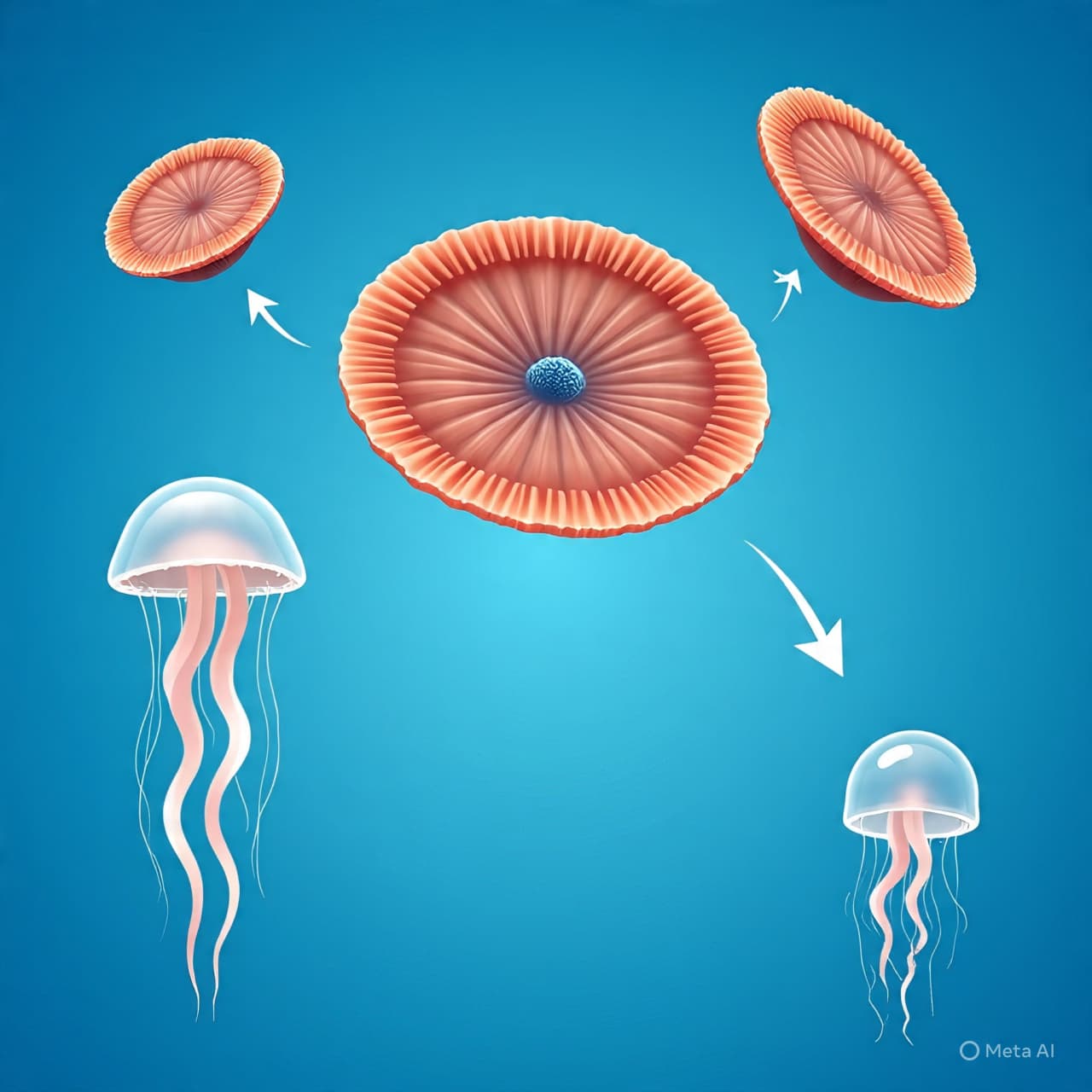
The sea often appears calm from a distance, its surface stretching outward in quiet continuity. Yet beneath that calm, motion persists in ways that are almost invisible—movements too small to see, but persistent enough to shape the lives of some of the ocean’s oldest inhabitants.
Among these ancient creatures are members of the phylum Cnidaria—a lineage that includes corals, sea anemones, and jellyfish. Their bodies appear simple and still, often anchored in place or drifting with slow intent. But new research suggests that along their surfaces, subtle currents flow continuously, guided not by tides or muscles, but by thousands of microscopic structures known as cilia.
A study published in Communications Biology describes how these hair-like cilia generate directional water currents across the bodies of certain cnidarians. The findings suggest that these currents are neither random nor universal across the group. Instead, they appear to belong to particular branches of the cnidarian family tree—and even to particular moments in an animal’s life.
To understand these currents, researchers observed living animals under microscopes while releasing tiny fluorescent beads into the surrounding water. The beads drifted across the animals’ surfaces, tracing faint but consistent paths. In those drifting trails, scientists could see the otherwise invisible flow of water being pushed by coordinated waves of beating cilia.
In sessile organisms—animals that spend much of their lives anchored to a surface—such currents can serve quiet but essential purposes. Water moving across the body may help transport nutrients, sweep away debris, or assist with the exchange of oxygen and waste. These flows, though measured in millimeters, create a small but meaningful circulation around the animal.
Yet the currents were not evenly distributed across the cnidarian world. The researchers found them in groups such as certain corals and jellyfish relatives, but notably absent in others. Some lineages, including octocorals and hydrozoans, appeared to lack these cilia-driven surface flows entirely.
Even within a single species, the presence of these currents could change as the animal aged. In several cases, currents were detected in the polyp stage—when the organism lives attached to a surface—but disappeared once the animal transformed into a free-swimming medusa, the familiar jellyfish form.
The distinction hints at a quiet logic in the evolution of these creatures. A stationary polyp may rely on cilia to bring water across its body, gently managing its immediate environment. But a swimming jellyfish, propelled by rhythmic muscular pulses, already moves water simply by traveling through it.
Over long evolutionary timescales, such subtle differences may have shaped how different cnidarian groups adapted to their habitats. The new research suggests that these surface currents likely appeared, disappeared, and reappeared in different lineages, responding to ecological pressures and the varied lifestyles of animals that have inhabited the oceans for hundreds of millions of years.
What emerges is a reminder that movement in the sea does not always come from waves or fins. Sometimes it begins with structures so small they are barely visible—thousands of synchronized cilia quietly stirring the water.
The study concludes that cilia-driven surface currents are widespread but unevenly distributed across cnidarian groups and life stages. Their presence appears linked to body structure, feeding strategies, and whether the animal lives fixed in place or moves freely through the water.
AI Image Disclaimer
Illustrations were created using AI tools and are intended as conceptual scientific representations rather than real photographs.
Source Check
Credible coverage and/or primary reporting exist from: Nature Communications / Communications Biology Phys.org Current Biology Nature Research ScienceDaily
Published by Banx Network. This article is part of the Banx decentralized media programme, powered by the BXE token on the XRP Ledger.