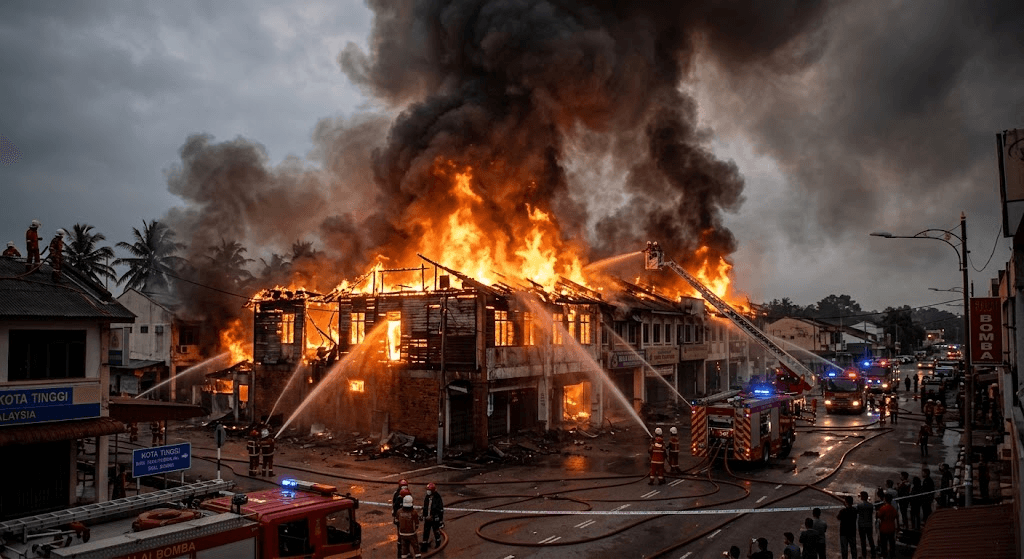
Evening settles over the Mediterranean with a quiet patience. Along Beirut’s corniche, the sea often glows faintly under the fading sun, and the city’s buildings catch the last warmth of daylight before slipping into night. The capital of Lebanon has long lived with the memory of conflict, yet it also carries the rhythm of ordinary life—cafés filling with conversation, traffic threading through narrow streets, and the distant call of waves along the shore.
In recent days, however, the skyline has been interrupted by the familiar shape of smoke rising against the dusk.
The Israel military said it conducted a series of strikes in Beirut, targeting Iranian-linked commanders believed to be operating in the city. According to Israeli officials, the operation was aimed at senior figures connected to Iran and its regional network of allied forces.
The strikes come amid an expanding confrontation across the Middle East, where tensions between Israel and Iran have increasingly spilled beyond national borders. Beirut, long situated at the crossroads of regional politics, has again found itself within the shifting geography of that struggle.
Emergency services across the city reported widespread damage in several neighborhoods where explosions were heard. Buildings were shaken, streets filled with debris, and rescue teams moved quickly through the darkness searching for survivors beneath collapsed structures.
Officials and humanitarian groups say the death toll from the strikes and related violence is approaching 400 people, with many more injured. Hospitals in the capital have faced a surge of casualties, while families continue searching for relatives amid the chaos of damaged districts.
The presence of Iranian-linked figures in Lebanon has long been tied to the influence of Hezbollah, a powerful movement that maintains close ties with Tehran. Over decades, the relationship between Iran and Hezbollah has shaped much of the region’s security landscape, drawing Lebanon into confrontations that often originate beyond its borders.
For residents of Beirut, the geopolitical dimensions of the conflict often appear as sudden disruptions in daily life: the sound of aircraft overhead, emergency vehicles racing through traffic, and the glow of fires visible from apartment windows.
Many in the city still carry memories of earlier crises—the civil war that once divided neighborhoods, the devastating port explosion in 2020, and the recurring tensions along Lebanon’s southern frontier. Each event has left its own imprint on the city’s architecture and its collective memory.
Now another chapter is being written in the quiet hours between dusk and dawn.
Diplomats across the region and beyond have called for restraint, warning that continued strikes and retaliation could deepen instability across the Middle East. The risk of escalation has become a central concern, as multiple countries monitor developments that could affect regional security, energy routes, and humanitarian conditions.
For the moment, the streets of Beirut remain filled with the practical work of recovery—ambulances moving through intersections, rescue teams sifting through rubble, neighbors gathering in small groups to share information and reassurance.
Above them, the smoke that once rose sharply into the sky has begun to thin, dissolving slowly into the night air.
Yet the consequences of the strikes remain visible in the city’s damaged neighborhoods and in the rising number of lives lost. Israeli officials say the operation was aimed specifically at Iranian commanders in Beirut, part of a broader campaign linked to the ongoing confrontation with Iran.
As the death toll approaches 400, Beirut finds itself once again at the intersection of regional conflict and human vulnerability—a city where the sea remains calm, even while the forces shaping its future move far beyond the shoreline.
AI Image Disclaimer Images accompanying this article are AI-generated visual interpretations and do not depict real photographs.
Sources Reuters Associated Press BBC News Al Jazeera The Guardian
Published by Banx Network. This article is part of the Banx decentralized media programme, powered by the BXE token on the XRP Ledger.