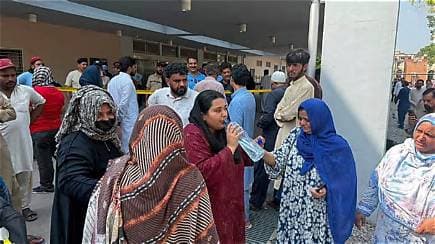
There are moments in public space that pass without notice—people standing, waiting, moving in loose patterns that rarely require explanation. A park bench, a train platform, a street corner at dusk: these are places where presence alone has long been enough, where being somewhere did not necessarily mean doing anything at all.
Yet the language of presence is changing, quietly, almost imperceptibly.
In Australia, proposed legislation in Queensland suggests a shift not in where people may go, but in how their presence might be interpreted. Under the draft laws, police would be given the authority to move individuals on if they are deemed to be “causing anxiety,” even in the absence of a criminal act.
It is a small phrase—“causing anxiety”—but one that carries an unusual weight. Unlike actions that can be measured or defined, anxiety resides in perception, in feeling, in the subtle exchange between one person’s behavior and another’s response. To translate that into legal grounds for intervention is to draw a boundary that is less visible than most, yet potentially wider.
The proposal is framed within a broader effort to address community safety and public order. Authorities argue that early intervention may prevent escalation, allowing officers to respond before situations develop into something more serious. In this sense, the law does not aim to punish, but to redirect—to move individuals along, to disperse rather than detain.
And yet, as with many such measures, its implications unfold in the spaces between intention and application.
The idea of “move-on” powers is not new. Variations of it have existed in different jurisdictions, often tied to specific behaviors—loitering, obstruction, disorderly conduct. What distinguishes this proposal is the threshold at which those powers may be used. Here, the emphasis shifts from observable disruption to perceived discomfort, from what is happening to how it is felt.
This is not without precedent. In recent years, legislation in other countries, including the United Kingdom, has expanded police authority based on similarly subjective criteria, such as protests deemed “too noisy” or causing “serious unease.”
Across these developments, a pattern begins to emerge—not abrupt, not uniform, but consistent in direction. The boundary between prevention and overreach becomes harder to trace, shaped not only by law but by interpretation, context, and the moment in which it is applied.
For some, such measures reflect a pragmatic response to changing social environments, where risks are less predictable and more diffuse. For others, they raise questions about how far authority should extend into the realm of perception—whether discomfort alone can, or should, carry the weight of enforcement.
In practice, much will depend on how the law is used. The same words can settle differently in different hands, in different streets, in different encounters. What remains constant is the setting: shared spaces where individuals move alongside one another, often without interaction, bound by an unspoken agreement of mutual tolerance.
It is within this quiet agreement that the proposed law would take shape—not in dramatic confrontations, but in ordinary moments where presence is reassessed, and movement is gently, or firmly, directed elsewhere.
In the end, the details are straightforward. Proposed laws in Queensland would allow police to issue move-on orders to individuals judged to be “causing anxiety,” even if no offense has been committed. The measures are part of broader policing reforms and remain subject to debate and legislative approval.
AI Image Disclaimer
These images are AI-generated to illustrate the themes described and do not depict real events.
Sources ABC News (Australia) Policing Insight The Guardian BBC News Reuters
Published by Banx Network. This article is part of the Banx decentralized media programme, powered by the BXE token on the XRP Ledger.