
Key Highlights
- New Theory:Researchers at St Andrews propose a theory on spacetime quasicrystals.
- Bridging Concepts:The theory connects general relativity with quantum gravity.
- Ongoing Research:Awaiting peer review and further mathematical validation.
In the historic coastal town of St Andrews, where the North Sea meets medieval architecture, a group of researchers is exploring a revolutionary concept in theoretical physics: the idea that spacetime may possess an intricate order that defies traditional repetition. This emerging theory draws inspiration from the unique properties of quasicrystals, which are known for their ordered yet non-repeating structures. By extending this concept into the realm of spacetime, the researchers suggest a new framework that could reshape our understanding of the universe.
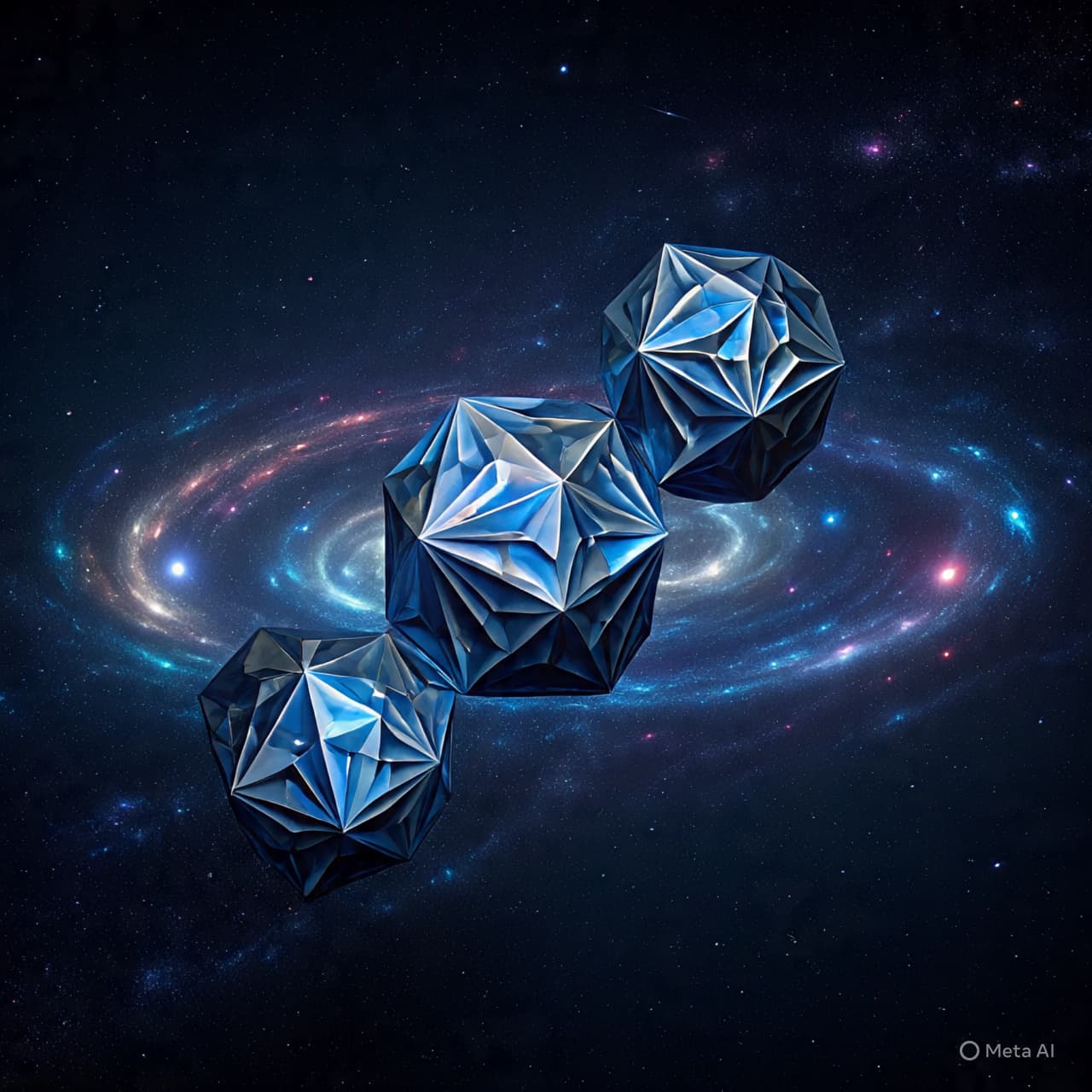
Quasicrystals, first identified in material science, exhibit a paradoxical nature—they possess a form of order that does not conform to the repetitive patterns seen in ordinary crystals. This characteristic has led the St Andrews team to propose that spacetime itself may be structured similarly, existing as a Lorentzian quasicrystal. In this model, the universe is not merely a smooth continuum or a rigid lattice, but rather a complex arrangement that maintains long-range order while avoiding simple repetition.
The implications of this theory are profound. It offers a potential solution to the longstanding tension between the smooth geometries of general relativity and the discrete nature suggested by quantum theories of gravity. By introducing the concept of a spacetime quasicrystal, the researchers aim to provide a middle ground that respects the principles of relativity while accommodating the irregularities inherent in quantum mechanics. This could lead to new insights into the nature of cosmic expansion, vacuum energy, and the fundamental scales of mass.
The beauty of this theoretical framework lies in its ability to bridge disparate scales and concepts. It suggests that the universe is not a blank canvas but rather a richly textured mosaic, where the rules governing its structure are orderly yet complex. The researchers emphasize that this theory does not seek to overturn established principles of physics but rather to enhance our understanding of them by introducing a hidden grain to the fabric of spacetime.
The recent paper detailing this theory was published on arXiv, marking a significant step in the ongoing exploration of spacetime quasicrystals. While the framework remains theoretical and is pending broader peer review, it opens up exciting avenues for future research in quantum gravity and cosmological symmetries. As the scientific community continues to investigate these ideas, the tranquil setting of St Andrews serves as a fitting backdrop for such profound inquiries into the nature of reality.
In conclusion, the work being done at St Andrews represents a quiet revolution in theoretical physics, inviting us to reconsider the fundamental structure of the universe. As researchers delve deeper into the implications of spacetime quasicrystals, we may find ourselves on the brink of a new understanding of the cosmos, one that harmonizes the elegance of order with the beauty of irregularity.
Published by Banx Network. This article is part of the Banx decentralized media programme, powered by the BXE token on the XRP Ledger.



