
Key Highlights
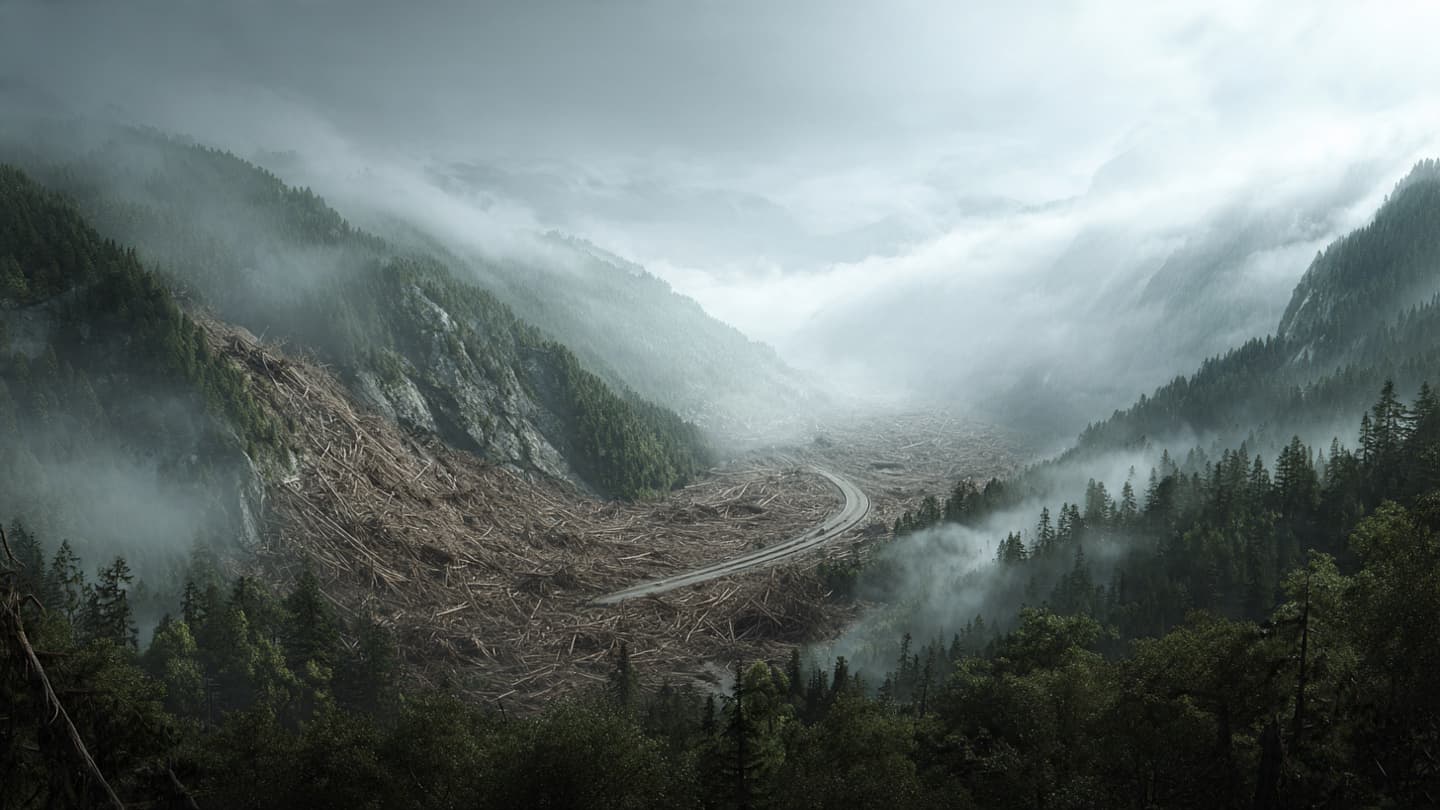
- Mudslide Impact:A significant mudslide has blocked highway access to several remote communities in British Columbia.
- Record Rainfall:The slide was triggered by a period of record-breaking rainfall, displacing thousands of tons of debris.
- Emergency Response:Crews are working to clear the road and restore access to affected areas.
In British Columbia, the mountains are not just a backdrop; they are the literal architecture of existence, a vertical world of cedar, hemlock, and granite. They stand with a stoic permanence, their peaks often lost in the low-hanging clouds that drift in from the Pacific. However, there is a limit to the weight even a mountain can hold, a threshold where the rain-soaked soil can no longer cling to the steepness of the slope. When that threshold is crossed, the earth moves with terrifying speed, resulting in a mudslide that reshapes the geography in mere seconds.
The sound of the earth sliding is a deep, subterranean roar, a folding of the landscape that ignores the constraints of human engineering. It takes trees, boulders, and the black ribbon of the highway, depositing them in a tangled heap at the bottom of the grade. In the aftermath, a profound silence envelops the area. The road, which acted as a vital artery for remote communities, is suddenly severed, leaving residents in a state of forced isolation.
Being cut off by the mountain serves as a stark reminder of the fragile nature of connectivity. Residents rely on the asphalt to bring mail, food, and news, but the mountain has its own agenda. For those living in the small towns nestled in the valleys, the mudslide is a reminder that they are guests in a landscape that is constantly in motion. A communal bracing occurs, as resources are gathered and a quiet waiting begins for the heavy machinery that will eventually arrive to clear the path.
The engineering challenge is immense—a struggle against the sheer volume of debris and the unstable nature of the remaining slope. Crews work in the shadow of the peaks, their yellow excavators appearing small against the scale of the slide. They move with caution, aware that the earth above them is still saturated and heavy with the memory of the storm. It is a slow, methodical reclamation of the path, a battle of inches against a mountain that has decided to move.
The resilience of those who choose to live in the remote reaches of the province is noteworthy. They possess a stoicism that matches the terrain, a patience born of living in a place where weather and geology govern life. When the highway is cut, they turn toward one another, sharing resources and finding a different rhythm in isolation. The lack of access is not just a logistical hurdle; it allows for a unique community to emerge.
The mudslide serves as a witness to changing climate conditions, a physical manifestation of a world becoming wetter and more volatile. Scientists point to the frequency of such events as evidence that the old stabilities of the mountainside are eroding due to new weather patterns. We are living through a period of transition, where the ground beneath us is no longer as reliable as it once was. The mountain is speaking, and its language is one of displacement and change.
As days pass, the sound of helicopters provides a tether to the outside world, bringing essentials and evacuating those in need. Images of the slide reveal a brown scar on the green mountainside, a mark that will take years for the forest to heal. The vulnerability of infrastructure is laid bare, reminding us that our reach into the wilderness is always temporary, subject to the whims of rain and gravity.
Eventually, the road will be cleared, the asphalt patched, and traffic will resume. Remote communities will once again be connected, and the memory of isolation will fade into winter stories. However, the mountain remains, its slopes still steep, its soil still prone to the pull of the earth. We move forward with renewed respect for the terrain, understanding that the path we travel is a gift from the peaks, given on a day when the earth decided to stay in place.
Transportation officials in British Columbia have confirmed that a significant mudslide has completely blocked highway access to several remote communities in the interior. The slide, triggered by a period of record-breaking rainfall, has displaced thousands of tons of debris and destroyed a section of the main roadway. Emergency crews are on-site conducting aerial assessments and planning the recovery efforts.
Published by Banx Network. This article is part of the Banx decentralized media programme, powered by the BXE token on the XRP Ledger.



