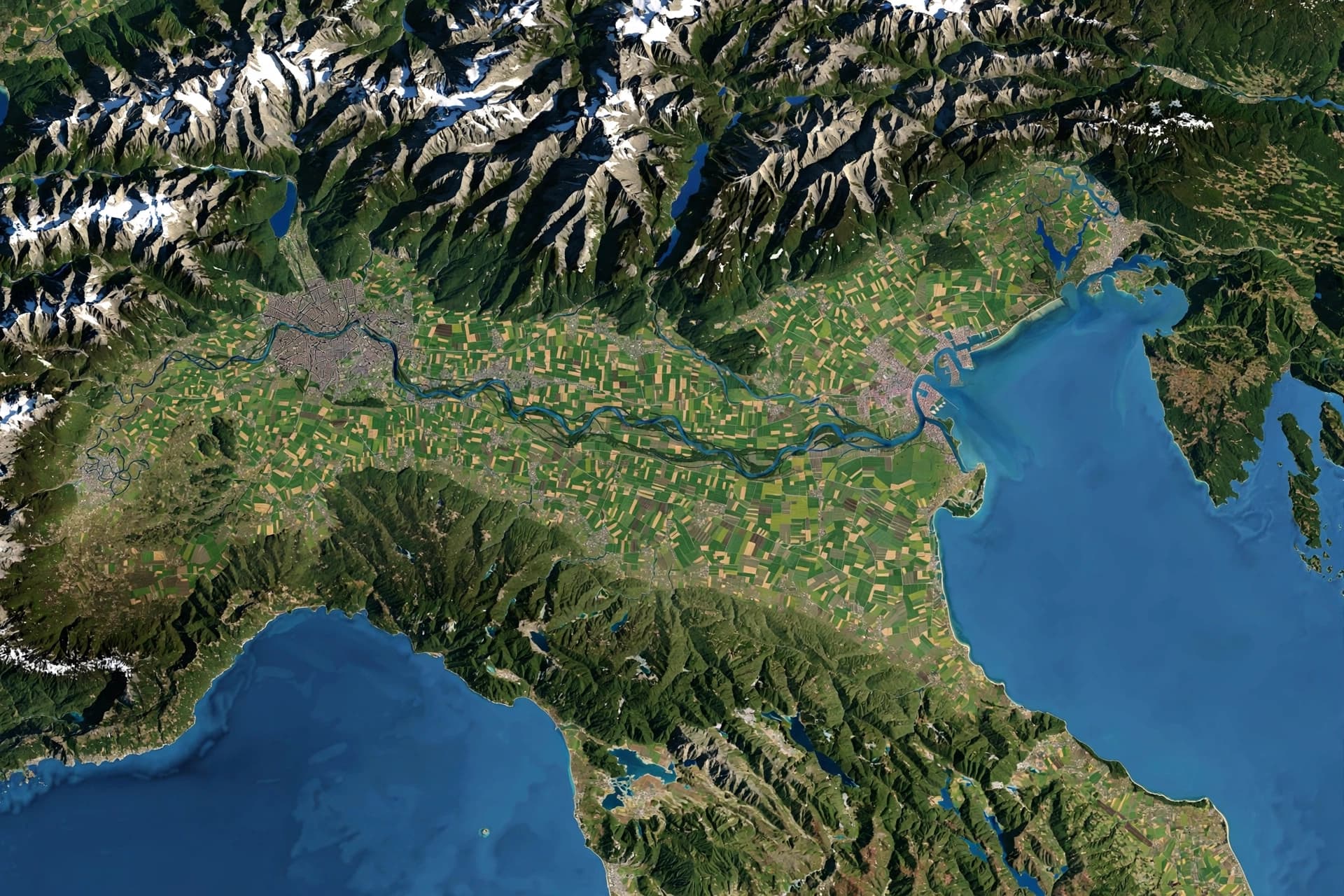
In the McMurdo Dry Valleys, Antarctica reveals a landscape that feels closer to another planet than to our own. The air is spare, the ground a mosaic of rock and frost, and the glaciers descend like slow rivers paused in mid-motion. Here, at Taylor Glacier, a small and startling phenomenon interrupts the whiteness: a rusty-red stain known as Blood Falls, where iron-rich water seeps from the ice and spills onto the frozen surface below.
For years, scientists have regarded Blood Falls as both anomaly and archive — a glimpse into hidden systems locked beneath the glacier. Now, new research suggests that the discharge from this subglacial outflow coincides with measurable lowering of the glacier’s surface above it. The findings connect what is visible at the surface with movements concealed deep below, revealing a synchronized response within the ice.
Glacier surface lowering, often detected through satellite altimetry and ground-based measurements, can signal changes in internal structure, melt dynamics, or drainage pathways. In the case of Taylor Glacier, researchers observed that episodes of surface subsidence aligned with pulses of outflow feeding Blood Falls. The implication is not one of sudden collapse, but of internal adjustment — pressure redistributing, brine channels shifting, and ancient waters finding momentary release.
The waters that give Blood Falls its color are rich in iron and salt, preserved beneath the glacier in a hypersaline reservoir cut off from direct contact with the atmosphere for long stretches of time. When this brine emerges and meets oxygen, iron oxidizes, turning the flow a deep red against the pale ice. The result is striking — an image that has drawn both scientists and explorers to this remote valley.
The McMurdo Dry Valleys are among the coldest and driest places on Earth, with minimal snowfall and limited surface melt. Yet beneath the apparent stillness lies a network of subglacial systems that challenge assumptions about frozen landscapes. The coincidence between surface lowering and outflow suggests that even in extreme cold, glaciers are dynamic — responding to internal hydrology in subtle but measurable ways.
Researchers studying the phenomenon rely on a combination of satellite data, GPS instruments, and field observations. By tracing elevation changes and correlating them with visible discharge events, they are piecing together how pressure builds and releases within the glacier. The surface may appear solid and unchanging, but its structure contains conduits and cavities that expand and contract over time.
Beyond its immediate geological interest, the study of Blood Falls carries broader scientific resonance. Subglacial brines in Antarctica are often considered analogs for potential habitats beyond Earth, where life might persist in cold, saline environments shielded from sunlight. Understanding how these systems behave on Earth offers clues to planetary processes elsewhere.
For now, Taylor Glacier continues its slow descent toward Lake Bonney, the red stain at its edge appearing and fading in response to forces hidden from sight. The surface lowers slightly, then steadies; the brine flows, then retreats. These are not dramatic shifts, but incremental movements in a landscape defined by patience.
In the Dry Valleys, change rarely announces itself loudly. It emerges instead as alignment — a dip in the ice above, a crimson ribbon below. Together, they tell a story of connection between surface and depth, between what we can measure from orbit and what seeps quietly from within. Antarctica remains austere, but it is not inert. Beneath its frozen exterior, the planet continues its quiet negotiations of pressure, salt, and time.
Published by Banx Network. This article is part of the Banx decentralized media programme, powered by the BXE token on the XRP Ledger.