
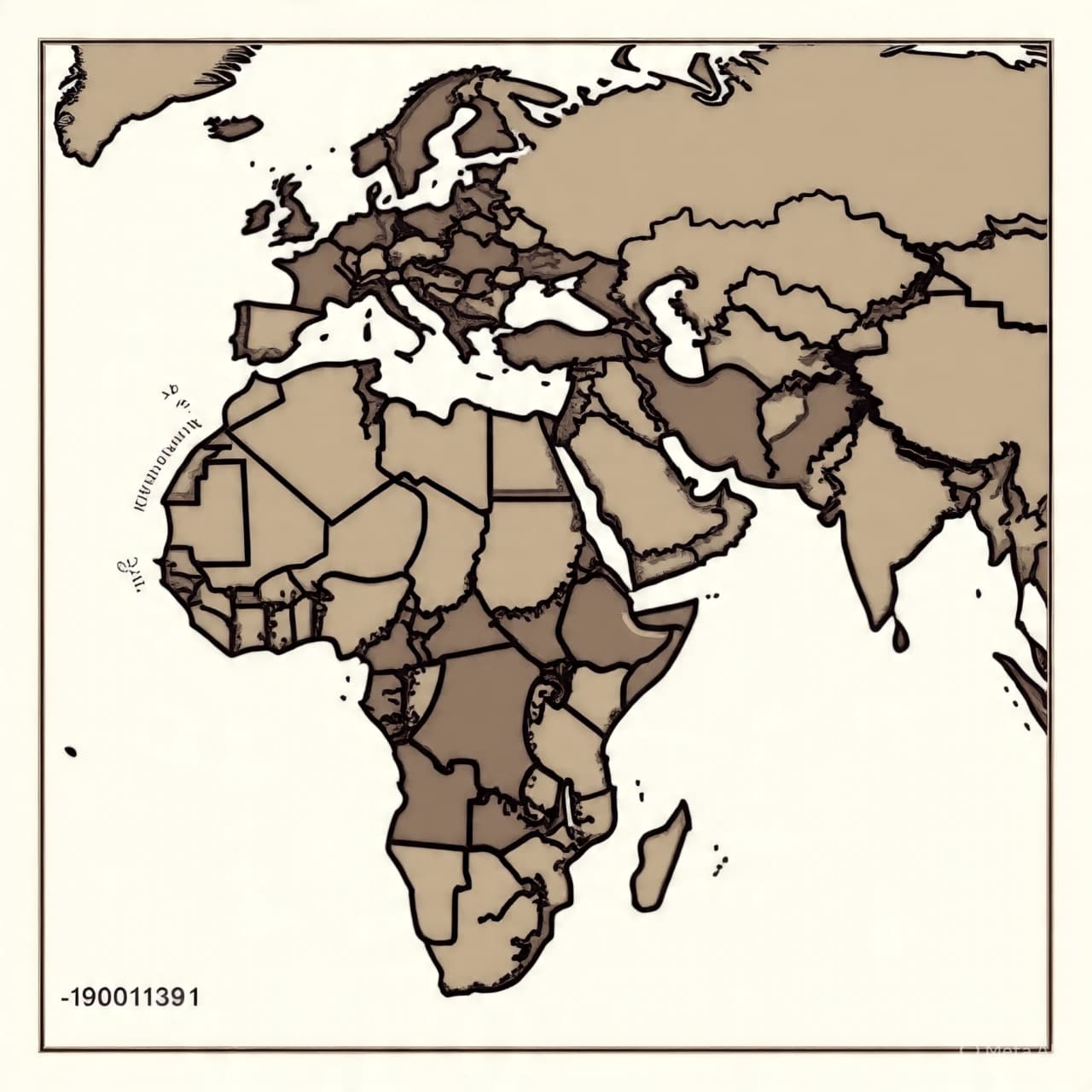
There is a tendency, when tracing origins, to look for a single place to begin. A point on the map where everything seems to gather—a landscape that holds the first step, the earliest trace, the moment from which all others follow. For much of modern science, that place has been approached with a kind of quiet certainty, its boundaries drawn by fossil discoveries and long-held assumptions.
Yet the past does not always remain where it is first found.
Across the shifting terrain of paleoanthropology, new research has begun to suggest that the story of human origins may be less concentrated than once believed. Rather than emerging from a single, well-defined region, early human populations may have been spread across a wider and more varied landscape, connected not by one location, but by movement and exchange.
For decades, East Africa has stood at the center of this narrative, supported by significant fossil finds and archaeological evidence. It remains an important part of the story. But recent studies, drawing on fossil records, environmental data, and increasingly on genetic analysis, indicate that early populations of Homo sapiens may have developed across multiple regions of the continent.
This perspective does not replace earlier findings so much as expand them. It suggests a network rather than a point—a series of populations adapting to different environments, occasionally interacting, exchanging genes, and gradually shaping what would become modern humans. In this view, evolution is not confined to a single origin, but unfolds across space and time, influenced by climate shifts, migration patterns, and ecological diversity.
Evidence supporting this broader model has emerged from various sources. Fossils found in different parts of Africa show a range of physical traits, some aligning with modern humans, others retaining older characteristics. Genetic studies reveal patterns of divergence and recombination that point to populations separating and reconnecting over long periods. Climate reconstructions suggest that changing environments may have alternately isolated and linked these groups, guiding their movement and interaction.
There is a certain quiet complexity in this idea. It resists simplicity, asking instead for a wider frame of reference. The origin of a species becomes less about a single beginning and more about a process—distributed, gradual, and shaped by many conditions at once.
It also reflects a broader shift in how science approaches the past. As new tools allow for more detailed analysis, earlier models are revisited, adjusted, and sometimes reimagined. What once appeared as a clear starting point becomes part of a larger pattern, one that accommodates variation and uncertainty.
And so, the search continues, not by abandoning what has been found, but by looking beyond it. The familiar sites remain significant, but they are no longer seen as the sole centers of origin. Instead, they become part of a wider landscape, one that holds multiple threads of the same story.
Recent research suggests that modern humans may not have originated from a single region, but rather from interconnected populations across Africa. Scientists are using fossil, genetic, and environmental data to better understand this more complex model of human evolution.
AI Image Disclaimer
These images are AI-generated for illustrative purposes and do not depict real scenes.
Sources
Nature Science National Geographic Smithsonian Magazine BBC Science
Published by Banx Network. This article is part of the Banx decentralized media programme, powered by the BXE token on the XRP Ledger.



