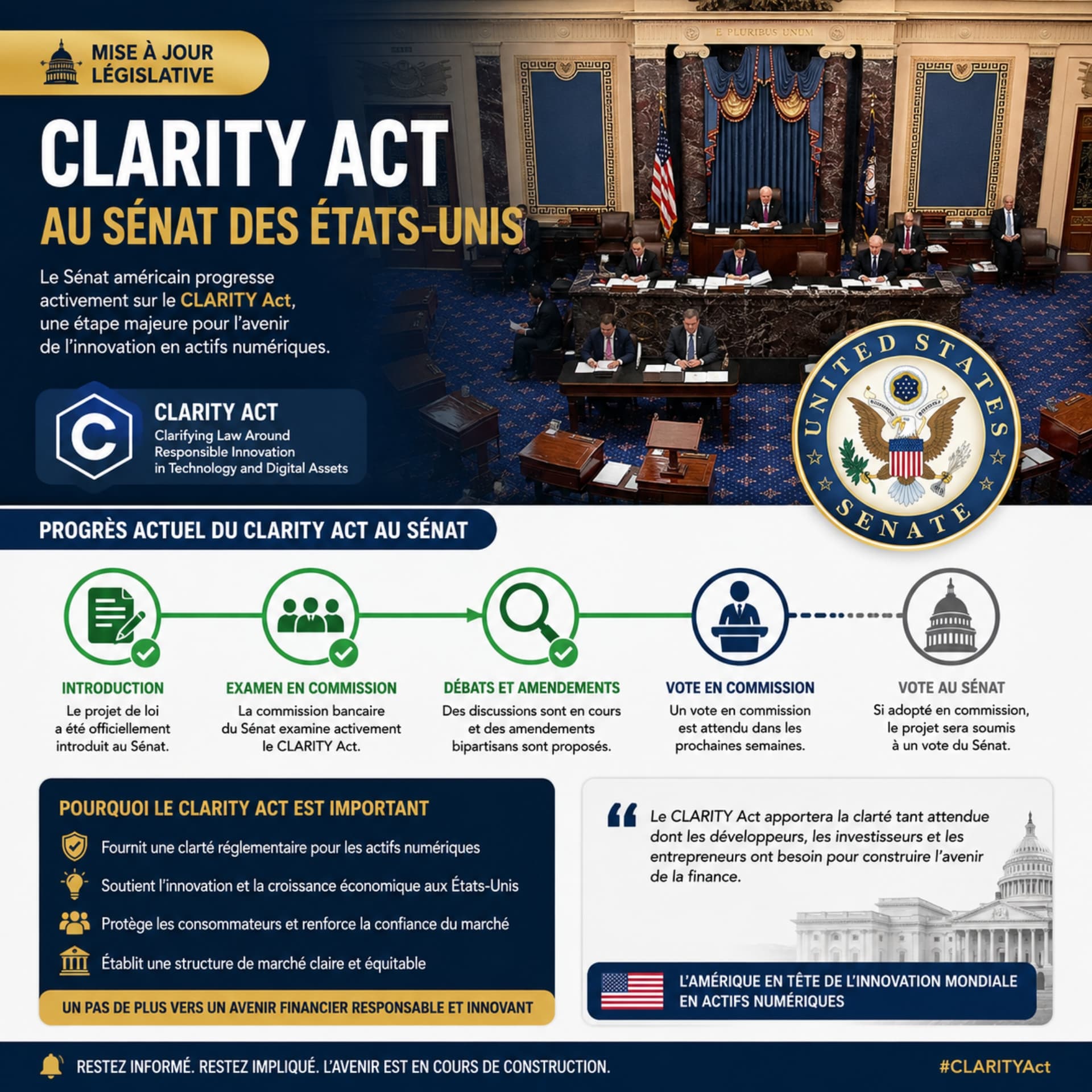
Where the CLARITY Act Stands in the Senate: A Progress Report After more than a year of momentum, the most significant piece of U.S. cryptocurrency legislation in history is stuck in a familiar place: the Senate calendar, waiting on votes that haven't yet materialized. From the House to Calendar No. 423 The Digital Asset Market CLARITY Act (H.R. 3633) began with a landslide. The House passed it on July 17, 2025, by a vote of 294–134, with more than 70 Democrats crossing party lines — the strongest bipartisan endorsement digital-asset legislation has ever received in Congress. The Senate picked up the baton this spring. The Senate Banking Committee, chaired by Tim Scott (R-SC), advanced the bill 15–9 on May 14, 2026, with Democrats Ruben Gallego (AZ) and Angela Alsobrooks (MD) breaking ranks to support it alongside Republicans. On June 1, 2026, the committee formally reported the bill with an amendment in the nature of a substitute, and it was placed on the Senate Legislative Calendar as Calendar No. 423 — meaning it no longer needs another committee vote and can go straight to the floor whenever leadership schedules it. The Missed July 4 Deadline The White House had informally targeted a July 4, 2026 signing ceremony. That date came and went without a floor vote, a cloture motion, or even a scheduled debate. The bill's backers, including Senator Cynthia Lummis (R-WY), had pushed to finalize compromise text around the holiday and "move in July," but unresolved disputes kept the bill parked on the calendar. Prediction markets have tracked the slipping odds in real time. Confidence in the bill becoming law in 2026 was priced around 59–60% in early June; by July 22, that figure had fallen to roughly 32–33%, reflecting growing doubt that the Senate can clear the bill before lawmakers leave town. The Math Problem Republicans control 53 Senate seats, short of the 60 needed to break a filibuster. Two GOP senators — Josh Hawley (MO) and Rand Paul (KY) — are expected to vote no on substantive grounds, meaning Republicans likely need seven to nine Democratic votes to get the bill across the line. So far, only Gallego and Alsobrooks have shown willingness to cross over, and neither has committed to the current text. Three disputes have proven especially stubborn: Ethics and conflicts of interest. Senator Alsobrooks has said she won't support a floor vote without a provision addressing government officials' crypto holdings — a direct response to the Trump family's extensive crypto activities, including stablecoins, memecoins, and mining ventures. A newly released draft reportedly bars the president from crypto ventures until 2029, a change aimed at winning over skeptical Democrats. Anti-money-laundering language. Democrats, led in part by Senator Jack Reed, have pushed for stronger AML provisions; Reed alone filed roughly 20 amendments ahead of the May markup. Law enforcement concerns. Senator Elizabeth Warren has called for a fuller floor debate to address outstanding law-enforcement issues she says remain unresolved in the current text. The Latest Text and the Clock Senate Republicans released an updated version of the bill on July 17, 2026 — one year to the day after the House vote — immediately following a White House meeting with President Trump. As of that release, no Senate Democrat had publicly endorsed the new draft. On July 22, Coinbase CEO Brian Armstrong signaled the bill was being teed up for a full Senate floor vote, a sign of renewed momentum even as the vote-counting math remains unresolved. The practical deadline is the Senate's August recess. Lawmakers returned from a work period on July 13 with roughly three usable legislative weeks before recess begins. Stifel's chief Washington policy strategist, Brian Gardner, has said the bill "probably needs" Senate passage by the end of July, warning that missing the August recess would cause its prospects to "deteriorate materially." Other Washington policy shops have been blunter still, suggesting a miss could effectively end the bill's chances for the year, given that the fall calendar will be consumed by midterm-election politics. What the Bill Would Actually Do If it clears the Senate, reconciles with the House version, and reaches the president's desk, the CLARITY Act would create the first comprehensive federal framework for digital assets, primarily by clarifying which cryptocurrencies fall under the SEC's jurisdiction as securities versus the CFTC's jurisdiction as commodities — a divide that has fueled years of regulatory uncertainty and enforcement disputes in the crypto industry. Bottom Line The CLARITY Act has cleared more hurdles than any prior crypto bill in Congress — House passage, committee approval, and a spot on the Senate calendar — but it remains at least four steps from law: a full floor debate, a 60-vote passage threshold, House-Senate reconciliation, and a presidential signature. With Democratic support still uncommitted and the August recess bearing down, the next two to three weeks will likely determine whether the bill becomes law in 2026 or slips into next year's legislative session. This article reflects the state of play as of July 22–23, 2026. Given the bill's fast-moving timeline, readers should check for the latest developments before citing vote counts or dates.
Published by Banx Network. This article is part of the Banx decentralized media programme, powered by the BXE token on the XRP Ledger.