The Brussels Ring Road is a continuous, pulsating loop that serves as the heartbeat of the capital’s mobility, a space defined by the ceaseless, rhythmic transition of vehicles. Here, motion is the default state; the landscape is a blur of passing colors and the constant, white-noise hum of the highway. It is a environment where time is measured in minutes saved or lost, and the focus of every driver is directed forward, toward the next exit, the next destination, and the continuation of their personal journey through the day.
When a high-speed collision occurs within this dynamic system, the effect is akin to a sudden, violent silence falling upon a crowded room. The seamless flow of traffic is interrupted, the momentum is neutralized, and the mechanical logic of the road is replaced by the raw, jarring reality of a catastrophe. A commercial truck and a passenger vehicle, each following its own trajectory, become part of a singular, tragic convergence. In that fraction of a second, the complex choreography of the Ring Road is shattered, leaving only the stark, static evidence of a life abruptly ended.
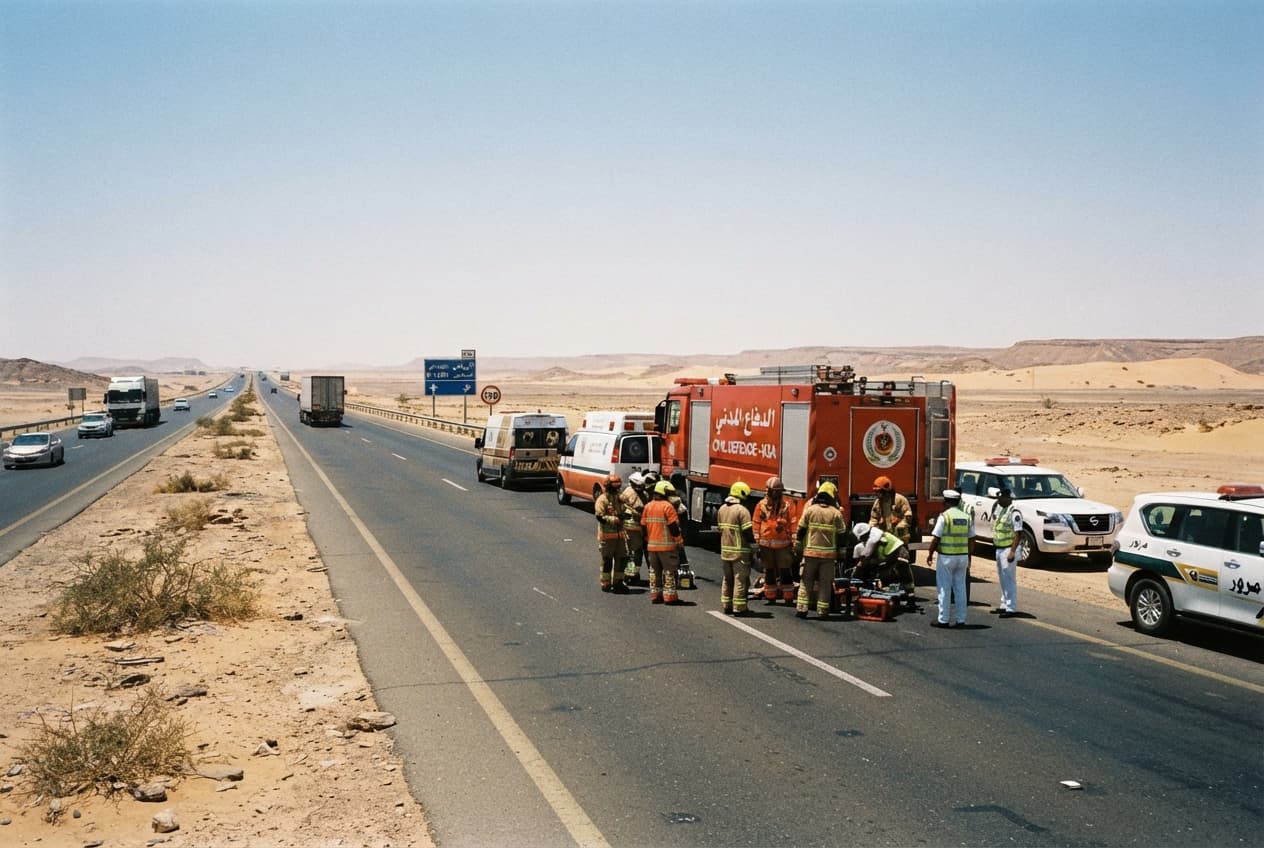
Emergency services arrive to navigate the wreckage, their lights casting rhythmic pulses across the asphalt that contrast with the chaotic stillness of the scene. They work with the practiced, somber efficiency of those who know the weight of their duty, moving between the damaged steel and the fragile remnants of the vehicles. It is a process that demands a total suspension of the surrounding, normal world; for the responders, the only reality is the one contained within the perimeter of the incident, a site where the promise of the journey has been fully eclipsed.
The Ring Road, usually indifferent to the individual lives traversing it, becomes a stage for a profound moment of reflection. For those caught in the resulting congestion, the delay is more than a simple inconvenience; it is an enforced pause that forces a confrontation with the reality of the road. One looks out at the scene—the flashing lights, the crumpled metal—and recognizes the thin, invisible line that separates the safety of one’s own transit from the sudden, final disruption faced by another. It is a humbling, unsettling realization of how quickly our paths can change.
This collision serves as a reminder that our modern systems of transit, as efficient as they may seem, are fundamentally dependent on a fragile, human-driven equilibrium. Every movement across the Brussels highway is an exercise in mutual reliance, a shared agreement that requires constant, split-second attention. When that attention falters, or when the mechanical variables of the road align in an unfortunate way, the system’s protective layers prove insufficient. It is a technical truth that carries a heavy human price.
As the authorities conduct their investigation, documenting the impact points and analyzing the conditions, the highway slowly begins to reclaim its flow. The debris is cleared, the lanes are reopened, and the steady, forward-looking pace of the city resumes. Yet, the memory of the event lingers in the consciousness of those who were present, a quiet, somber awareness that the road remains a place where the unexpected can happen. The highway continues to carry the weight of its travelers, but with a momentary shift in the rhythm of the day.
Reflecting on the loss of the driver, one is forced to consider the narrative of the person who did not reach their destination. Behind every statistic of a traffic fatality is an entire history—a home, a family, a set of plans that were interrupted in a single, kinetic instant. The highway, in its relentless pursuit of progress, often obscures this individual reality, but the tragedy forces it into the light. It is an acknowledgment of the precious, fleeting nature of the lives that sustain our urban and regional connectivity.
Ultimately, the event on the Brussels Ring Road is a sobering note in the broader song of the city. It calls for a renewed focus on safety, not just in the engineering of our vehicles and roads, but in the mindfulness we bring to our daily travels. As the traffic returns to its hypnotic cycle, the lesson remains: we are all moving together, connected by the paths we share, and the responsibility for one another is as constant as the motion itself. The highway is a testament to our capacity for connection, but also to our vulnerability to the sudden, sharp turns of fate.
A high-speed collision occurred on the Brussels Ring Road, involving a commercial truck and a passenger vehicle. The impact resulted in the death of the passenger vehicle driver at the scene, while the truck driver was assessed by medical personnel. The highway remained partially closed for several hours as emergency teams stabilized the area and began a preliminary investigation into the cause of the incident.
Published by Banx Network. This article is part of the Banx decentralized media programme, powered by the BXE token on the XRP Ledger.