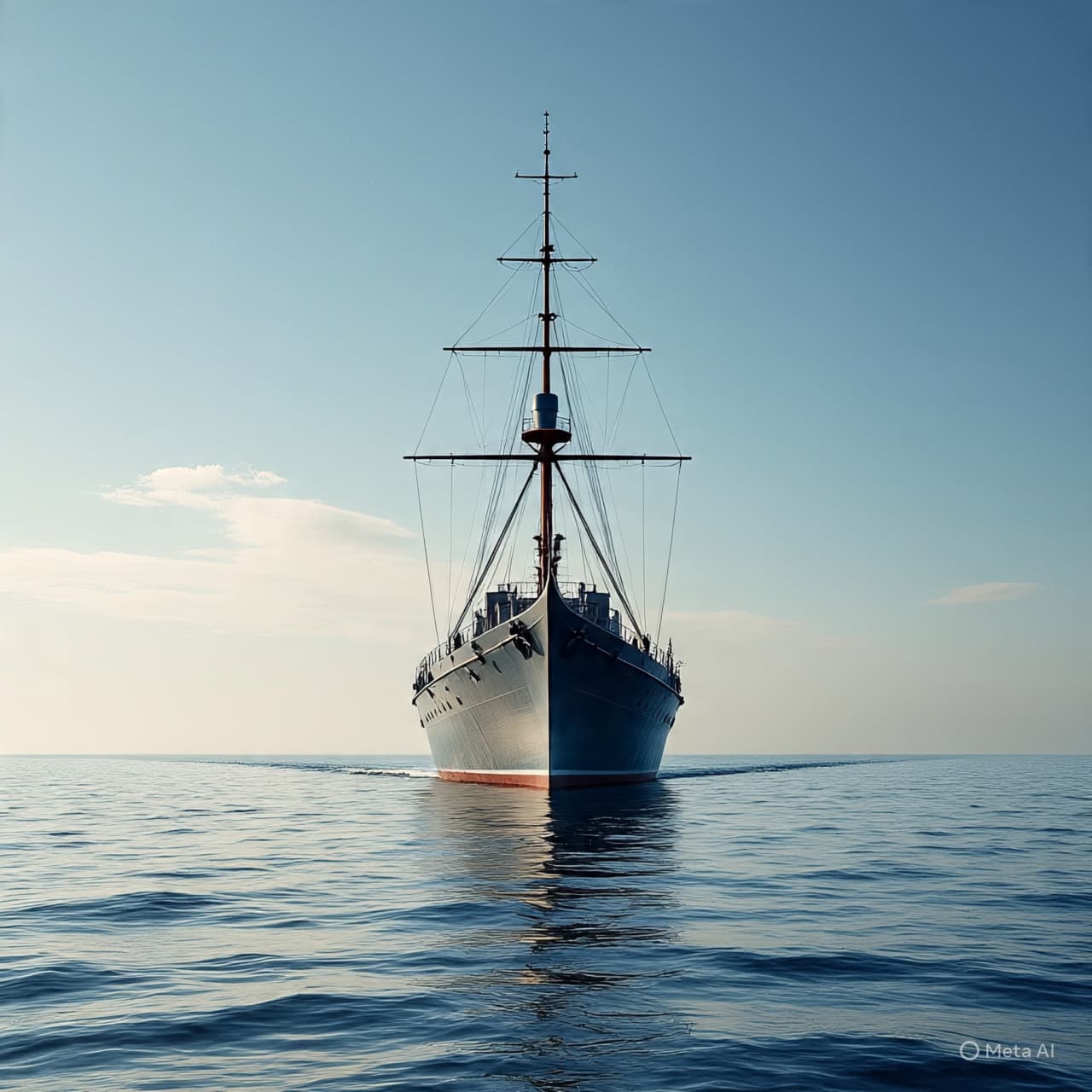
The sea has a way of keeping its own counsel.
Across the Indian Ocean, far from the crowded harbors and watchful coastlines of nations, the surface can appear almost motionless—an immense plain of water where ships travel like slow-moving thoughts across a horizon that never seems to end. Beneath that calm surface, however, currents shift quietly, unseen and deliberate, carrying with them the tensions of distant capitals and the long memory of maritime rivalry.
It was in such waters, not far from Sri Lanka’s maritime approaches, that an Iranian naval vessel vanished from the surface this week. One moment it was moving steadily along its route; the next, according to military accounts, a torpedo launched from an American submarine struck its hull, sending the ship downward into the vast quiet of the ocean floor.
The vessel, identified by several defense analysts as the Iranian frigate IRIS Dena, had recently been involved in naval activities in the region and was believed to be traveling back toward Iranian waters. The strike, confirmed by U.S. officials, formed part of the broader confrontation unfolding between Iran, Israel, and the United States—an expanding conflict that has begun to stretch from land and sky into distant maritime corridors.
For naval historians, the moment carries a particular resonance. Pentagon officials acknowledged that the attack marked the first time in decades that a U.S. submarine had destroyed an enemy warship using a torpedo in active conflict. Beneath the surface of the sea, where modern submarines move unseen and almost silent, such encounters remain rare but decisive.
Yet the sinking itself has become only part of the story.
In the days that followed, Iranian officials offered a different description of the vessel’s condition. One government minister stated publicly that the ship had been “unarmed” at the time of the strike, saying it was not carrying active weapons or munitions as it sailed across the Indian Ocean. The remark introduced a new dimension to the incident, raising questions about the status of the vessel during its final voyage.
Military specialists note that the frigate class to which the ship belonged was designed as a fully equipped combat platform, typically capable of carrying missiles, torpedoes, and a helicopter. Whether those systems were operational or loaded at the time of the attack remains uncertain, and the differing accounts have added to the diplomatic friction now surrounding the episode.
In the aftermath of the strike, distress signals drew attention from vessels operating nearby. Rescue efforts in the surrounding waters brought surviving sailors from lifeboats and floating debris, though reports from regional authorities suggested that many members of the crew did not survive the sinking. The full toll remains under review as Iranian officials continue to assess the loss.
Such moments, though sudden in their occurrence, rarely arise in isolation. Over the past weeks, tensions between Iran and its regional adversaries have deepened through a series of military operations, aerial strikes, and warnings issued across diplomatic channels. The sea, which has long served as both corridor and buffer between rival powers, is now becoming another stage upon which these pressures unfold.
Across maritime maps, shipping lanes continue their steady lines between continents. Tankers pass through straits and cargo ships move quietly from port to port, their journeys governed by schedules and tides rather than by the unseen calculations of conflict. Yet events like this remind observers how quickly the stillness of open water can give way to the sudden gravity of war.
For now, the sinking of the Iranian frigate remains a point of dispute as well as a marker of escalation. Iranian officials continue to question the circumstances of the strike, while U.S. authorities maintain that the operation was part of a legitimate military campaign linked to the wider confrontation with Tehran.
Investigations and diplomatic exchanges are expected to continue in the coming days as both governments assess the implications of the incident. What happened in the waters of the Indian Ocean now forms part of a larger and evolving conflict, one whose boundaries continue to expand beyond the horizon.
AI Image Disclaimer
Visuals are AI-generated and serve as conceptual representations.
Sources (Media Names Only) Bloomberg The Guardian ABC News Defense News Time
Published by Banx Network. This article is part of the Banx decentralized media programme, powered by the BXE token on the XRP Ledger.